Introduction
In beef cow-calf operations, the timing of conception is one of the most important factors affecting herd productivity and profitability. Every 21-day delay in conception can reduce calf weaning weight by approximately 40 pounds, resulting in substantial losses in revenue at marketing. In addition, daughters born to late-conceiving cows are less likely to have reached puberty by the start of their first breeding season and are more likely to conceive later themselves. Likewise, replacement heifers that conceive early during their first breeding season remain in the herd longer and produce more calves over their lifetime than heifers that conceive later. Consequently, increasing the proportion of females that conceive early in the breeding season improves both short- and long-term productivity of the cow herd.
Successful reproductive programs begin with proper herd management. Cows and heifers should maintain an adequate body condition score (BCS ≥ 5 on a 9-point scale), receive appropriate vaccination and parasite-control programs in consultation with a veterinarian, and be managed under an adequate nutritional program throughout the production cycle. Bulls should undergo an annual breeding soundness examination before the breeding season, and replacement heifers should reach approximately 55% to 65% of their expected mature body weight before breeding.
When these management practices are combined with estrus synchronization for timed natural service, producers can substantially increase the proportion of females conceiving early in the breeding season compared with natural service alone.
Estrus synchronization programs for natural service breeding
Cyclic beef cows and heifers normally exhibit estrus approximately every 21 days, providing only one opportunity to conceive during each estrous cycle. Consequently, under natural service alone, it takes at least 21 days for all cycling females to have an opportunity to be bred.
Estrus synchronization concentrates estrus expression into a much shorter period, allowing a greater proportion of females to be serviced shortly after bulls are introduced. Females that fail to conceive after the synchronized estrus generally return to estrus in a relatively synchronized manner approximately three weeks later, further increasing the proportion of cows conceiving early in the breeding season.
An additional benefit of estrus synchronization is its ability to stimulate the onset of reproductive activity in some females that are not yet cycling. Protocols containing progestins, such as intravaginal progesterone inserts (CIDR®) or oral melengestrol acetate (MGA®), can induce estrous cyclicity in postpartum cows and stimulate puberty in prepubertal heifers. MGA is approved only for use in heifers. Although these treatments do not induce cyclicity in every non-cycling female, they increase the number of females available for breeding early in the season.
Because synchronized females receive an opportunity to conceive immediately after bulls are introduced, estrus synchronization effectively provides at least one additional breeding opportunity during the breeding season. Research has demonstrated that this management practice can increase overall pregnancy rates by approximately 5% to 10%, while substantially increasing the proportion of females that conceive during the first 21 days of breeding.
Overall, estrus synchronization for natural service breeding is an effective management tool to increase early conception, improve overall pregnancy rates, and facilitate shorter breeding seasons.
Selection of a program for use with natural service
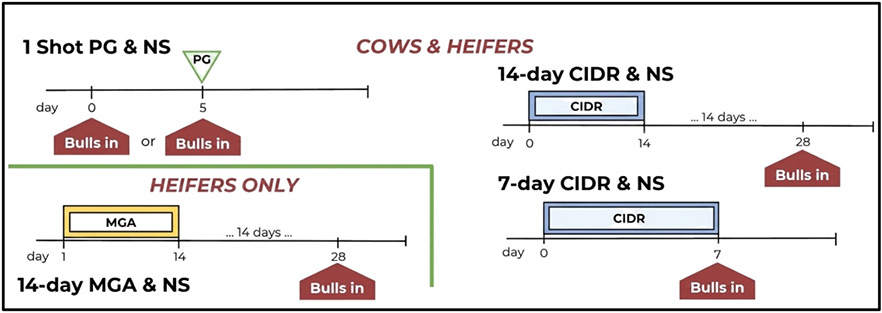
Figure 1 illustrates the 2026 Beef Reproduction Task Force recommendations for estrus synchronization programs used with natural service breeding.
Unlike synchronization protocols designed for artificial insemination, which maximize the number of females expressing estrus within a very short period, protocols for natural service must account for the breeding capacity of the bull. Excessive synchronization can overwhelm a bull if too many females are in estrus simultaneously. Therefore, synchronization programs for natural service are designed to distribute estrus over a slightly longer period while still increasing the proportion of females bred early in the breeding season.
A practical recommendation is to use approximately one bull for every 25 females when implementing estrus synchronization for natural service. Use of young, inexperienced sires after synchronization is discouraged due to the concentrated breeding window, but bull-to-cow ratios should be reduced if young bulls are used (e.g., 12 cows for a yearling bull and 18 cows for an 18-month-old bull). Single sire breeding pastures also inherently involve more risk. Periodic observation of breeding groups is recommended to ensure mating is taking place and females do not continue to return to estrus throughout the breeding season. In addition, postpartum cows should generally be at least 45 days after calving before initiating a estrus synchronization program.
Recommended estrus synchronization programs
1-Shot PG & Natural Service
This protocol consists of a single injection of prostaglandin F2α analogue (PG). Females that exhibit estrus during the 4 to 5 days before PG administration will not respond to the injection because they no longer possess a functional corpus luteum that is responsive to prostaglandin. Therefore, bulls should be introduced 4 to 5 days before PG administration. This management strategy results in more females conceiving early in the breeding season than introducing bulls on the day PG is administered.
Because this protocol does not include a progestin source, it does not stimulate estrous cyclicity in postpartum anestrous cows or induce puberty in prepubertal heifers. Consequently, when a large proportion of females are not cycling at the beginning of the breeding season, progestin-based protocols generally produce better reproductive performance.
7-Day CIDR® & Natural Service
This protocol uses a CIDR® insert for seven days, with bulls introduced on the day of CIDR removal.
The primary advantage of this program is that progesterone exposure can induce estrous cyclicity in some postpartum cows and prepubertal heifers, thereby increasing the number of females eligible to conceive early in the breeding season. This program is particularly advantageous to late-calving cows as it induces early resumption of cyclicity for breeding. Thus, it provides a good balance between reproductive performance and ease of implementation.
14-Day CIDR® & Natural Service and MGA® Programs
The 14-day CIDR® and MGA® protocols are considered long-term estrus synchronization programs. MGA is approved only for use in replacement heifers and is not approved by the U.S. Food and Drug Administration for use in mature cows.
Following CIDR removal or the final day of MGA feeding, females commonly exhibit a synchronized estrus that is relatively infertile. Consequently, bulls should not be introduced immediately after progestin withdrawal. Instead, bulls should be introduced approximately 14 days later, as recommended in Figure 1.
These long-term protocols are particularly effective for replacement heifers because the extended progestin treatment, followed by the 14-day interval before breeding, effectively induces puberty in many prepubertal heifers. As a result, these protocols generally produce higher pregnancy rates when a substantial proportion of heifers have not yet reached puberty.
When using MGA®, the product should be fed at 0.5 mg per heifer daily using an appropriate feed carrier. Commercial MGA products are typically available as medicated pellets, and producers should carefully follow label directions to ensure accurate daily intake.
Although MGA is an economical synchronization option, successful implementation requires:
- Adequate bunk space to ensure uniform feed consumption.
- Daily labor for feed delivery.
- Proper acclimation of heifers to bunk feeding before treatment.
- Consistent feed intake throughout the treatment period.
For producers who already feed replacement heifers daily, MGA is often the most economical synchronization program.
An additional advantage of the long-term protocols is that they provide opportunities to complete other management procedures early in the synchronization period, including prebreeding reproductive tract examinations, vaccinations, deworming, and other herd health practices.
Although the 14-day CIDR® protocol is also recommended for postpartum cows, producers should recognize that this program requires approximately 27 to 28 days from protocol initiation until bulls are introduced. Consequently, it may not be practical for operations aiming to begin breeding within a shorter timeframe.
Considerations and conclusions
Estrus synchronization for natural service breeding is a practical, proven management tool that increases the proportion of females conceiving early in the breeding season, resulting in heavier calves at weaning, improved lifetime productivity of replacement females, and greater overall herd profitability. The greatest reproductive benefits are achieved when synchronization programs are implemented as part of a comprehensive reproductive management strategy that includes proper nutrition, adequate body condition, sound herd health practices, fertile bulls, and a defined breeding season.
No single synchronization program is ideal for every operation. Producers should select a protocol based on herd management, labor availability, feeding practices, the proportion of cycling females, and breeding objectives. The 1-Shot PG protocol provides a simple, low-labor option for herds with a high proportion of cycling females. The 7-day CIDR® protocol offers greater flexibility and improved reproductive performance by inducing cyclicity in some postpartum, late calving cows and prepubertal heifers. The 14-day CIDR® and MGA® protocols are particularly well suited for replacement heifer development because of their superior ability to induce puberty before breeding.
When properly implemented, estrus synchronization improves reproductive efficiency without increasing management complexity excessively and provides producers with an effective tool to shorten the breeding season, increase the number of calves born early, and enhance the long-term productivity and profitability of beef cow-calf operations.