Select Synch
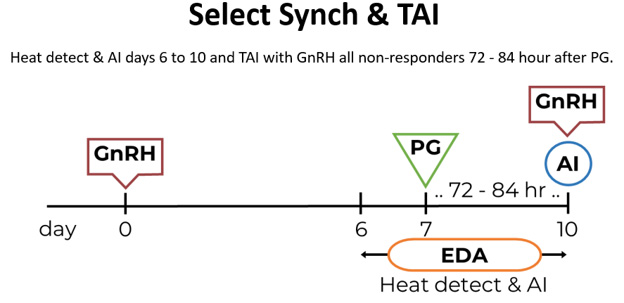
This protocol requires estrus detection and will require performing artificial insemination (AI) over multiple days. Note that estrus detection needs to begin on the day prior to administration of prostaglandin (PG; Figure 1). Because it does not involve a CIDR, this protocol has a lower overall pharmaceutical cost but is less effective in inducing cyclicity in anestrous cows. Because of this, Select Synch is not a commonly recommended protocol. It may, however, be a cost-effective option for producers who are very comfortable with estrus detection and AI, have plenty of time and labor, and are managing herds in which the majority of cows are cycling prior to the start of the protocol.
Select Synch + CIDR
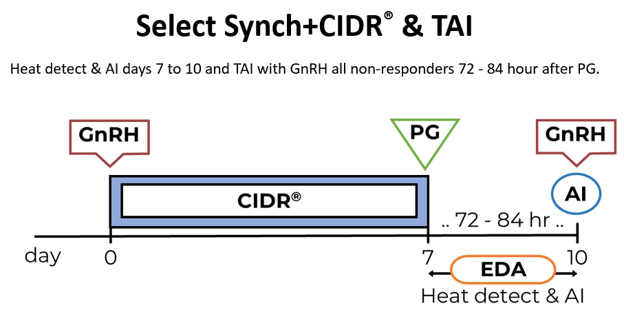
This protocol requires estrus detection similar to the traditional Select Synch, but it also includes a CIDR for 7 days during the synchronization. Because a CIDR is in place during the protocol, estrus detection starts after PG administration (Figure 2), rather than the day before PG administration as in the standard Select Synch protocol. Because a CIDR is added to the protocol, costs are increased in comparison to the traditional Select Synch. However, the CIDR helps to concentrate estrus expression, which most likely reduces labor. The majority of the estrus expression occurring after this protocol will take place up to 60 hours after PG administration. When this protocol was validated, Larson et al. (2008) evaluated pregnancy by AI in the Select Synch + CIDR vs. Select Synch without a CIDR. There was no significant difference observed in the percentage of cows becoming pregnant by AI (58% vs. 53% respectively). In the study authors were very rigorous with estrus detection, for producers that are not efficient in estrus detection pregnancy by AI might be even reduced in the select synch + CIDR protocol.
7-Day CO-Synch + CIDR
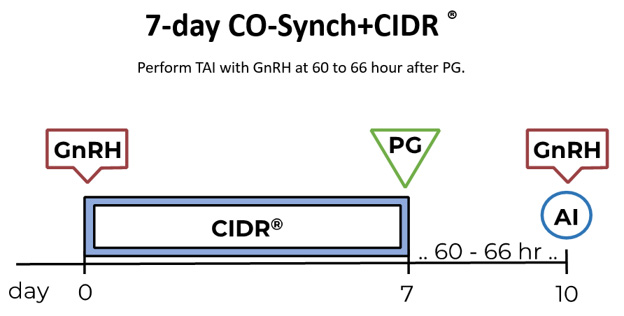
This is one of the most commonly used protocols across the industry for fixed-time AI of beef cows. The main difference from the Select Synch + CIDR is that AI is performed at a fixed-time (TAI) without requiring estrus detection. Fixed-time AI is effective because, as previously mentioned, most of the cows are expected to show estrus by 60 hours after the PG injection. The 7-Day CO-Synch + CIDR protocol is simple, involving only two animal handling events before TAI is performed. Fixed-time AI is suggested to be performed at 60 to 66 hours after CIDR removal. Because this protocol has been found to be reasonably effective among both anestrous and cycling cows, it is an excellent option for typical cow groups when a minimal number of animal handlings is desired. Larson et al. (2008) compared pregnancy by AI in cows subjected to the Select Synch + CIDR and the 7-Day Co-Synch + CIDR + TAI, and no significant differences were observed between both protocols in regards of the percentage of cows becoming pregnant by AI (58% vs. 54%).
7 & 7 Synch
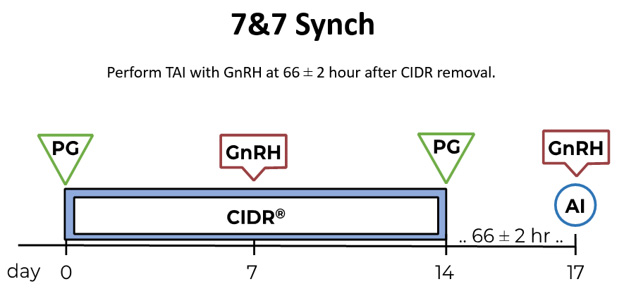
The 7 & 7 Synch is a longer protocol than the previously mentioned ones. The CIDR stays in place for 14 days (Figure 4), and there are three animal handling events before the TAI. This protocol requires more labor and more hormones than the 7-Day CO-Synch + CIDR protocol. However, a distinct advantage of this protocol is a much larger proportion of cows expressing estrus prior to TAI. In multiple large studies, this has resulted in a substantial increase (7-10%) in pregnancy rate resulting from AI (Bonacker et al., 2020, Oosthuizen et al., 2025) when compared to the 7-day Co-Synch + CIDR (54% vs. 61%). The increase in estrous response and pregnancy rates using this protocol stems from the PG+CIDR pre-synchronization prior to GnRH administration. If maximum pregnancy rates to AI are desired and producers are willing to handle cows three times prior to fixed-time AI, this protocol is recommended. 7 & 7 Synch is also highly recommended if using sexed semen for fixed-time AI. If using sexed semen, consider applying estrus detection aids at the time of CIDR removal on Day 14 in order to identify cows that are the best candidates to receive sexed semen.
5-Day Co-Synch + CIDR
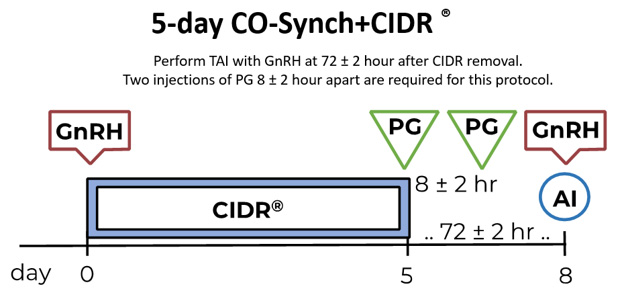
The 5-Day CO-Synch + CIDR protocol is similar to the 7-Day CO-Synch + CIDR but involves a shorter period of CIDR treatment (Figure 5). As a result, it requires administering two doses of PG approximately 8 hours apart. Because of the additional handling of cows and the additional pharmaceutical cost, the 5-Day protocol is a less commonly recommended protocol. Early research with this protocol suggested an increase in pregnancy rates to TAI when compared with the 7-Day CO-Synch; however, not all studies have replicated this finding, with some researchers reporting similar pregnancy rates between the two protocols.
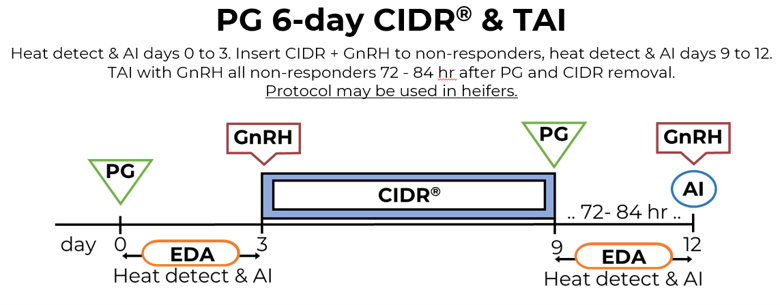
PG 6-Day CIDR
This protocol works very well for producers who are comfortable with estrus detection and AI but also want the benefits associated with use of a CIDR. This protocol may also be used in heifers. The biggest advantage of this protocol when used in conjunction with estrus detection is a reduction in synchronization product costs: females expressing estrus and receiving AI from days 0 to 3 do not receive the subsequent GnRH, CIDR, or additional dose of PG (Figure 6). Although it does require more time and labor, the PG 6-Day CIDR protocol may be a good option for producers who are comfortable with estrus detection and would like to avoid having large numbers of females to AI on any one day. Alternatively, this protocol can be used as a TAI protocol without estrus detection from Days 0 to 3. Although less commonly used for TAI, the use of PG at the start of the PG 6-Day CIDR protocol enhances the proportion of cows ovulating in response to GnRH on Day 3, similar to the goal of the 7 & 7 Synch protocol. In comparing the 7 & 7 Synch and PG 6-Day CIDR protocols, however, Ketchum et al. (2025) reported a much greater proportion of cows expressing estrus prior to TAI when using the 7 & 7 Synch protocol (76% vs 56%). Pregnancy rates to TAI were similar between the 7 & 7 Synch and PG 6-Day CIDR protocols in that study, but relatively low pregnancy rates were reported for both protocols for unknown reasons (37% vs 38%).
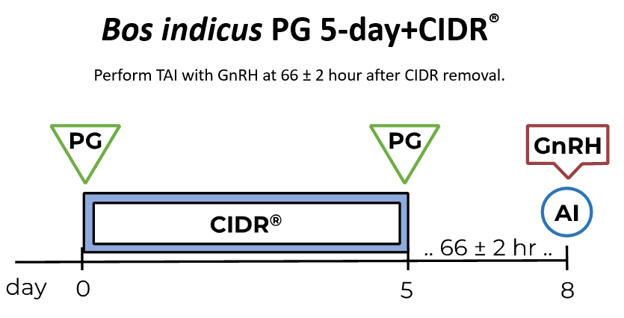
Bos indicus PG 5-Day + CIDR
This protocol, also sometimes referred to as Bee-Synch II, has been found to be advantageous in Bos indicus (e.g., Brahman) and Bos indicus cross (e.g., Brahman x Angus crosses, Brahman x Hereford crosses, etc.) cows. Currently, it is unclear whether this protocol or other options should be preferred among Bos indicus-influenced cows when the percentage of Bos indicus-influence is below 50% (Figure 7).
Calendar organization during the breeding season
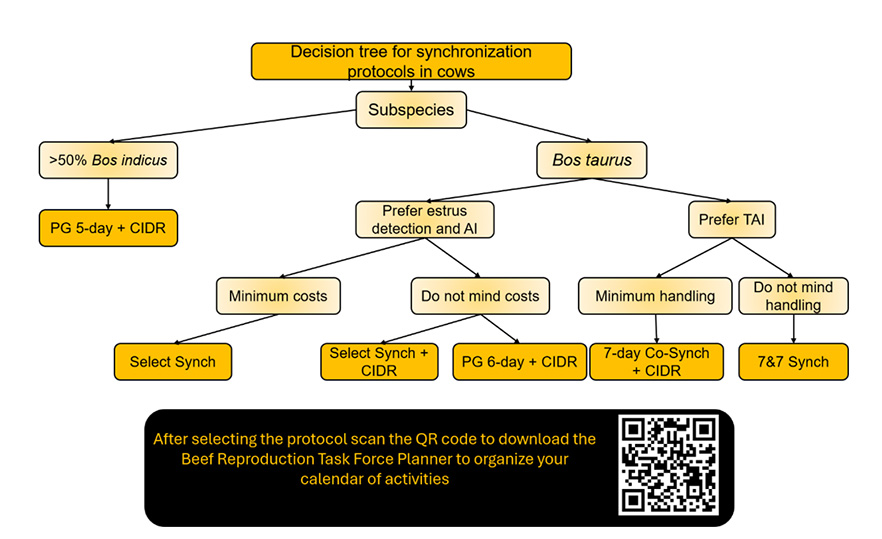
We understand that selecting the best protocol for your operation can be overwhelming. For this reason, we have created a decision tree to help with your selection criteria (Figure 8). After defining the best protocol for your operation, we recommend you download the estrous synchronization planner from the Beef Reproduction Task Force webpage, which will facilitate organizing your calendar.
Final remarks
Pharmaceutical products used for estrus synchronization should be administered at the label dose. Consult product packaging. Label-approved applications vary from product to product, and pharmaceutical products for synchronization should be used in the context of an ongoing veterinarian-client-patient relationship.
For more information on proper handling and administration of synchronization products, see University of Missouri Extension publication G2022, Guide to Estrus Synchronization Products.
Protocol recommendations are based on peer-reviewed research in the field of hormonal control of the bovine estrous cycle. This is not an exhaustive list of all possible protocols but provides commonly used and effective options.