Introduction
Sex-sorted semen, also referred to as sexed semen, is a reproductive technology used in artificial insemination (AI) to increase the probability of producing calves of the desired sex. The technology separates sperm cells carrying the X chromosome (female) from those carrying the Y chromosome (male), creating populations enriched for either female- or male-producing sperm. Commercial systems achieve this separation by exploiting the slight difference in DNA content between X- and Y-bearing sperm.
In most commercial systems, sperm cells are stained with a DNA-specific fluorescent dye and sorted using flow cytometry. Because the X chromosome contains approximately 3.8% more DNA than the Y chromosome, X-bearing sperm absorb more dye and emit greater fluorescence when exposed to a laser, allowing them to be separated from Y-bearing sperm. Although the process is not perfect, modern technologies typically achieve 85% to 95% accuracy for the desired calf sex.
Currently, three commercial sex-sorting technologies are available worldwide.
| Technology | Company | Sorting method |
|---|---|---|
| SexedULTRA 4M | Sexing Technologies (STgenetics/Inguran; licensed to many AI companies) | Flow cytometry-based sperm sorting. The "4M" designation indicates 4 million sperm per straw, compared with the previous industry standard of 2 million sperm per straw. |
| Ultraplus™ | STgenetics | An improved version of SexedULTRA 4M with reported conception rates approximately 3% greater than SexedULTRA 4M. It is increasingly replacing SexedULTRA 4M in the marketplace. |
| Sexcel® | ABS Global | Uses IntelliGen® technology, which differs from conventional flow cytometry. The system combines DNA staining with a proprietary laser-based process that selectively eliminates sperm carrying the undesired sex chromosome. |
Fertility
The sex-sorting process, combined with cryopreservation, can reduce sperm viability by damaging sperm cell membranes and compromising overall sperm function. Consequently, the lifespan of sex-sorted sperm within the female reproductive tract is generally shorter than that of conventional semen. The magnitude of this reduction varies among sires, reflecting differences in individual sperm resilience to the sorting and freezing processes.
Several alternative sperm sexing methods—including magnetic nanoparticle separation, immunological separation, and centrifugation-based enrichment—are currently under investigation. However, none has consistently demonstrated fertility comparable to commercially available sex-sorting technologies.
Numerous studies have reported lower pregnancy rates following AI with sex-sorted semen compared with conventional semen. Nevertheless, pregnancy rates can approach 90% of those achieved with conventional semen when sex-sorted semen is used in females that have expressed estrus before insemination and are bred at the appropriate time relative to ovulation.
Estrous response and timing of artificial insemination
Females expressing estrus before AI generally have greater circulating concentrations of estradiol than females that fail to express estrus. Estrus expression is associated with approximately 27% greater pregnancy rates following AI with conventional semen and is even more important when using sex-sorted semen.
Estradiol plays a critical role in preparing the reproductive tract for fertilization by promoting sperm transport, enhancing the oviductal and uterine environment, and extending the functional lifespan of viable sperm. Because sex-sorted sperm have reduced lifespan within the reproductive tract, inseminating closer to the time of ovulation becomes particularly important.
When AI is performed after observation of estrus, some research trials have reported improved conception rates with sex-sorted semen when AI is performed slightly later than the time typically recommended as optimal with conventional semen.
Standing estrus typically lasts 12 to 18 hours, with ovulation occurring approximately 24 to 32 hours after the onset of standing heat (Figure 1). Therefore, current recommendations are to perform AI with sexed semen approximately 16 to 22 hours after estrus is detected (Figure 1). This strategy places viable sperm in the reproductive tract closer to ovulation, maximizing the probability of fertilization. Ongoing research efforts are re-evaluating the sensitivity of modern sexed semen to timing of AI, as technological advances made in recent years may have helped mitigate sperm cell damage that occurs during the sorting process.
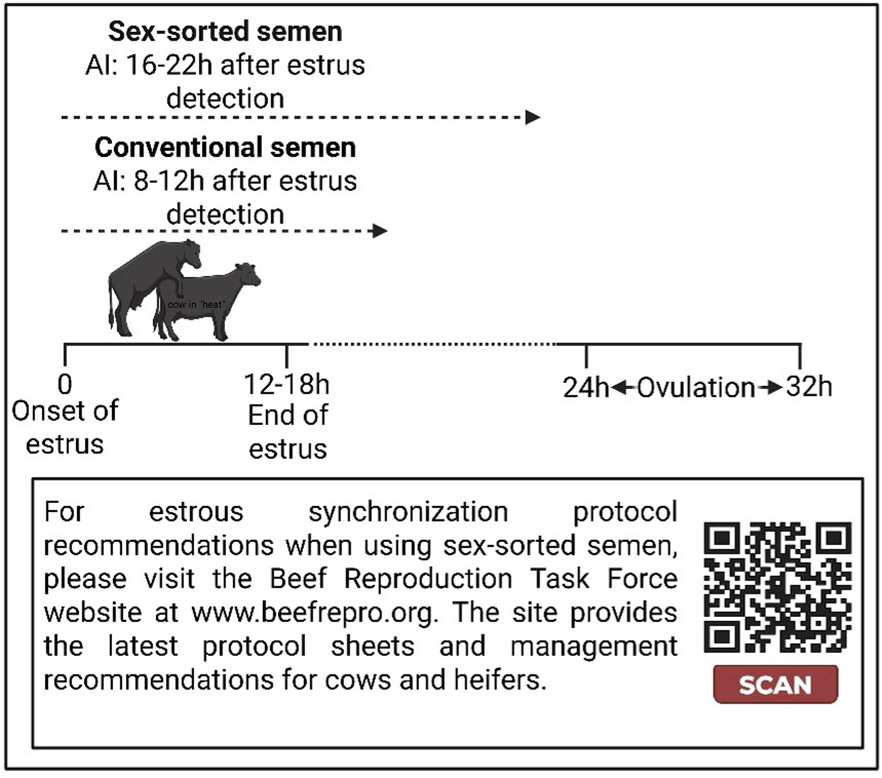
The use of estrus detection aids, such as tail chalk or estrus-detection patches, is strongly encouraged to improve the accuracy of insemination timing. Additionally, producers using estrus synchronization should select a protocol likely to result in a large proportion of the females expressing estrus. Among currently available synchronization protocols, the 7&7 Synch program has consistently increased estrus expression by approximately 10 percentage points compared with the traditional 7-day CO-Synch + CIDR protocol, making it an attractive option for maximizing the number of females eligible for insemination with sex-sorted semen.
Fixed-time AI (FTAI) and Split-time AI (STAI)
When insemination based solely on estrus detection is impractical, fixed-time AI (FTAI) and split-time AI (STAI) provide effective alternatives for using sex-sorted semen.
For FTAI, current Beef Reproduction Task Force recommendations advise inseminating only females that have expressed estrus before the scheduled AI. Females receiving sex-sorted semen should be inseminated at the recommended times listed on the Beef Reproduction Task Force protocol sheet for sexed semen. Producers should note carefully the difference in recommended times for mature cows versus yearling heifers. Females that fail to express estrus before the scheduled insemination are generally better candidates for conventional semen, given the lower cost per unit and the lower conception rates anticipated in non-estrous females.
Split-time AI (STAI) provides another strategy to increase the proportion of females inseminated after estrus expression. In this approach, females that have already expressed estrus are inseminated at the initial FTAI time using sex-sorted semen. Females that have not expressed estrus are evaluated again approximately 24 hours later, allowing additional females time to exhibit estrus before insemination. Those expressing estrus during this interval can then receive sex-sorted semen, whereas non-estrous females may be inseminated with conventional semen. This approach increases the number of females inseminated under optimal physiological conditions while maintaining acceptable pregnancy rates.
Conclusion and Considerations
Sex-sorted semen has become a valuable reproductive technology for accelerating genetic progress and increasing the production of replacement females or terminal-market calves in beef herds. Although pregnancy rates remain slightly lower than those achieved with conventional semen, continuous improvements in sex-sorting technologies and AI management have substantially narrowed this gap. Successful use of sex-sorted semen depends on breeding females under optimal physiological conditions, particularly ensuring that females have expressed estrus before insemination and that AI is performed as close to ovulation as possible. Consequently, estrus detection and estrous synchronization are fundamental components of successful sexed-semen programs.
Producers should prioritize the use of sex-sorted semen in healthy, cycling females with adequate body condition (i.e. ≥5 on a 9-point scale) and follow synchronization protocols that maximize estrus expression. When labor and facilities allow, inseminating females based on observed estrus remains the preferred strategy to optimize fertility. In operations where estrus detection is more challenging, fixed-time AI and split-time AI offer practical alternatives that improve the chances of successful outcomes while maintaining the management advantages of timed breeding. Because recommendations continue to evolve as new research becomes available, producers are encouraged to consult the Beef Reproduction Task Force for the most current estrous synchronization protocols and management recommendations for the use of sex-sorted semen in beef cattle.