Introduction
Artificial insemination (AI) is one of the most powerful tools available to accelerate genetic progress and increase the value of beef cowherds. AI provides access to genetically superior, performance-tested sires that would otherwise be financially unattainable for many producers. It also enables targeted matings, strategic use of sex-sorted semen, and reduces the risk of venereal disease transmission. When combined with estrous synchronization, AI improves reproductive efficiency by increasing the proportion of females conceiving early in the breeding season, resulting in a more uniform calf crop.
According to the 2017 USDA-APHIS Beef Cow-Calf Management Practices Survey, approximately 15.1% of replacement heifers and only 5.5% of mature cows are bred by AI. Adoption is concentrated among seedstock producers and large commercial operations (≥200 cows). In contrast, small- and medium-sized operations, which account for nearly 90% of U.S. beef farms and approximately 40% of the national cow inventory, have been slower to adopt AI.
The most commonly cited barriers are the costs associated with labor, synchronization products, and AI technicians. Seedstock producers generally recover these costs easily due to the higher market prices received for seedstock cattle. Larger commercial operations often offset AI expenses by reducing bull inventories and capturing additional value from the genetic merit of AI-sired calves. Small- and mid-sized commercial operations, however, often cannot reduce bull numbers when AI is followed by clean-up bull breeding. Additionally, smaller operations typically market smaller groups of calves and may have more difficulty accessing market premiums. Consequently, small- and mid-sized commercial beef operations may need to explore alternative management and/or marketing strategies to realize the same economic returns seen by larger commercial operations when using AI.
Implementing multiple AI services early in the breeding season offers an alternative approach. By increasing the proportion of AI-sired calves and reducing or eliminating reliance on natural-service bulls, producers can capture greater genetic value while making AI more economically competitive. This strategy has the potential to expand adoption of reproductive technologies, particularly among small- and mid-sized beef operations.
Economic opportunity with multiple AI services
Natural-service bulls represent one of the largest annual operating expenses in cow-calf production. Annual ownership cost includes depreciation, maintenance, and the risk of bull loss. Assuming a purchase price of $7,000, a salvage value of $3,500, and a useful life of five breeding seasons, annual depreciation equals approximately $700 per bull. Adding estimated maintenance costs ($800/year) and risk of bull loss ($624/year). The risk of bull loss was calculated assuming an 8% annual probability of bull loss [0.08 x ($7,000 + $800) = $624/year], excluding additional losses from reduced reproductive performance caused by delayed or missed conceptions. Thus, the estimated annual cost of bull ownership is approximately $2,124 per bull. Note that this does not include the any opportunity costs of foregone net income that could have been derived from calves born to additional cows; this is an important consideration, as some of the farm or ranch’s total carrying capacity is allocated to maintenance of herd bulls rather than additional cows.
For a typical 30-cow herd, one bull is generally adequate based on the recommended bull-to-female ratio of 1:25 to 1:30. Likewise, the cost of one estrous synchronization and AI program for 30 females is approximately $2,100 (Table 1), excluding additional labor.
Table 1. Estimated costs of estrus synchronization and AI
| Item | Cost |
|---|---|
| Drugs per head | $25 |
| Semen per head | $25 |
| Labor and technician costs | $20 |
| Total for 30 heads | $70 |
| Total | $2,100 |
When only one AI service is followed by clean-up bulls, small- and mid-sized producers generally cannot reduce bull numbers because pregnancy per AI typically ranges from 45% to 60%. Consequently, both AI expenses and annual bull ownership costs are incurred.
In contrast, when multiple AI services replace natural service, the initial investment in synchronization can be spread across additional breeding opportunities. Because previously used progesterone inserts can be reused and only females remaining open require re-insemination, the additional cost of subsequent AI services is relatively small. Under these conditions, multiple AI services become economically competitive with bull ownership, particularly for small- and mid-sized operations (Table 2).
Table 2. Cost breakdown for four breeding systems considering a 30-cow herd size
| -- | Breeding system* | |||
|---|---|---|---|---|
| Item | Bull only | AI + clean-up bull | Two AI services | Three AI services |
| AI cost | $0 | $2,100 | $2,100 | $2,100 |
| Bull/year | $2,124 | $2,124 | $0 | $0 |
| Second AI** | $0 | $0 | $675 | $675 |
| Third AI** | $0 | $0 | $0 | $315 |
| Total cost | $2,124 | $4,224 | $2,775 | $3,090 |
| *Extra labor cost involved with handlings was not considered in these calculations. **For the second and third AI services, drug costs were removed, reducing the cost to $45 per head. We conservatively assumed a 50% pregnancy rate per AI, resulting in approximately 15 and 7 cows being submitted to the second and third AI services, respectively. |
||||
Compared with a bull-only breeding system, implementing one AI service followed by clean-up bulls increases total breeding costs by approximately 99%. However, replacing natural service with two or three AI services increases costs by only 31% to 45%, while substantially increasing the proportion of AI-sired calves and eliminating bull ownership.
Advantages of multiple AI services
Multiple AI services provide producers with greater flexibility to select sires for specific breeding objectives while maintaining access to highly reliable, performance-tested genetics. According to the 2017 USDA-APHIS survey, only 31.4% of cow-calf operations perform annual breeding soundness examinations on natural-service bulls, leaving many herds vulnerable to reduced fertility.
Natural-service breeding is inherently less flexible because one bull must simultaneously satisfy maternal and terminal breeding objectives. Commercial producers often seek moderate-sized, efficient replacement females while the beef industry continues to emphasize rapid growth and heavier carcasses. Artificial insemination allows producers to select specialized sires for different groups of females, including calving-ease sires for replacement heifers, maternal sires for replacements, and terminal sires for market calves.
AI also allows producers to change sires annually without purchasing and selling bulls, reducing the risk of inbreeding in closed herds while facilitating crossbreeding systems that maximize heterosis and breed complementarity. For additional information, refer to MU Extension Publication G2040, Crossbreeding Systems for Small Herds of Beef Cattle.
Ultimately, adoption of AI-based breeding systems depends on reproductive performance and the ability to capture genetic value. Missouri market data clearly demonstrate this opportunity. For example, analysis of 2,924 pregnant heifers marketed through the Show-Me-Select sales between 2018 and 2024 (values adjusted to July 2025 dollars) showed that AI breeding increased sale value by an average of $114.50 per heifer after accounting for other influential traits, including pregnancy stage and body weight (Greater marketing prospects and premium value for Missouri-produced heifers). Additional premiums may also be available through value-added marketing programs.
Resynchronization and re-insemination
Reproductive performance is determined by both service rate (the proportion of eligible females inseminated) and conception rate (the proportion of inseminated females that become pregnant) in 21 days (one estrous cycle). Their product is the pregnancy rate achieved during a 21-day estrous cycle.
Following the first synchronized timed AI service, service rate is effectively 100%, as all females are serviced if performing timed AI. Therefore, pregnancy rate is determined primarily by conception rate. For subsequent AI services, however, maintaining both high service rates and high conception rates becomes essential. Consequently, successful multiple-AI breeding systems depend on efficient methods to rapidly identify and rebreed females that failed to conceive to the prior service(s).
Three practical approaches are currently available:
- Estrus detection alone
- Early resynchronization with re-insemination approximately 21 days after the first AI
- Conventional resynchronization with re-insemination approximately 28 days after the first AI
Reusing intravaginal progesterone inserts previously used during the initial synchronization substantially improves the economics of resynchronization because progesterone inserts represent the largest drug expense. CIDR® inserts marketed in the U.S. contain 1.38 g progesterone, and progesterone remains present in the devices after a standard 7-day use. Research studies have evaluated reuse of CIDRs and have reported effective control of the estrous cycle can be achieved for up to three 7-day treatments (21 total days). To be clear, however, a CIDR is labeled as a single-use item, and reuse of CIDRs constitutes extra-label drug use not approved by the U.S. Food and Drug Administration (FDA). Additionally, reuse of CIDRs could increase risk of venereal disease transmission and vaginitis if not properly cleaned and sanitized after each use.
Producers electing to reuse CIDRs should, at minimum ensure, CIDRs are properly cleaned and sanitized after initial use and are allowed to fully dry prior to any storage or re-use. Follow current recommendations outlined in our recent Extension publication (What Did We Learn From Reusing CIDRs in Beef Cows?).
Estrus detection only
Re-insemination based solely on estrus detection is the simplest and least expensive approach because it does not require additional synchronization products. However, it is labor intensive, as most open females return to estrus between 17 and 24 days after the initial AI. Because estrus expression occurs over several days, missed heats are common and reduce service rate.
When using this strategy, estrus detection aids such as estrus detection patches are strongly recommended to improve estrus detection and maximize re-insemination rates. In comparison, resynchronization protocols shorten and synchronize estrus return, reducing labor while improving service rates.
Resynchronization followed by re-insemination 21 days after the first AI
The additional drug cost associated with this strategy is relatively small when CIDRs are reused. Females of unknown pregnancy status receive a CIDR approximately 12 to 13 days after the first AI. The insert is removed seven days later, and females detected in estrus are re-inseminated over the next four to five days (Figure 1).
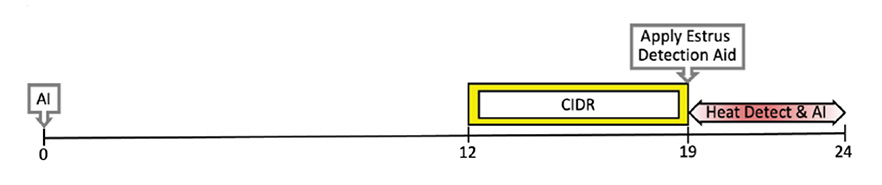
The primary advantage of this approach is that it shortens the interval of estrus return, reducing labor requirements while increasing the proportion of females that can be re-inseminated.
At CIDR insertion, GnRH analogues should not be administered, as ovulation would delay estrus return in nonpregnant females. Likewise, PGF₂α analogues should not be administered at CIDR removal, since it will induce luteolysis and pregnancy loss in pregnant females.
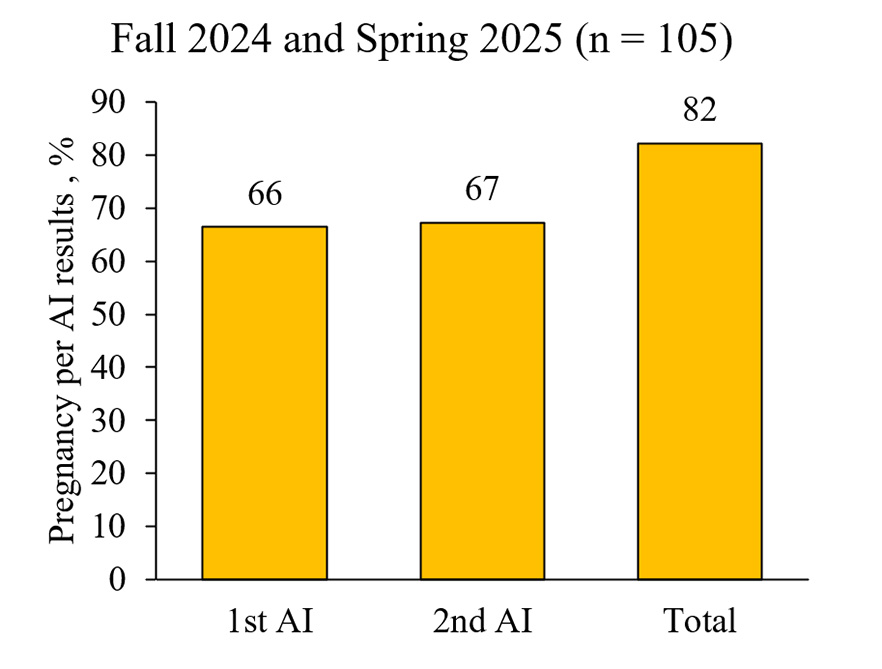
Preliminary research conducted at the University of Missouri with small number of cows (n = 105) indicates that this approach can produce cumulative pregnancy rates exceeding 80% after only two AI services within the first 24 days of the breeding season and reusing CIDRs (Figure 2). Thus, costs incurred in the resynchronization included only estrus patches for all cows.
One limitation of this approach is that service rate may remain below 100% because some nonpregnant females experience delayed estrus return following early embryonic loss or are missed because of estrus detection failure. Emerging technologies, such as Color Doppler ultrasonography for early pregnancy diagnosis based on corpus luteum blood flow between 20 and 24 days after the first AI, can identify many of these nonpregnant females and increase opportunities for timely re-insemination. In preliminary University of Missouri research (Figure 2), incorporating Color Doppler ultrasonography between days 20 and 24 increased re-insemination rate by approximately 13 percentage points, resulting in improved cumulative pregnancy outcomes. Although this technology is still undergoing validation in our laboratory, it shows considerable promise for enhancing the efficiency of multiple-AI breeding systems.
Resynchronization followed by re-insemination 28 days after the first AI
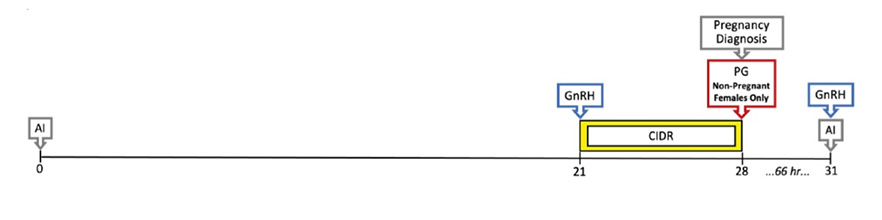
This approach maximizes service rate by combining conventional pregnancy diagnosis with resynchronization but delays re-insemination by approximately one week compared with the 21-day strategy. As with earlier resynchronization, previously used CIDRs can be reused to reduce costs. Using a similar approach, research has demonstrated cumulative pregnancy rates of approximately 82% in beef cows after two AI services completed within the first 30 days of the breeding season.
Females of unknown pregnancy status are submitted to the standard 7-day CO-Synch + CIDR protocol approximately 21 days after the first AI. At CIDR removal, a conventional B-mode ultrasound examination is performed to identify pregnancies based on the presence of a viable embryo with a heartbeat. Only females confirmed open receive a PGF₂α analogue and are subsequently re-inseminated (Figure 3). Day 28 after AI is generally considered the earliest stage at which pregnancy diagnosis using conventional ultrasonography can be performed with high accuracy.
Conclusion and considerations
Multiple AI services provide producers with an opportunity to substantially increase the proportion of AI-sired calves while reducing or eliminating dependence on natural-service bulls. By spreading synchronization costs across multiple breeding opportunities, this approach improves the economic competitiveness of AI, particularly for small- and med-sized cow-calf operations that may otherwise struggle to justify a single AI service followed by clean-up bulls.
Successful implementation depends on maintaining both high service rates and acceptable conception rates after each insemination. Effective estrus detection, strategic use of resynchronization protocols, and reuse of progesterone inserts can improve the efficiency and affordability of multiple AI systems. Emerging technologies, such as Color Doppler ultrasonography for early pregnancy diagnosis, may further enhance these systems by identifying nonpregnant females sooner and increasing opportunities for timely re-insemination.
Producers should select the breeding strategy that best matches their labor availability, facilities, management goals, and marketing plan. Operations focused on maximizing genetic progress, reducing bull ownership costs, or increasing the proportion of AI-sired calves should strongly consider multiple-service AI systems as a practical and economically viable alternative to conventional bull-based breeding. As reproductive technologies continue to evolve, multiple AI services will become an increasingly important tool for improving the profitability, productivity, and long-term sustainability of U.S. beef operations.