A Roadmap to Safe and Compliant Food Production for Very Small Food Processors
This resource is intended for educational purposes for very small-scale food processors only and is not a substitute for regulatory review, process authority evaluation, legal advice or food safety plan development.
Product name
Hot pepper jelly
Product description
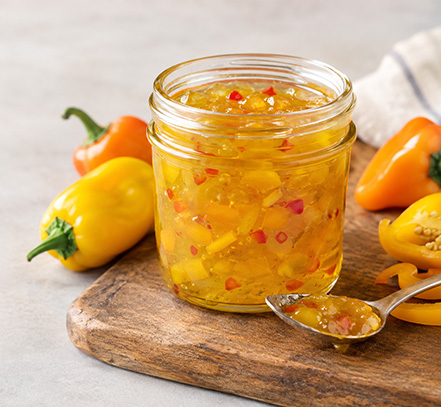
Hot pepper jelly is a popular Southern preserve made from chopped sweet and hot peppers, sugar, pectin (if required by the recipe), and an acidifying ingredient such as food-grade citric acid or 5% acidity vinegar. The mixture is cooked until it reaches the desired gel consistency, filled into sterilized jars while hot, and processed in a boilingwater canner according to a research-tested recipe to produce a shelf-stable product.
Primary food safety hazard that requires special attention
Peppers, both hot and sweet varieties, are classified as low-acid vegetables because their natural pH is typically above 4.6. To produce a safe, shelf-stable product, the recipe must include acidification to achieve a finished equilibrium pH of 4.6 or below. Food-grade citric acid or standardized (5% acetic acid content) apple cider vinegar is often used to create this product.
Traditional hot pepper jelly formulations also contain a high concentration of sugar, which lowers the product’s water activity (aw). Together, proper acidification, reduced water activity, and adequate thermal processing control the primary food safety hazards associated with shelf-stable pepper jelly.
Failure to adequately acidify and thermally process low-acid foods can create conditions favorable for the growth of Clostridium botulinum, a bacterium that produces the potential neurotoxin responsible for botulism.
Improper formulation, inadequate processing, or seal failure may also allow the growth of spoilage microorganisms, including molds and yeasts. Some molds can produce mycotoxins, making it essential to follow validated recipes, achieve the proper acidity, process jars correctly, and inspect sealed containers before distribution.
Regulatory classification
Peppers are a low-acid vegetable, and some hot pepper jelly formulations may meet the regulatory definition of an acidified food. However, some validated formulations contain sufficient sugar to reduce water activity (aw) to 0.85 or below. Products meeting this threshold may be exempt from FDA acidified food regulations. Producers should not assume that their hot pepper jelly recipe qualifies for this exclusion without appropriate formulation and product verification.
Note: A water activity value of 0.85 or less (aw ≤ 0.85) is an important FDA regulatory threshold. Foods at or below this level are generally exempt from FDA acidified food regulations because the reduced water activity limits the growth of many microorganisms.
Regulatory agencies
- U.S. Food and Drug Administration (FDA)
- Missouri Department of Health and Senior Services (DHSS)
- Local health department or public health authority
Commercial food manufacturers are generally subject to the FDA Food Safety Modernization Act (FSMA) Preventive Controls for Human Food Rule. However, exemptions and modified requirements may apply depending on the size of the operation and the intended market. Producers should determine which requirements apply before expanding beyond direct-to-consumer and retail sales.
Is this product allowed under Missouri cottage food law?
No. Missouri’s cottage food law allows individuals to produce and sell certain food items, including baked goods and some jams and jellies, from their home kitchens, but it excludes potentially hazardous foods. Potentially hazardous foods are those that require temperature control to prevent the growth of harmful bacteria. Pepper jelly, due to its potential pH and water activity, is considered potentially hazardous and, therefore, is not allowed under the Missouri cottage food law. It should be prepared in an inspected commercial kitchen using an approved recipe and validated process.
Training considerations
- Home canning workshop
- Hazardous analysis critical control points (HACCP)
- Better Process Control School (BPCS)
All food businesses, regardless of size, are required to identify and control food safety hazards in their products and follow current good manufacturing practices (cGMPs). Foundational requirements include employee hygiene and training, sanitation, preventive controls, allergen management, packaging integrity, recordkeeping, and accurate labeling.
Formal food safety training is not required for small businesses exempt from FSMA Preventive Controls Rule; however, producers remain responsible for manufacturing safe food products. Home canning education can help producers understand safe formulation and processing principles. HACCP and BPCS provide more advanced training that may be beneficial when producing shelf-stable acidified foods or expanding into larger-scale production.
Facility requirements
- Inspected shared-use or commissary kitchen
- Registered food manufacturing facility (required for wholesale and out-of-state markets)
Many small food businesses begin production in a shared-use or commissary kitchen inspected by the local health department. However, using an inspected kitchen does not guarantee compliance. The recipe formulation must undergo process authority review to ensure the product and process are safe for sale. Small-scale producers may also choose to work with a co-packer that operates a registered food manufacturing facility. The best option will depend on the scale of the operation, market channel, and financial feasibility, but all must comply with applicable regulatory requirements. Wholesale and interstate sales require production in a registered food manufacturing facility.
Although HACCP is not a regulatory requirement for hot pepper jelly manufacturers in Missouri, implementing a HACCP-based food safety plan is strongly recommended to identify hazards, establish preventive controls, and ensure product consistency.
Testing and recordkeeping recommendations
- Equilibrium pH testing records
- Recipe or formulation records
- Written food safety plan (including standard operating procedures [SOPs] and hazard analysis)
- Production batch records
- Process authority letter
- Personnel training records
- Ingredient supplier records
Hot pepper jelly formulations can vary considerably, and some formulations may fall within the regulatory definition of an acidified food. Acidified foods are subject to additional recordkeeping and processing requirements that require specialized equipment to adequately manage the food safety risk. Producers should use a validated hot pepper jelly formulation and follow it consistently. Any significant recipe modifications should be evaluated by a qualified process authority before the product is offered for sale.
Before offering the product for sale under the retail food pathway, producers should have the finished product tested by a professional laboratory to verify that the applicable pH and water activity thresholds are met. Additionally, each product batch should be tested for equilibrium pH to help verify that the product is consistently manufactured according to the established formulation. Producers should maintain testing documentation and make records available to regulatory authorities upon request.
Producers wishing to develop new formulations or make significant formulation changes should consult with a qualified process authority or other qualified food process expert to ensure the finished product is safe and appropriately classified. Producers considering scaling beyond Missouri retail food production, including entering wholesale markets, should also consult with a qualified process authority. Additional process validation, facility, and regulatory requirements may apply as the business grows. These requirements are beyond the scope of this guide.
Ingredient and supplier considerations
All ingredients should be sourced from reputable suppliers that comply with applicable federal, state, and local food safety requirements. Whether ingredients are grown on-site or purchased from external suppliers, the processor is responsible for ensuring that ingredients are received, handled, stored, and used in a manner that prevents contamination and preserves product safety and quality.
Labeling considerations
- Common name of the food
- Net weight (in both U.S. units and International System of Units [SI])
- Full name and address of the producer
- Ingredient statement (listed in descending order by weight)
- Major food allergen declaration, if applicable
- Lot/batch code for traceability and recall purposes
- Nutrition facts*
- Appropriate storage or handling instructions, if applicable
Avoid making disease treatment, prevention, or other unauthorized health claims on product labels or marketing materials. Such claims may cause the product to be regulated differently and may violate FDA labeling requirements.
*Your business can be exempt from adding a nutrition facts label if you sell a maximum of $50,000 of food to consumers a year or if your total overall sales are under $500,000 a year.
Common producer misunderstandings
- Peppers are naturally low-acid vegetables. Safe, shelf-stable pepper jelly requires a validated formulation that achieves appropriate acidity and water activity.
- Reducing the amount of acid, reducing sugar, or substituting ingredients may significantly impact the safety of the food product.
- Maintaining product testing and production records demonstrates consistent manufacturing practices, and these records may be requested by regulatory agencies.
Suggested next steps
- Develop the product using a validated formulation.
- Verify that the finished product consistently achieves an equilibrium pH of 4.6 or below and the target soluble solids (Brix) value, and maintain testing records.
- Produce the product in a sanitary environment following current good manufacturing practices (cGMPs).
- Verify that labeling complies with Missouri and federal requirements.
- Sell only through market channels permitted under the regulatory pathway that applies to your operation.
Food safety tips for preparing and storing hot pepper jelly:
- Use fresh, wholesome peppers free from contaminants and from a producer following good agricultural practices (GAPs).
- Use a validated formulation and do not alter the acid or sugar ratios.
- Measure equilibrium pH using a calibrated pH meter, and maintain records for each batch.
- Process jars using approved boiling water canning procedures with clean jars and new lids.
- Inspect every jar for a proper hermetic seal before storage and distribution.
- Store finished products in a cool, clean, and dry location.
Additional resources
Current Good Manufacturing Practice, Code of Federal Regulations
Manufactured Foods, Missouri DHSS
Understanding FSMA: HACCP HARPC and the Preventive Controls for Human Food Rule, Pennsylvania State University Extension
National Center for Home Food Preservation, University of Georgia
This work is supported by the U.S. Department of Agriculture’s (USDA) Agricultural Marketing Service through the Resilient Food Systems Infrastructure Program grant to the Missouri Department of Agriculture. Its contents are solely the responsibility of the authors and do not necessarily represent the official views of the USDA.
Image credit: OpenAI. (2026). Image of golden pepper jelly [AI-generated image]. ChatGPT.