A Roadmap to Safe and Compliant Food Production for Very Small Food Processors
This resource is intended for educational purposes for very small-scale food processors only and is not a substitute for regulatory review, process authority evaluation, legal advice or food safety plan development.
Product name
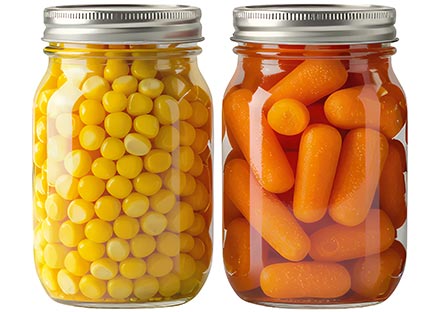
Low-acid canned foods: green beans, shelled beans, corn, carrots, peas, potatoes, and sweet potatoes
Product description
Low-acid canned foods (LACFs) are foods, other than alcoholic beverages, with a finished equilibrium pH greater than 4.6 and a water activity (aw) greater than 0.85. These products are commercially processed and packaged in hermetically sealed containers to achieve shelf stability and protect against contamination by harmful microorganisms, including Clostridium botulinum. Because they lack sufficient natural acidity to inhibit the growth of harmful bacteria, LACF require specialized thermal processing to ensure they can be safely manufactured as shelf-stable products.
Regulatory classification
Low-acid canned foods are classified as high-risk, commercially processed products and are subject to federal low-acid canned food regulations (21 CFR Part 113). Unlike products such as jams, jellies, and many baked goods, these foods require a validated scheduled thermal process and strict commercial manufacturing controls to ensure product safety.
Is this product allowed under Missouri cottage food law?
No. Missouri’s cottage food law does not allow the production of low-acid canned foods. Commercial production requires an approved food manufacturing facility and compliance with applicable state and federal food processing regulations.
Food safety hazard that requires special attention
The primary hazard associated with low-acid canned foods is Clostridium botulinum, the bacterium that causes botulism. Because sealed containers create an anaerobic, or low-oxygen, environment, improperly processed lowacid foods can support the growth of this organism and the production of its toxin. Although rare, botulism is a severe foodborne illness that can be fatal. Commercial processors control this hazard by using a scientifically validated thermal process developed specifically for each product.
Regulatory agencies
- U.S. Food and Drug Administration (FDA)
- Missouri Department of Health and Senior Services (DHSS)
- Local health department or public health authority
The FDA is the primary federal regulator of low-acid canned foods that are commercially distributed in the United States. To help ensure the safe and consistent manufacture of these products, the FDA requires both the registration of the food canning establishment and the submission of a scheduled process for applicable products.
Food processing facilities that manufacture LACFs must register with the FDA using Form FDA 2541, Food Canning Establishment Registration. In addition, a scheduled process must be filed with the FDA for each product, container size and type, and processing method. Because LACFs require a thermal process sufficient to destroy microorganisms of public health significance, this process must be incorporated into the scheduled process filing. Depending on the product and processing method, filings are submitted using the appropriate FDA process filing form (Form FDA 2541d, -e, -f, or -g).
Before submission, the scheduled process should be established and validated by a recognized process authority. Process filings that have not been properly validated may be rejected by the FDA. Required filing information typically includes the product description, formulation, container specifications, processing times and temperatures, and critical factors. Food canning establishment registrations must be renewed every two years through the FDA Industry Systems website.
In addition to FDA registration and process filing requirements, processors should contact the Missouri DHSS Manufactured Food Program to determine any applicable state requirements. Missouri does not currently license or permit food processing establishments; however, the state may conduct routine inspections, typically on an annual basis. Facilities that are inspected by the FDA generally are not subject to separate routine inspections by DHSS. Before constructing or modifying a processing facility, operators may request a plan review to evaluate compliance with current Good Manufacturing Practices (GMPs) and other applicable food manufacturing requirements.
Local public health authorities may have additional requirements based on the facility’s location and operations. Producers should consult their local health department before beginning production to ensure compliance with all applicable local regulations.
Training and other recommendations
- Better Process Control School (BPCS)
- Food safety plan development
- Process authority review
- FDA scheduled process filing
Personnel responsible for the production and processing of low-acid canned foods must receive appropriate training in commercial food processing, thermal processing principles, and process control. A qualified process authority should establish a scheduled process for each product. A scheduled process identifies the critical processing conditions, including time, temperature, pressure, container size, and other factors necessary to ensure product safety. Personnel responsible for supervising production and processing activities should have the knowledge, training, and competency required to implement, monitor, and verify adherence to the scheduled process.
Facility requirements
- FDA food canning establishment (FCE)
Low-acid canned foods must be produced in a commercial processing facility that can implement a validated scheduled process and maintain all required production records.
Because low-acid canned food production requires specialized equipment, technical expertise, and strict process controls, many very small processors find it more practical and cost-effective to partner with an experienced co-packer rather than establish and operate their own processing facility.
Testing and recordkeeping recommendations
- Scheduled process documentation
- FDA process filing records
- Thermal process records (time, temperature, pressure, as applicable)
- Recipe/formulation and product specification records
- Production batch records
- Food safety plan, standard operating procedures (SOPs), and hazard analysis
- Ingredient supplier and receiving records
- Equipment calibration records
- Container examination and closure or seam inspection records, as applicable
- Critical factor monitoring records
- Deviation and corrective-action records
- Finished-product testing records, as applicable
- Processing equipment maintenance records
- Personnel training records
Each product must have a scheduled process established by a qualified process authority. The processor is responsible for following the scheduled process during every production run and maintaining records that verify all critical processing conditions were achieved.
Ingredient and supplier considerations
All ingredients should be sourced from reputable suppliers that comply with applicable federal, state, and local food safety requirements. Whether ingredients are grown on-site or purchased from external suppliers, the processor is responsible for ensuring that ingredients are received, handled, stored, and used in a manner that prevents contamination and preserves product safety and quality.
Labeling considerations
- Common name of the food
- Net weight
- Full name and address of the producer
- Ingredient statement (listed in descending order by weight
- Major food allergen declaration, if applicable
- Lot or batch code for traceability and recall purposes
- Nutrition facts
- Appropriate storage or handling instructions, if applicable
- Traceability records for ingredients and finished products
Common producer misunderstandings
- Growing your own vegetables does not exempt you from commercial food processing requirements.
- Home pressure canners cannot meet the regulatory requirements for low-acid canned food production. Processors must use a commercial retort to achieve the validated thermal process.
- Most shared-use commercial kitchens are not designed or approved for manufacturing shelf-stable low-acid canned foods.
- When using a co-packer, confirm that the facility has the equipment, process controls, and regulatory capabilities necessary to follow an established and validated scheduled process.
Suggested next steps
- Determine whether low-acid canned food production aligns with your business model.
- Contact the Missouri DHSS before investing in equipment or facility modifications.
- Identify a commercial processing facility or co-packer that can support LACF production and complies with all applicable regulatory requirements.
- Consult with a qualified process authority to establish a scheduled process for each product.
- Complete required food safety training, including Better Process Control School when applicable.
- Complete the required FDA registrations and process filings, and develop the necessary food safety plans, processing procedures, and production records before beginning commercial production.
Additional resources
Acidified and Low-Acid Canned Foods Guidance, FDA
Acidified Foods and Low-Acid Canned Foods, Missouri DHSS
Current Good Manufacturing Practice, Code of Federal Regulations
Establishment Registration and Process Filing for Acidified and Low-Acid Canned Foods, FDA
Registration of Food Facilities, FDA
Thermally Processed Low-Acid Foods Packaged in Hermetically Sealed Containers, Code of Federal Regulations
This work is supported by the U.S. Department of Agriculture’s (USDA) Agricultural Marketing Service through the Resilient Food Systems Infrastructure Program grant to the Missouri Department of Agriculture. Its contents are solely the responsibility of the authors and do not necessarily represent the official views of the USDA.
Image credit: IllustrationInspire - stock.adobe.com