Image

New
Canning homemade soup? Learn safe pressure canning techniques and try a seasonal orange marmalade recipe in this food preservation guide.
New
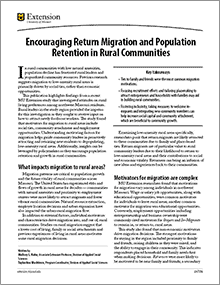
Social ties, community attachment, and employment opportunities motivate migration to rural areas, offering insights for leaders aiming to attract residents.
New $75 to $90.90
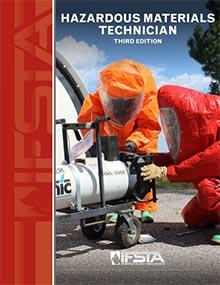
This manual prepares emergency responders conducting technical, advanced, offensive operations during hazardous material incidents to meet the Technician-level certification requirements of NFPA 470, Hazardous Materials/Weapons of Mass Destruction (WMD) Standard for Responders, 2022 Edition. This manual adds to the techniques and principles learned in IFSTA’s Hazardous Materials for First Responders, Sixth Edition.
New $63.50 to $74.70
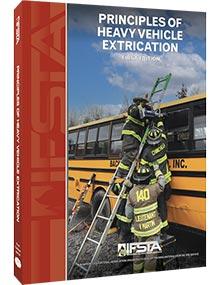
This manual provides rescue personnel with an understanding of the current challenges, techniques, skills and equipment available for the safe and effective extrication of victims trapped in heavy vehicles and in passenger vehicles involved in heavy vehicle incidents. It teaches heavy vehicle extrication in three levels of capability: Awareness, Operations and Technician.
$71.91 to $84.60
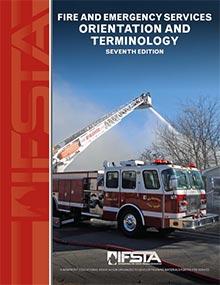
This manual acquaints new firefighters and fire science students with the history, traditions, terminology, organization, and operation of the fire and emergency services. It also contains descriptions of fire service organizations, operational roles, and career paths.
New $74.97 to $88.20
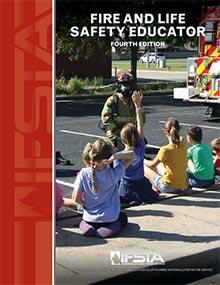
This manual focuses on life safety educators assigned to the implementation, management, and administration of fire and life safety programs; and on the life safety educator’s role as an integral part of a department’s or organization’s community risk reduction program.
New $61.20
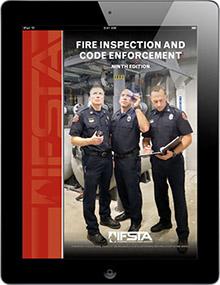
This manual covers fire dynamics, building components and services, site access, fire hazard recognition, water-based fire suppression systems, plan review and inspection procedures.
Revised
If you are a landowner considering lease hunting as a potential income-generating opportunity, learn what you need to consider beforehand. Sample leases are included in this University of Missouri Extension guide.

New $47
This two-pocket folder includes the MyActivity Pyramid and MyPlate graphics. It also has information and suggestions for daily calorie and food intake.
New $30
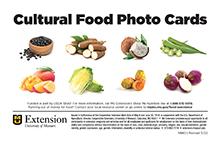
In this set of 60 cards, each nonbranded food card displays a Nutrition Facts label on the back, a photo of a nontraditional or cultural food.
Reviewed
Learn how to collect and analyze deer harvest data to inform population management decisions on your property.
Reviewed
Antlers are among the most identifiable characteristics of species of the deer family. Visit our website to learn about antler development.
Reviewed
White-tailed deer management
This deer conservation guide is one in a series developed jointly by MU Extension and the Missouri Department of Conservation.
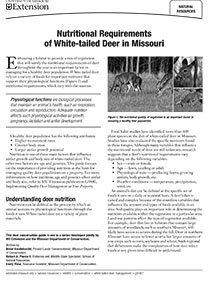
Reviewed
White-tailed deer rely on a variety of foods for nutrients. Learn how to enhance habitat on your property to maintain a healthy white-tailed deer population.
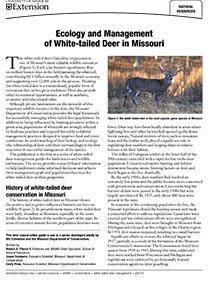
Reviewed
The white-tailed deer is one of Missouri’s most valuable wildlife. Visit our site to learn about the Ecology and Management of White-Tailed Deer in Missouri.
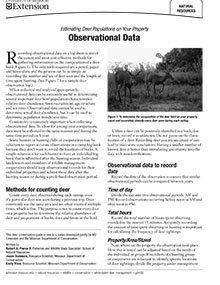
Reviewed
When collected appropriately, observational data can be useful. Visit our site for our Estimating Deer Populations on Your Property: Observational Data guide.
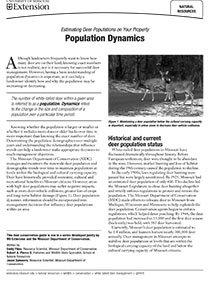
Reviewed
Deer populations are hard to calculate. Visit our site to view our resource on Estimating Deer Populations on Your Property: Population Dynamics.
Reviewed
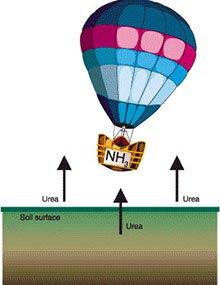
Ammonia gas can be lost from the soil and return to the atmosphere. Visit our site to learn about Nitrogen in the Environment: Ammonia Volatilization.
Reviewed
Nitrogen in soil undergoes mineralization and immobilization, affecting plant growth and water quality. Excess nitrate may contaminate groundwater, posing health risks.
Reviewed
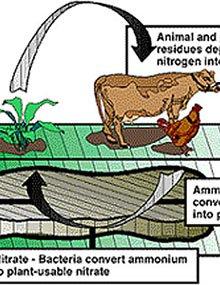
Nitrogen in the soil can go through many complex chemical & biological changes. Visit our site to learn about Nitrogen in the Environment: Nitrogen Cycle.
Reviewed
Denitrification converts soil nitrates to nitrogen gas. It occurs in low-oxygen soils and can impact water quality.
Reviewed
Nitrogen fixation converts atmospheric nitrogen into plant-usable forms, enhancing soil fertility and reducing fertilizer needs.
Reviewed
Legumes convert atmospheric nitrogen into usable forms, enriching soil and reducing fertilizer needs for subsequent crops.
Reviewed
Nitrogen is important for all plants and it comes in many forms. Visit our site to learn about Nitrogen in the Environment: Nitrogen's Most Common Forms.