Why CIDR duration matters
Controlled internal drug release (CIDR) devices are commonly used in estrous synchronization programs for artificial insemination (AI) in beef cattle. The CIDR releases progesterone, which helps control the estrous cycle and coordinate follicular development so that estrus and ovulation occur within a predictable period after device removal.
Several recommended synchronization protocols for beef cows and heifers in the United States use CIDR devices for 7 days. Maintaining the recommended timing of CIDR insertion and removal is important because the duration of progesterone exposure influences the development and age of the dominant follicle that will ultimately ovulate.
Estrous response is also closely associated with fertility to fixed-time AI (FTAI). Females that express estrus before FTAI generally have greater pregnancy per AI (P/AI) than females that do not express estrus. Therefore, synchronization programs should promote a timely and synchronized estrous response while maintaining development of a fertile ovulatory follicle.
Research conducted with synchronization programs outside the United States has suggested that extending progesterone treatment by one or two days may improve estrous synchrony and, in some circumstances, pregnancy rates. However, whether extending CIDR treatment provides similar benefits in U.S. synchronization programs designed for 7 days of CIDR exposure was unknown.
This question also has practical implications. Weather, labor availability, cattle handling issues, or other unforeseen circumstances can occasionally prevent producers from removing CIDRs on the scheduled day. Understanding the consequences of leaving CIDRs in place for an additional day or two can help producers make informed management decisions.
Evaluating 7, 8 and 9 days of CIDR treatment
University of Missouri researchers evaluated the effects of extending CIDR treatment in two trials conducted in partnership with Missouri beef producers and MU Research, Education and Extension Centers.
The first trial evaluated 497 cows and heifers enrolled in a Select Synch + CIDR program. Females received CIDRs for 7, 8 or 9 days. Following CIDR removal, females were monitored for estrus and inseminated based on estrus during the subsequent 72 hours. Females that did not express estrus during this period received FTAI.
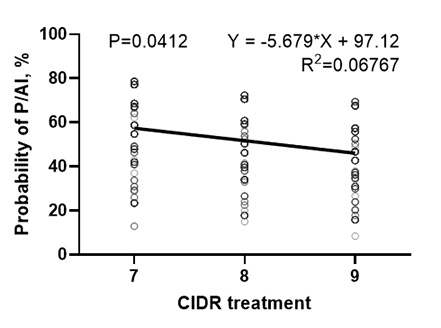
Extending CIDR treatment from 7 to 8 or 9 days did not improve the proportion of females expressing estrus or alter the overall interval from CIDR removal to estrus. Across treatments, approximately 67% of females expressed estrus, with an average interval of approximately 52 hours from CIDR removal to estrus. Despite the similar estrous response, pregnancy rates declined as CIDR treatment was extended. Pregnancy per AI was 57.7% for females receiving CIDRs for 7 days, 50.9% for those receiving CIDRs for 8 days, and 46.4% for those receiving CIDRs for 9 days.
Thus, extending CIDR treatment from 7 to 9 days resulted in an approximately 11-percentage-point reduction in P/AI. Statistical analysis indicated that each additional day of CIDR treatment was associated with an estimated 5.7-percentage-point decrease in P/AI (Figure 1).
Similar response with the 7-day Co-Synch + CIDR program
A second trial evaluated whether extending CIDR treatment by one day would produce a similar response in cows and heifers enrolled in the 7-day Co-Synch + CIDR program.
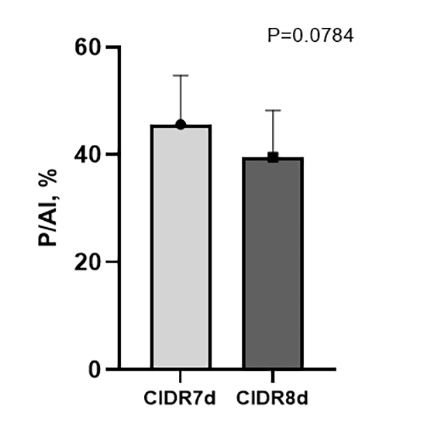
Females received CIDRs for either 7 or 8 days and were subsequently bred by FTAI. Pregnancy per AI was 45.6% (238/428) following 7 days of CIDR treatment compared with 39.5% (215/431) following 8 days of treatment. This represented a reduction of approximately 6 percentage points when CIDR treatment was extended by one day (Figure 2).
Why might extending CIDR treatment reduce fertility?
The lack of improvement in estrous response suggests that simply increasing the duration of progesterone exposure does not provide additional synchronization benefits in protocols already designed around 7 days of CIDR treatment.
A possible explanation for the reduction in fertility is prolonged development of the dominant follicle. Synchronization protocols coordinate progesterone exposure, follicular development, luteolysis and ovulation within specific intervals. Extending one component of the protocol without adjusting the remaining hormonal treatments may result in an aged dominant follicle at ovulation.
Aged follicles can ovulate, but prolonged follicular dominance may compromise oocyte quality and subsequent fertility. Therefore, a female expressing estrus or ovulating after prolonged CIDR treatment does not necessarily have the same probability of establishing pregnancy as a female following the recommended synchronization schedule.
Recommendations for beef producers
These results do not support intentionally extending CIDR treatment from 7 to 8 or 9 days in estrous synchronization programs designed for 7 days of CIDR exposure.
Producers using Select Synch + CIDR, 7-day Co-Synch + CIDR or other protocols specifically designed around 7 days of CIDR treatment should remove CIDRs on the scheduled day and follow the recommended timing for the remaining treatments and AI.
When an unexpected circumstance prevents CIDR removal on Day 7, leaving the device in for an additional day does not mean that females cannot become pregnant. However, producers should recognize that extending CIDR exposure may reduce pregnancy success and should not consider delayed removal a strategy for improving estrous synchronization.
Synchronization protocols are designed around specific relationships among hormone administration, follicular development, estrus, ovulation and timing of insemination. Consequently, changing the timing of one step can influence the effectiveness of the entire program.
Take-home message
Follow the recommended 7-day CIDR schedule. Extending CIDR treatment to 8 or 9 days did not improve estrous response and was associated with lower pregnancy per AI. When using synchronization protocols designed for 7 days of CIDR exposure, removing CIDRs on schedule remains the recommended management practice.