Editor’s note
3/4/2026 — This new publication is currently only available as a PDF.
Research conducted in Missouri has demonstrated that establishing and managing native grasses and forbs can provide quality livestock forage, wildlife habitat and conservation benefits. Native warm-season grasses (NWSGs) can complement cool-season grass pastures in a rotation and provide a quality hay source. They can be a highly palatable forage for grazing livestock and can make excellent summer forage at times of the year when cool-season grass production becomes limited. For these reasons, establishment of NWSGs should be an integral part of a livestock pasture and grazing program.
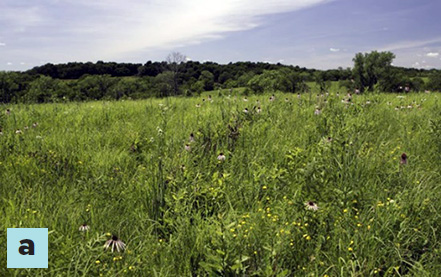
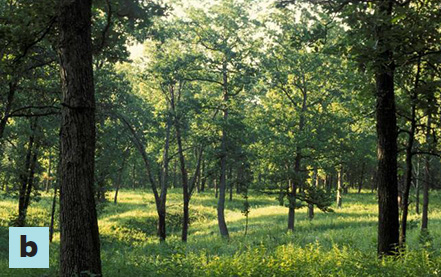
NWSGs have been an important component of the tall-grass prairie and open woodland ecosystems, referred to as savannas, that historically occurred over a large part of Missouri (Figure 1). These early successional plant communities adapted to and were maintained by frequent disturbances, such as fire. Over the years, these types of native plant communities have been converted to other land uses. For example, monocultures of low-growing, sod-forming cool-season grasses, such as tall fescue and smooth brome, have been increasingly used for livestock forage because these grasses can tolerate more-intensive grazing and provide a reliable, high-quality forage resource.
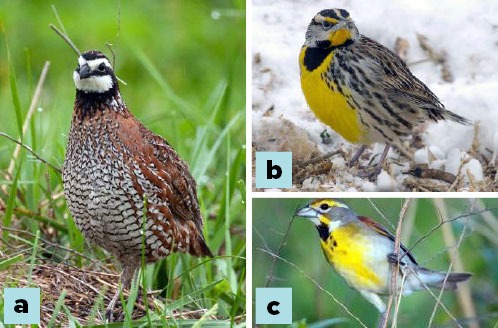
However, the widespread use of introduced species has contributed to steep declines in populations of grassland songbirds, including meadowlarks, grasshopper sparrows and numerous others. Those birds have adapted to an ecosystem of native grasses and forbs, which are components of early successional plant communities. Other wildlife species, such as bobwhite quail, have also experienced significant declines in populations due to the loss of these plant communities (Figure 2).
As the name implies, native warm-season grasses grow during the warm months of the year and are typically dormant during autumn and winter, whereas cool-season grasses primarily grow in the spring and fall. Several species of warm-season grasses are native to Missouri. NWSGs can be established as monocultures of one species or as a combination of species for forage and wildlife habitat. In addition, many of these grasses can be established in mixtures with forbs and legumes, which are broad-leaved herbaceous plants that offer both forage and wildlife benefits.
Download the PDF for the full publication.