Editor’s note
The following abstract describes a publication that is only available as a downloadable PDF.
Results of a Case Study
Abstract
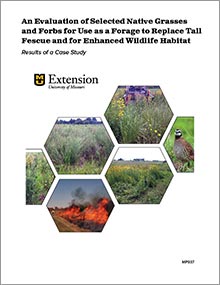
A multiyear demonstration was developed at the MU Bradford Research Farm to determine the benefits of establishing native cool- and warm-season grasses, forbs and legumes as alternative forages that could potentially be used to replace tall fescue as a forage for use by livestock producers and to enhance wildlife habitat. One of the primary objectives of this project was to evaluate the yields and forage quality of native grasses and forb-legume mixtures compared to tall fescue, a nonnative cool-season grass that is the primary forage in pastures across Missouri.
Research has documented that the forage quality and yield of tall fescue is greatly reduced during the summer months and drought conditions. In addition, tall fescue provides extremely poor habitat for wildlife, particularly ground-nesting birds, such as bobwhite quail, wild turkey and numerous species of grassland birds. Establishment techniques, management practices, and yield and forage quality results from this demonstration are presented as a case study so that landowners can potentially implement similar practices on their property.
Pages
- 15