Editor’s note
This summary is meant to improve transparency around farmers market prices and is for educational purposes only. Prices are subject to change based on seasonality, vendor and location.
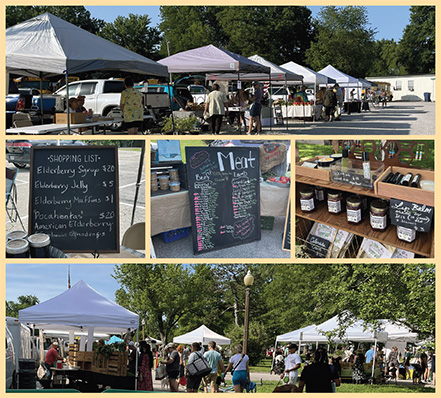
This publication summarizes the 2025 Missouri farmers market prices reported on the Missouri Department of Agriculture’s Market News: Farmers Market Report website. This summary is for educational purposes to improve transparency around farmers market prices for consumers and producers.
2025 farmers market reported prices dataset
Market reporters visit farmers markets across Missouri and record posted prices for more than 300 different products by one or more vendors per market per region. Between June and October, 1,154 regional market observation reports were submitted, at sporadic intervals. For each reported day, one or more prices representing one or more vendors will have been reported. The full dataset reports the low-average, the average and the high-average price per observation day. Not all farmers markets are represented in these price reports. The price average represents a convenience sample, and some items may only be reported in a few regions of the state. Price data for additional product units or varieties and by specific geography may be available the Farmers Market Report website.
What this summary covers
Covered commodities: Market reports are aggregated into these different commodity types: beef (conventional or grass-fed), chicken, goat, lamb, pork, rabbit, egg, fruit and nut, herb, honey, mushroom and vegetable.
Commodity details: Price details for varieties within commodity categories — types of protein cuts, types of vegetables and fruits, etc. — are summarized when more than three observation days were submitted for either the whole state or both rural and urban markets. Some variety details have been omitted when prices were relatively consistent; additional details may be available online.
Chosen unit: For each commodity, market reporters observe and submit prices for multiple unit sizes. The price summary includes the most frequently reported unit size — bunch, dozen, each, head, pint, pound or quart — for each commodity category. If all reported commodities used the same units, an average price across all varieties is included.
Observation days: The count of the number of days price observations were reported at farmer markets within a region is noted in the observations column. Prices are only included in the summary when at least three days of price observations were collected.
Average prices: Table 1 reports a statewide summary of the annual average price, a simple average of all observed daily averages, and the lowest and highest observed price for each item. Table 2 reports the rural and urban market average prices for a shortened list of commodities and commodity details. Rural market prices were observed in up to seven regions and urban market prices in up to four regions; a map of the regions is available on the Farmers Market Report website. Not all regions may have observations each year.
Data considerations
- Averaged price summaries do not indicate how much a specific grower should charge for their product or what a fair going price might be.
- Farmers market prices are driven by product quality, farm reputation, availability and demand, time of season, product distinctiveness and other factors.
- These summaries can be one consideration as farmers do their own market research. Producers should build a marketing strategy that aligns their production quality and quantities with their marketing capacity.
- Prices at a farmers market are different than prices at grocery stores or other places.
Farmers market price reports from other states
- University of Kentucky Center for Crop Diversification
- Cornell University New York price data
- South Carolina Farmers Market Price data
MU Extension resources for producers direct-marketing farm products
Know your cost of production when pricing your product:
- Enterprise budgets estimate the cost of farm production.
- MU Extension publication G648, Break-even Pricing, Revenue and Units, includes a break-even pricing tool that estimates the cost of value-added products.
- MU Extension publication G647, Refining Market Channel Selections Based on Cost, includes a market channel cost assessment tool that estimates the cost of entering different market channels.
Know what state sales tax you are required to collect:
- MU Extension publication G479, Missouri Farmers Market Sales Tax Exemption for Farm Products Sold, can help you determine whether you need to collect sales tax and, if so, on what items.
Table 1. 2025 Missouri Farmers Market Price Summary
Table 2. 2025 Missouri Farmers Market Price Report Details: Rural and Urban Markets
The Missouri Department of Agriculture funds the annual collection of posted prices at farmers markets.
This work is partially supported by the U.S. Department of Agriculture’s (USDA) Farm Service Agency through project award number FSA23CPT0012862. Its contents are solely the responsibility of the authors and do not necessarily represent the official views of the USDA.