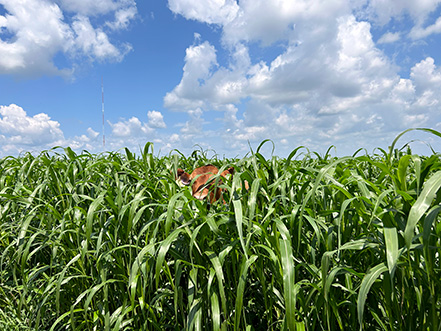
Sorghum-sudangrass (SS) is a productive warmseason annual grass, making it a perfect complement to cool-season perennial pasture systems (Figure 1). When properly managed, sorghumsudangrass provides a high-yielding, nutrient-dense summer forage that excels in drought conditions.
Summer grazing
When to begin grazing
Do not graze until the average stand height reaches 24 inches. Grazing SS before it reaches 24 inches can reduce regrowth and increase the risk of prussic acid and, potentially, nitrate/nitrite poisoning (more on toxicity below).
Rest and rotation
Proper rest of the SS stand can substantially increase productivity and forage quality. Keeping the stand in a vegetative state is essential to maintain high forage quality. Quality decreases substantially as SS enters reproductive growth stages and changes regrowth potential.
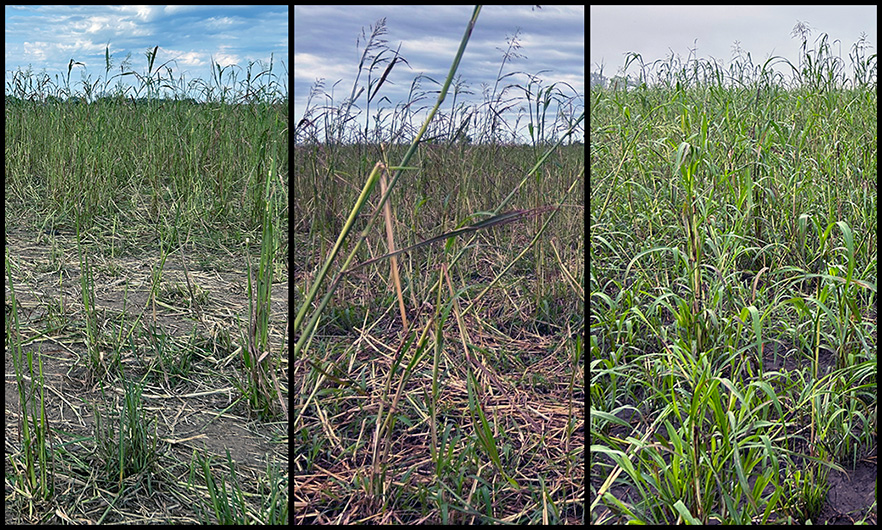
The easiest way to control the maturity progression of SS stands is through rotational grazing. A 30-to-45- day rest period typically provides adequate recovery and prevents reproductive growth. Remove livestock when stubble height reaches 6 to 8 inches. Through rotational grazing, forage productivity and total gain per acre can be increased.
Assess grazable leaf area to guide livestock removal (Figure 2). When most leaf material is consumed, leaving stems about 8 inches tall, remove livestock to allow regrowth until the field averages 24 inches.
Stocking
Flexibility is key when grazing warm-season annual forage. Varying stocking rates throughout the season is a great way to maintain vegetative growth. Stocking rates at the beginning of the grazing season typically start between 2,000 and 5,000 pounds of body weight per acre (Figure 3). Heavier stocking rates may be needed from Day 6 to Day 30 followed by a reduced stocking rate for the remainder of the grazing season.
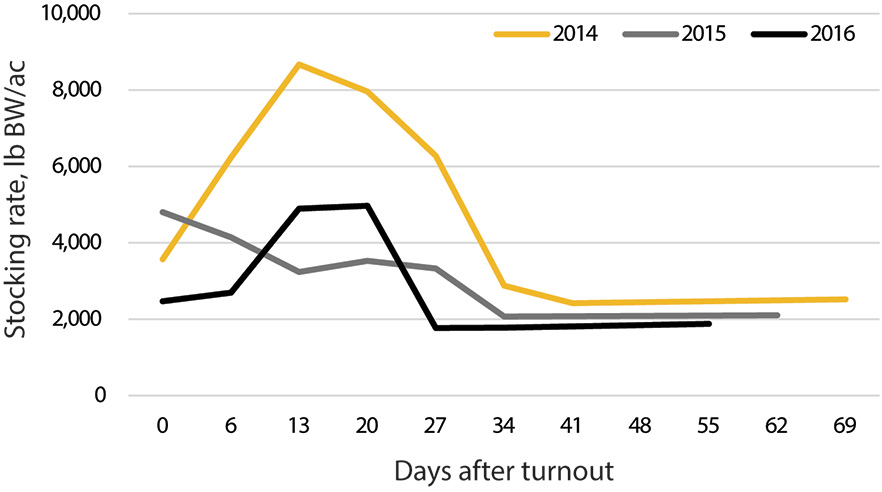
As flexibility is not always practical, grazing can commence with a set stocking rate. When using the same initial stocking rates, plant growth will likely outpace consumption. If SS becomes reproductive during rotational grazing, it is often best to return to the beginning of the rotation instead of continuing through overmature forage. This strategy prevents overly long rest periods that cause trailing forage to become overmature. The remaining forage can be used for hay or mowed to return it to a vegetative state. Alternatively, it can be grazed if animals are allowed to be selective.
Managing sorghum-sudangrass in a diverse cover crop mixture
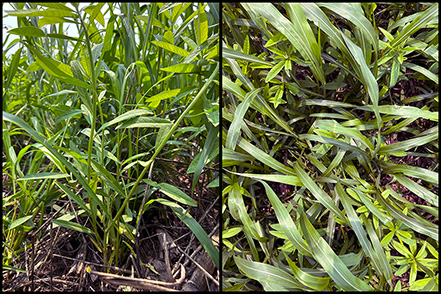
Diverse forage mixtures may boost energy and protein availability, slightly increasing daily gain (by 0.17 pounds in growing cattle), but adding species to sudangrass monocultures doesn’t increase yield. SS’s tall, fast growth can limit forage availability for species such as sunn hemp (Figure 4). To maintain diversity, ensure light reaches other species by keeping grazing intervals short and SS height below 36 inches. This practice opens the canopy for other species’ growth. Although diversification may reduce total yield, carrying capacity can match pure SS stands.
Toxicity concerns
Nitrate/nitrite intoxication and prussic acid (cyanide) poisoning can occur when grazing SS, but both can be effectively prevented with proper management.
Prussic acid
Prussic acid is also known as hydrogen cyanide. The immature leaves of sorghum can produce the cyanogenic glycoside (sugar) dhurrin as they grow. Dhurrin hydrolyzes especially rapidly in the rumen, liberating the hydrogen cyanide, which disrupts cellular oxygen use. The most common clinical signs are rapid collapse and sudden death. While potentially present in all plant parts, dhurrin is most concentrated in young, fast-growing tissues, especially the leaves. Stressors such as wilting, high nitrogen (N) fertilization and especially frost significantly increase the risk of prussic acid poisoning. To reduce risk:
- Remove livestock before any frost. Wait at least two weeks and test before turning out for grazing.
- Graze only when forages, including regrowth and new tillers, reach at least 24 inches, using rotational grazing to deter consumption of new growth.
Nitrate and nitrite
In the rumen, nitrate is converted to nitrite and then to ammonia. Conversion from nitrate to nitrite is limited by the number and type of bacteria present. Without enough of the right type of bacteria, nitrite builds up and is absorbed into the bloodstream, where it turns hemoglobin into methemoglobin, which carries oxygen ineffectively. Clinical signs of nitrate/nitrite poisoning include chocolate brown blood and mucous membranes, staggering, rapid breathing, premature parturition or abortion, and death. Overabundance of N from excess fertilizer application and environmental stress can cause excess N accumulation. The highest nitrate concentrations are generally in the lower stem but may migrate up the stem under some circumstances. To reduce risk:
- Split N applications; apply a maximum of 50 pounds of N at once.
- Avoid grazing during severe drought.
- Avoid grazing stems and lower plant portions.
- Introduce cattle gradually: Keep them full on hay, provide supplemental energy feedstuffs, and start with low-nitrate fields.
- Assess nitrate concentrations if questions persist about forage quality.