Across the U.S. more and more farmland is owned by nonoperating landowners: individuals who own farmland, but have it managed by tenant farmers. An estimated 87% of farmland is owned by nonoperating landowners. Women nonoperating landowners make up an important, but sometimes overlooked, part of this group.
Landowners want their farms managed with care. Regenerative farming practices offer several benefits to build the health and resiliency of your land. Integrating practices like cover crops, no-till, and crop rotations (among others) can help build soil health, improve water quality, benefit wildlife and pollinators, and more. But it can be tricky to learn what farming practices are best to keep your land resilient and productive in the short and long-term. It can also feel daunting to know how to work with your tenant farmer, especially if you are interested in changing how they are managing your land. This guide will help by providing:
- An overview of how regenerative agriculture can benefit your land and the principles of soil health
- Descriptions of some common regenerative farming practices for farms that produce row crops
- Strategies for supporting your tenant’s adoption of regenerative agriculture
- Opportunities and resources for nonoperating landowners
Regenerative agriculture and the soil health principles
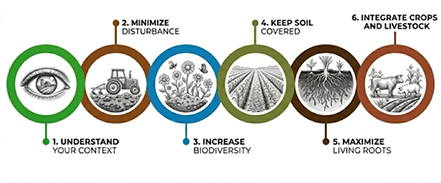
Regenerative agriculture focuses on building resilient production systems by building soil health, adapting to climate challenges, enhancing ecosystems, and restoring biodiversity. The United States Department of Agriculture defines soil health as “the continued capacity of soil to function as a vital living ecosystem that sustains plants, animals, and humans.” The soil health principle (Figure 1) are a set of management principles that guide decisions on how to build soil health on farms:
- Understand your context
- Minimize disturbance
- Increase biodiversity
- Keep soil covered
- Maximize living roots
- Integrate crops and livestock
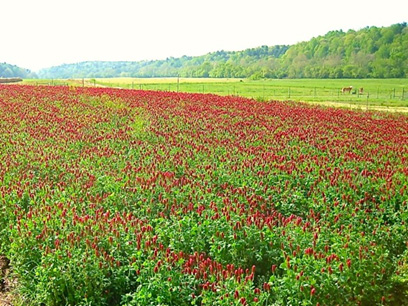
There are many different types of regenerative farming practices that could help you build soil health on your farmland (Figure 2). Below is an overview of several regenerative farming practices that can be used on row crop production systems.
Cover crops
Cover crops are crops that are planted when the primary cash crop is not being grown to provide a living cover for all or most of the year. By keeping the soil covered and maintaining living roots, cover crops offer many benefits, including building soil health, reducing erosion, increasing nutrients, and providing weed control.
Conservation tillage and strip-till
Conservation tillage systems reduce or completely eliminate the process of tilling soil prior to planting (these practices are sometimes referred to as “reduced tillage” or “no till”, respectively).
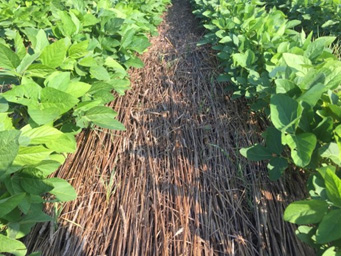
Strip till is another conservation tillage option to reduce soil disturbance. This practice involves tilling narrow bands where crops will be planted and leaving undisturbed strips in between (Figure 3).
Crop rotations
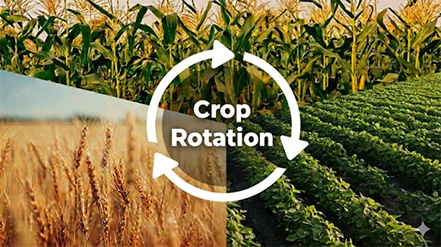
Instead of planting the same crop season after season, crop rotation involves growing a planned sequence of different crops across a field over successive seasons (Figure 4). This practice adds biodiversity to your farm, builds soil health, and can help protect against weed and pest pressure.
4R Nutrient management
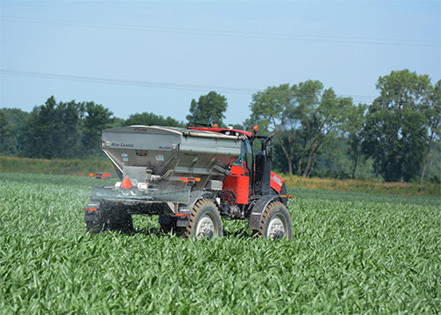
4R nutrient management practice means applying the right nutrient source at the right rate at the right time in the right place. By applying nutrient sources precisely where it is needed, you can maximize efficiency, reduce input costs, and minimize the potential environmental harm of runoff (Figure 5).
Strategies for supporting your tenant’s adoption of regenerative agriculture
Even though you are not the one managing your farmland, there are many ways you can support your tenant to help them adopt regenerative farming practices.
Educate yourself
Understanding the importance of soil health is an important first step to shifting how your farmland is managed. There is no one-size-fits-all approach to regenerative agriculture, so you’ll want to understand what approaches to take for your specific context.
There exists a range of resources available through online sources, such as the University of Missouri’s Center for Regenerative Agriculture’s website. Another great option is to attend educational in-person or virtual events on regenerative agriculture, conservation, and soil health. In fact, there are opportunities and resources developed specifically for women nonoperating landowners. Participating in one or more of these learning opportunities is a great way to educate yourself and meet other landowners with similar interests.
Here are some resources and opportunities tailored for women nonoperating landowners:
- Women Caring for the Land - Women, Food and Agriculture Network (WFAN) WFAN developed the Women Caring for the Land program to provide resources and community to women nonoperating landowners to help them achieve their conservation goals. This pioneer program offers free online resources in addition to sharing event information.
- Women Landowners Leading Regeneration (WLLR) - University of Missouri Center for Regenerative Agriculture WLLR program offers virtual learning opportunities while building relationships with a cohort of fellow women nonoperating landowners. This project uses the Women Caring for the Land approach to learn about farm conservation, identify resources, and build communities of women landowners.
- Women for the Land - American Farmland Trust (AFT) - AFT facilitates peer-to-peer learning circles for women to learn about different agricultural topics, including farm business management, agricultural conservation, and helpful resources. Learning circles allow participants to share their own experience while also learning from experts in the field. Find a learning circle near you.
Engage in conversations with your tenant
Start having open conversations with your tenant about your interests in having your farmland managed with regenerative farming practices to build soil health. You want to build mutual trust so that both you and your tenant are comfortable with how the land is being managed.
Share with your tenant what you have learned by educating yourself on regenerative agriculture and soil health. They may already be interested in adopting regenerative practices and didn’t know how to bring it up to you as the landowner. Alternatively, you can share information with them so they can learn more about the benefits of building soil health or even suggest going to educational events together.
Ask your tenant if they have any concerns or feel barriers to adopting regenerative farming practices. They may worry that they don’t have the knowledge or experience to effectively use new practices or perceive that their yields will decrease. By understanding their concerns, you can discuss what steps you can take to make them feel more comfortable.
Make a conservation plan
A conservation plan is important to identify your goals and plan specific management steps to reach them. You can reach out to a conservation specialist to help you develop your conservation plan. There are conservation specialists that provide these services at federal and state conservation agencies, such as USDA’s Natural Resources Conservation Service (NRCS) and Conservation Districts.
- Learn more about getting assistance on a conservation plan on the USDA NRCS website. Get conservation planning assistance.
- Find your USDA NRCS Service Center.
Find your Conservation District office to get a sense of conservation plans and what you may want to include, you can check out a sample conservation plan.
Lease agreements
Your lease agreement with your tenant is an important tool to mutually support both of your interests. One major barrier to tenant farmers’ adoption of regenerative farming is that often, lease agreements are made on an annual basis. This means that your tenant may be concerned about investing time and money in regenerative farming practices that they will not see the benefit of. Multiyear lease agreements are a great way to offer long-term security to your tenant. As a landowner, you can propose a three-to-five-year formalized (written) lease agreement so that your tenant feels comfortable that they will also benefit from building soil health with regenerative farming practices. You can also add provisions to your lease requiring that the tenant use specific regenerative farming practices.
You can learn more about developing multiyear lease agreements, additional provisions to your lease agreements, and find sample lease agreements at the following sites:
- Sustainable Farm Leasing Quick Reference Guide
- Basics of Farm Lease Agreements
- Conservation Provisions in Leases
Share costs
Some regenerative farming practices require an investment of some kind that goes beyond typical farming costs. For example, farmers must purchase seed and sometimes adjust their equipment to grow cover crops. You can share costs in a few different ways, including paying a share of the required inputs (e.g. cover crop seed) or of equipment needed to do the practice or reducing rental rates.
It is important to formally acknowledge your commitment to cost-sharing with your tenant. You can add a cost-sharing lease addendum to your written lease that outlines the contributions of each party.
Another option is to lessen the amount of rent you are charging your tenant to ease any real or perceived financial burdens your tenant might have. This can help offset some of the initial costs associated with adopting regenerative farming practices or address concerns about a temporary yield drag, which is most common during the first three years of transition from conventional methods. You may also consider using a graduated rental structure, where you lower the initial rental amount but then gradually increase it after the regenerative farming practices are in place.
In addition to your own financial investments, your tenant farmer may be eligible for state and federal incentive programs, such as cost-share payments, which go directly to the farmer even when the land is rented. Learn more about conservation cost-share programs like the Environmental Quality Improvement Program (EQIP) and the Conservation Stewardship Program (CSP) offered by USDA’s Natural Resources Conservation Service and cost-share programs offered through Missouri’s Department of Natural Resources through the Soil and Water Conservation Districts.
Find a tenant who shares your values
Sometimes, landowners and tenants simply don’t have the same goals and interests related to adopting regenerative agriculture. If you have tried to have these conversations and support your tenant farmer and they still do not want to manage your farm as you would like, it might be time to find a tenant who more aligns with your objectives.
“Farm linking” platforms are online sites where you can search for people seeking farmland. American Farmland Trust (AFT) has a National Farm Link Finder that you can use to select your state and find a land-linking platform specific to where your farmland is located.
Other resources
This guide offers an overview of regenerative agriculture, soil health, and some tips for how you can start championing your interests in owning resilient and health farmland. If you want to learn more about how you can engage with your tenant farmers to adopt regenerative systems, check out these resources:
- Listen to the Regenerative Reflections podcast episode, Making Regenerative Ag Happen Alongside Non-Operating Landowners
- Center for Regenerative Agriculture at the University of Missouri
- The Sustainable Agriculture Research and Education program