Introduction
Expected Progeny Differences (EPDs) are among the most valuable tools available for genetic selection in the beef industry. They allow producers to compare the genetic merit of animals and make selection decisions that improve economically important traits. Despite their widespread use, EPDs are often misunderstood.
One of the most common misconceptions is that an EPD predicts the performance of every individual calf. In reality, every calf inherits a unique combination of genes from its sire and dam, resulting in natural genetic variation among offspring. Understanding this random inheritance provides the biological foundation for interpreting EPDs, understanding the value of genomically-enhanced EPDs (GE-EPD), and recognizing why calf performance can deviate from parental expectations.
This publication explains how the random shuffle of genes creates genetic variation among calves and how genomic testing improves our ability to predict genetic merit early in life. For practical guidance on using EPDs, accuracy values, and selection indexes when selecting bulls, see the companion MU Extension publication Using Beef Cattle Sire Summaries: A Practical Guide to Selecting Better Bulls.
The random shuffle of genes
Each calf inherits one-half of its DNA from its sire and one-half from its dam. However, the genes inherited from each parent are not passed to every offspring in the same combination. Instead, each sperm and egg receives a random assortment of chromosomes, creating tremendous genetic diversity among offspring.
Cattle have 30 pairs of chromosomes. During sperm formation, one chromosome from each pair (either from his sire or dam) is randomly passed to a sperm cell. If we consider the chromosome inherited from the sire's father as "paternal" and the chromosome inherited from the sire's mother as "maternal," the formation of each sperm cell is similar to flipping 30 coins. Each "coin flip" determines whether the paternal or maternal chromosome is inherited. Because there are two possible outcomes for each of the 30 chromosome pairs, a single sire can produce 2³⁰ (1,073,741,824) different chromosome combinations in sperm (Figure 1).
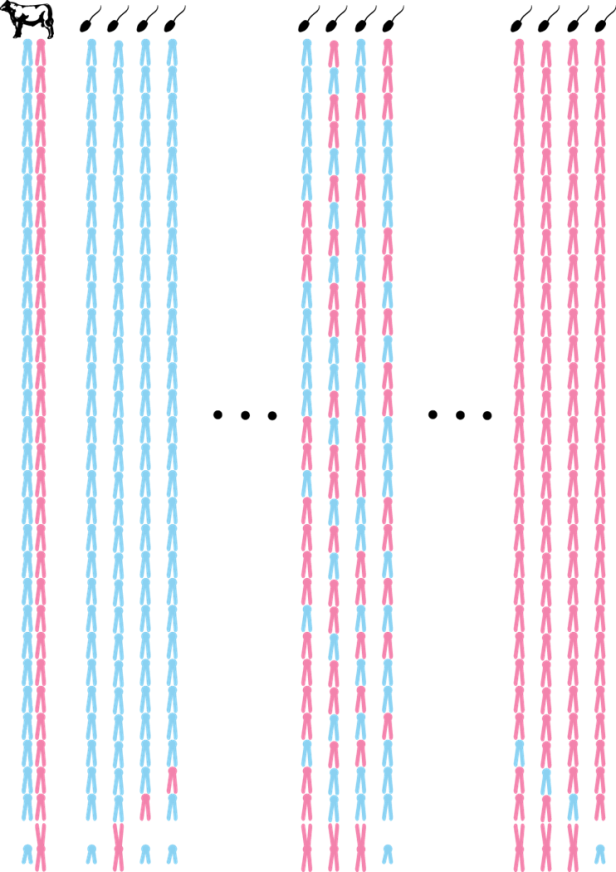
The same random process occurs during egg formation in the dam, resulting in another 2³⁰ possible chromosome combinations. Together, these independent processes create more than 2⁶⁰ (approximately 1.15 quintillion) possible chromosome combinations from a single mating before considering recombination, the natural biological process in which paired chromosomes exchange segments of DNA before being passed to the next generation. Recombination creates even more genetic diversity, making the number of possible genetic combinations virtually limitless.
In other words, no two sperm are exactly alike, no two eggs are exactly alike, and no two calves inherit the exact same combination of genes from their parents. This random inheritance of chromosomes explains why genetic variation exists within every cattle population and provides the biological foundation for genetic improvement through selection.
Why full siblings are different: mendelian sampling
Think about a set of full siblings you know well. They may be your own children or a group of embryo transfer flush mates produced from the same sire and dam. Although they share the same parents, they often differ phenotypically in one way or another. These differences result from the random inheritance of genes.
On average, full siblings share approximately 50% of their DNA, but each inherits a unique combination of chromosome segments from its parents. Consequently, no two full siblings (except identical twins) are genetically identical. Full siblings, including embryo transfer flush mates, may differ in calving ease, growth, maternal performance, structural soundness, carcass merit, or longevity because each inherited a different sample of genes from the same sire and dam. These genetic differences exist even when calves are raised under similar environmental conditions. This natural genetic variation is known as Mendelian sampling.
EPDs predict the average genetic merit a parent is expected to transmit to its offspring, not the genetic merit of every individual calf. This relationship can be summarized as:
EPD₍calf₎ = ½ EPD₍sire₎ + ½ EPD₍dam₎ + Mendelian Sampling
The first two terms represent the parent average, while the Mendelian sampling term accounts for the calf's unique inheritance, or deviation from that average. Some calves inherit a more favorable combination of genes than the parent average, or what you could call “win the genetic lottery”, while others inherit a less favorable combination. This explains why individual calves have inherently different genetic potential, and eventually different EPDs, even when they have the same parents.
Parent average versus genomically-enhanced EPDs
At birth, very little information is available to estimate an animal's unique genetic merit. Traditionally, a young animal's EPD is based primarily on its pedigree, with the best prediction being the average of its sire's and dam's EPDs, commonly referred to as the parent average.
Parent averages provide the best estimate of a young animal's genetic merit when only pedigree information is available. As a result, full siblings and embryo transfer flush mates begin life with very similar, or often identical, EPD profiles despite inheriting different combinations of genes.
As performance records and progeny information accumulate, breed associations become better able to estimate Mendelian sampling. Consequently, EPDs may increase or decrease over time as they more accurately reflect the animal's true genetic merit. At the same time, the accuracy associated with those EPDs increases because more information supports the genetic prediction.
Genomic testing has dramatically improved this process. Rather than relying solely on pedigree relationships, GE-EPDs incorporate information from thousands of DNA markers distributed across the genome. Rather than assuming an animal inherited the average combination of genes from its parents, genomic testing provides information about the genes the animal actually inherited. As a result, GE-EPDs provide a more reliable estimate of genetic merit long before sufficient performance or progeny records become available.
A real-world example
The influence of Mendelian sampling can be clearly demonstrated using a group of embryo transfer flush mates (Table 1). All six calves were produced from the same genomically tested sire and dam and therefore share identical pedigree information. However, only the three heifers had been genomically tested.
Table 1. Expected Progeny Differences for Calving Ease Direct, Birthweight, and Ribeye Area for a sire and dam, along with 6 full sibling progeny resulting from said mating1.
| Animal | Birth date | CED | WW | REA | GE-EPDs |
|---|---|---|---|---|---|
| Sire | 3/2017 | +2.3 | +55 | +0.67 | Yes |
| Dam | 1/2017 | -4.7 | +57 | +0.35 | Yes |
| Heifer 1 | 1/2019 | -3.9 | +68 | +0.46 | Yes |
| Heifer 2 | 1/2019 | -9.2 | +69 | +0.55 | Yes |
| Heifer 2 | 1/2019 | -5.7 | +72 | +0.60 | Yes |
| Bull 1 | 2/2019 | -1.3 | +56 | +0.51 | No |
| Bull 2 | 1/2019 | -1.3 | +56 | +0.51 | No |
| Bull 3 | 1/2019 | -1.3 | +56 | +0.51 | No |
| 1Data reported are real EPDs and GE-EPDs from AHA, pulled July 9, 2021. | |||||
Because the three bull calves had not been genotyped, their EPDs were based primarily on the parent average until their own performance or progeny records became available. Consequently, all three bulls reported identical EPDs for Calving Ease Direct (CED), Weaning Weight (WW), and Ribeye Area (REA). Without genomic information, the national cattle evaluation could not distinguish the unique combination of genes inherited by each bull, therefore treating them as equal.
In contrast, the three heifers had been genomically tested. Although they shared the same parents as the bulls, their GE-EPD differed considerably from one another. These differences did not occur because their genetics changed. Instead, genomic testing identified the unique chromosome segments inherited by each heifer, allowing the genetic evaluation to estimate a portion of each animal's Mendelian sampling term.
For example, CED EPDs among the three heifers ranged from -3.9 to -9.2, WW EPDs ranged from +68 to +72, and REA EPDs ranged from +0.46 to +0.60. Meanwhile, each of the three non-genotyped bulls retained identical parent-average EPDs (CED = -1.3, WW = +56, and REA = +0.51) because no genomic information was available to distinguish them.
Why genomic testing matters
The flush mate example illustrates an important limitation of pedigree information. Pedigree tells us where an animal's genes came from, but it cannot determine which genes the animal actually inherited.
Figure 2 provides a simplified illustration of gene inheritance across three generations. The sire (orange) inherited chromosome segments from his sire (yellow) and dam (red), while the dam (purple) inherited chromosome segments from her sire (blue) and dam (pink). During the formation of sperm and eggs, these chromosome segments are randomly shuffled before being passed to the next generation. Although the three calves share the same sire and dam, each inherited a different combination of chromosome segments from their parents. As a result, every calf is genetically unique despite having the same pedigree. This random inheritance of genes is the biological basis of Mendelian sampling and explains why full siblings, including embryo transfer flush mates, differ in their genetic merit.
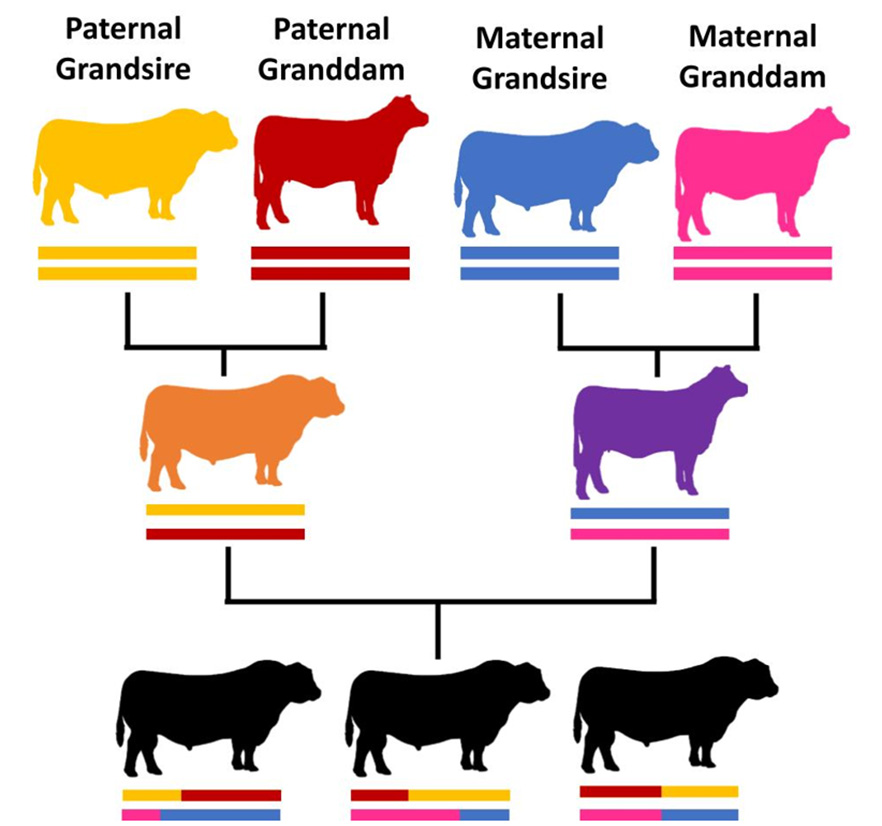
Genomic testing provides information beyond pedigree by identifying many of the chromosome segments an animal actually inherited from each parent. This additional information allows breed associations to account for a portion of Mendelian sampling when calculating GE-EPDs, resulting in more reliable estimates of genetic merit for young animals.
Although genomic testing improves genetic predictions early in life, it does not replace performance records or progeny data. Instead, it complements these sources of information. As additional phenotypic and progeny records become available, EPD accuracies continue to increase, further improving the prediction of an animal's genetic merit. Together, pedigree, performance, progeny, and genomic information provide the most comprehensive estimate of genetic merit currently available.
Putting it into practice
Understanding how genes are inherited helps explain many of the situations producers observe in their own herds.
A bull with a low Birth Weight EPD may occasionally sire a heavy birth weight calf. Likewise, a high-growth sire may produce a calf that grows more slowly than expected. These individual observations do not mean the EPD was inaccurate. Rather, they reflect the random inheritance of genes, differences in the genetic merit of the dams, and environmental factors such as nutrition, health, and management. EPDs estimate an animal's genetic potential, but the degree to which that potential is expressed depends on the environment in which the animal is raised. Therefore, EPDs are designed to predict average genetic differences among progeny, not the performance of every individual calf.
This biological variation exists in every breeding system. Whether a single AI sire is bred to an entire cow herd, a natural service bull is turned out with multiple females, or embryo transfer is used to produce flush mates, every calf inherits a unique combination of genes. As a result, individual calf performance will always vary.
For this reason, EPDs should be interpreted as predictions of average progeny performance, not guarantees of the performance of every individual calf. The value of an EPD becomes evident when evaluating the average performance of a group of progeny rather than judging a sire based on one exceptional calf.
GE-EPD reduce uncertainty by providing a more accurate estimate of an animal's genetic merit early in life. By incorporating genomic information into the genetic evaluation, producers can make more informed selection decisions while reducing the risk associated with purchasing or retaining young breeding animals.
Whether selecting replacement females, purchasing herd sires, or identifying elite donor females, understanding the random shuffle of genes provides the biological foundation for making sound genetic decisions. Although no genetic evaluation can remove the natural variation observed among calves, GE-EPDs provide the most reliable estimate of an animal's future genetic contribution currently available.
For practical guidance on interpreting EPDs, accuracy values, selection indexes, and modern sire summaries, see the companion MU Extension publication, Using Beef Cattle Sire Summaries: A Practical Guide to Selecting Better Bulls.