John W. Howard II and Peng Tian
Plant Diagnostic Clinic
Bacterial Leaf Scorch (BLS) disease is caused by the bacterium Xylella fastidiosa, which infects the xylem of susceptible trees. This disease is transmitted by insect vectors, primarily sapsucking leafhoppers, though infection by root grafts are known to have occurred. Xylems infected with BLS eventually become blocked and are unable to transport water and nutrients from the tree roots to leaf tips. There is no cure for BLS and an infected tree will progressively decline and reach mortality in 5-8 years.
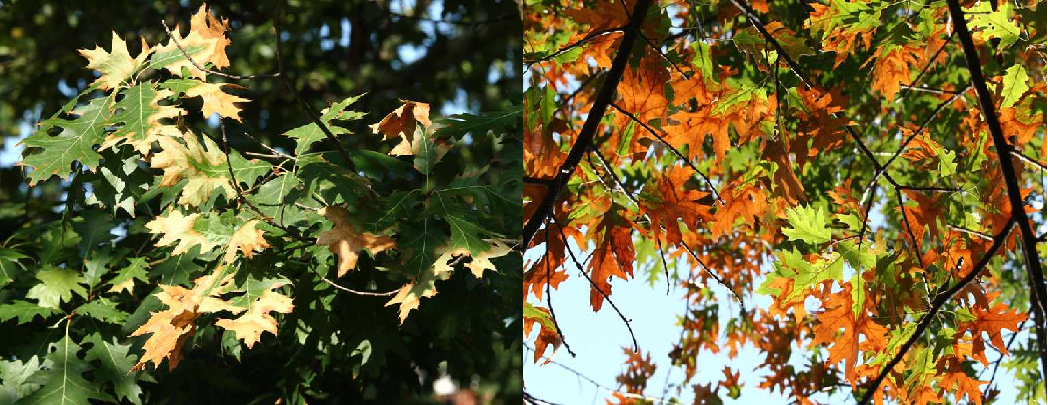
Xyllela fastidiosa affects a variety of oak species, elm, maple, mulberry, sweetgum, and sycamore. Symptoms of BLS include marginal scorching that slowly spreads inward towards the main veins, further leading to twig dieback (Figure 1). BLS symptoms are similar to drought stress and can be difficult to distinguish between them. Timing of onset of symptoms is generally a differentiation between drought stress and BLS as drought stress injury occurs soon after an environmental event whereas BLS symptoms tend to develop in mid-summer and progressively worsen into fall. A variety of hosts may also exhibit a halo type ring at the scorched boundary. Indeed, BLS symptoms are also often confused with those of Oak wilt and Tubakia leaf spot.
Proper diagnosis is crucial to determine the proper treatment plan
- Oak wilt is fungal disease that kills a tree, especially red oak family trees, within a year. Quick actions such as removal of the tree as well as root trenching must be considered to prevent the spread of fungal spores to nearby trees.
- Tubakia leaf spot is generally only a visual nuisance requiring limited to no treatment.
- The only way to accurately identify BLS is by laboratory analysis. Management of BLS include antibiotic root injection and it requires annual reapplications. However, this method only slows down the progress of the infection without curing the host.
The MU Plant Diagnostic Clinic utilizes molecular method such as PCR and serological test such as ELISA, to differentially diagnose Oak Wilt, Tubakia and BLS. Depending on the sample, tree owners submitting suspected tree samples may have diagnostic reports available in as little time as one day. Quick and accurate diagnosis can facilitate tree owners to make timely and appropriate management decisions.
Disease management
- Prevent Environmental Stress. Providing sufficient watering and fertilization to maintain general health can extend the life of the infected tree. Increased environmental stress may hasten BLS severity.
- Sanitized Pruning and cleanup. Prune twig dieback regularly to reduce spread of bacterium while cleaning pruning tools with a 10% bleach solution between cuts. If composting leaves, all infected materials require exposure to temperature of at least 140 °F to eliminate the bacteria.
- Chemical Management. Once you have a confirmed BLS diagnosis from the MU Plant Diagnostic Clinic, contact a certified arborist and discuss if springtime antibiotic tree root injections are right for your situation. Insecticide treatments are ineffective at controlling disease spread and are not recommended.
References
- BLS in the Midwest and Plains States, University of Missouri Extension.
- Oak Wilt, BLS or Abiotic Scorch? University of Missouri Center for Agroforestry.
- Bacterial Leaf Scorch, Missouri Botanical Garden.