John W. Howard II and Peng Tian
MU Plant Diagnostic Clinic
An excessively wet spring, a late frost and a moderate summer contributed to increased incidence of Tubakia leaf spot disease on oak trees this year. This disease predominantly infects Oak species with latent symptoms of dark red to brown spots on leaves appearing in mid to late summer. For appropriate diagnosis, the MU Plant Diagnostic Clinic can help you confirm if your plant has this fungal disease.
Name: Tubakia spp.
Symptoms and signs
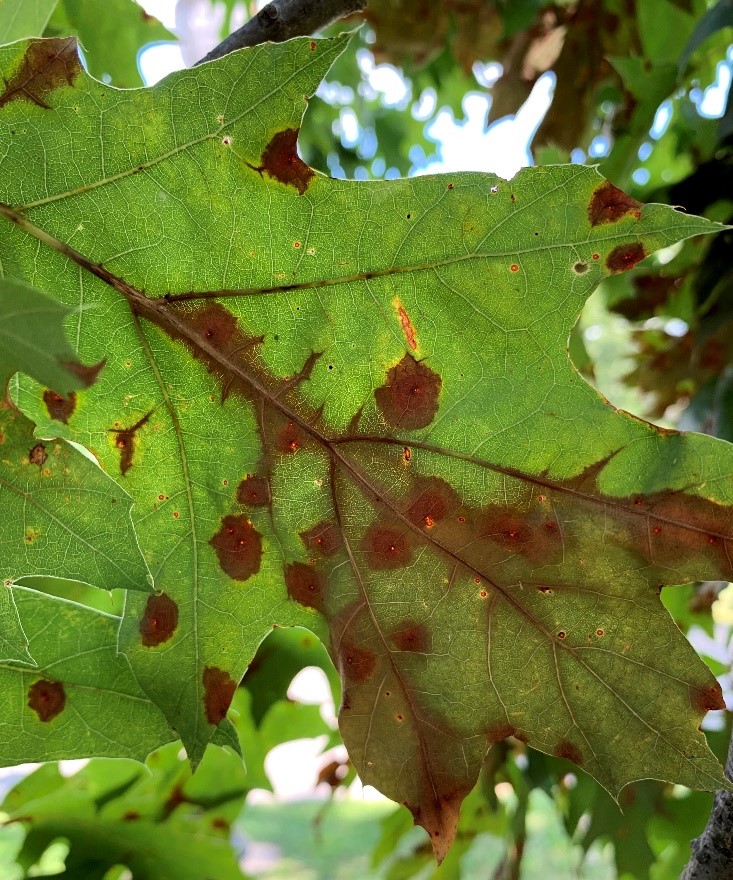
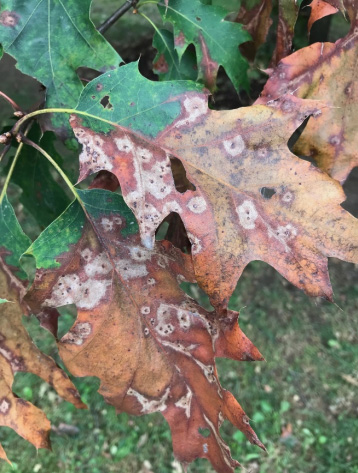
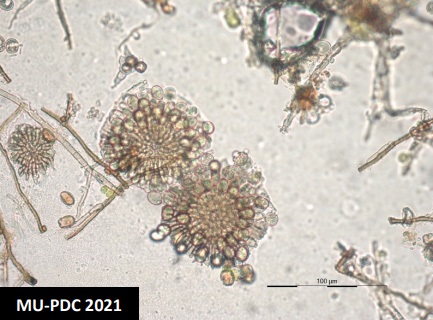
Typical symptoms are circular leaf spots that are dark red to brown ranging from ¼ to ½ inch in diameter (Figure 1). The leaf spots occurring on leaf veins result in vascular collapse and tissue death with severe cases causing early defoliation (Figure 2). Heavily congregated Tubakia leaf spots are often confused as Oak wilt or Anthracnose disease. The spores of Tubakia spp. are microscopic and cannot be seen unaided, thus proper identification requires analysis with a laboratory microscope. Tubakia spp. have a unique fruiting structure called pycnothyrium that composes of a shield like scutellum of radial projected hyphae. The scutellum is supported by a short columnar stalk that bears the round to ovoid conidia spores (Figure 3).
Life cycle
The spores (conidia) of Tubakia spp. overwinter on infected twigs and leaves, either attached to the tree or on the ground. Spring wind and rain splash spreads fungal spores and infects trees early in the season. Infected trees may remain asymptomatic until mid to late summer, or early fall.
Host range and damage
All oak species are susceptible, though it is most common in the red oak group (such as black, red, shingle, and pin oak). Secondary hosts include maple, elm, and hickory. Unlike the fatal Oak wilt disease, Tubakia leaf spot on Oak is mostly a cosmetic nuisance.
Disease management
- Prevent Environmental Stress. Provide sufficient watering, fertilization, and air circulation to trees.
- Clean up tree litter. Removal of infected ground leaves and twigs can reduce the presence and spread of infectious spores. If composting, all leaves require exposure to temperature of at least 140 °F to eliminate the fungus.
- Chemical Management. Fungicide applications are generally unnecessary. Early season fungicide applications on nursery crops during wet conditions may be warranted.
References
- Tubakia (Actinopelte) Leaf Spot, University of Wisconsin-Madison, Wisconsin Horticulture Division.
- Tubakia leaf spots in Oak, Iowa State University, Extension and Outreach.
- Tubakia Leaf Blotch, University of Massachusetts Amherst, UMass Extension.
- Tubakia leaf spot appearing on oak trees, Michigan State University, MSU Extension.