-
Image
 John Chamberlin is a firm supporter of grazing standing milo. He is in his third year of working with MU Extension to save feed and labor costs on his east- central Missouri diversified farm. Photo by Linda Geist.
 -
Image
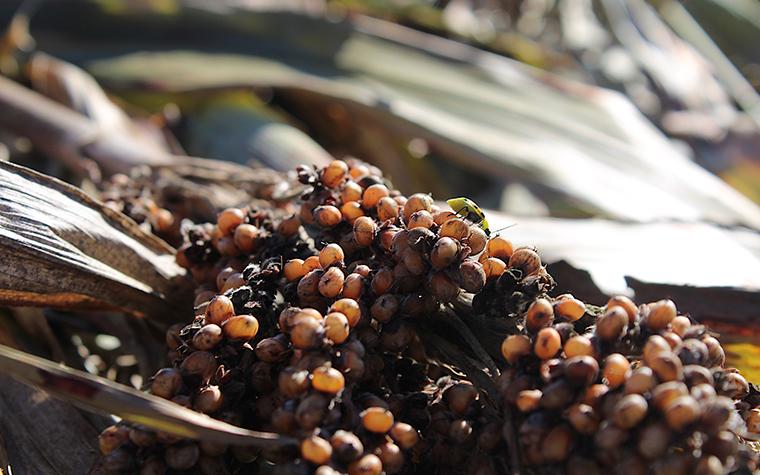 Composite forage tests of all plant parts of milo shows a TDN of 73%-75% and crude protein of 7%. That is adequate energy but requires protein supplementation, says MU Extension agronomist Rusty Lee. Allocating 12 pounds of grain per cow per day yields a possible carrying capacity of 420 cow days per acre. Photo by Linda Geist.
 -
Image
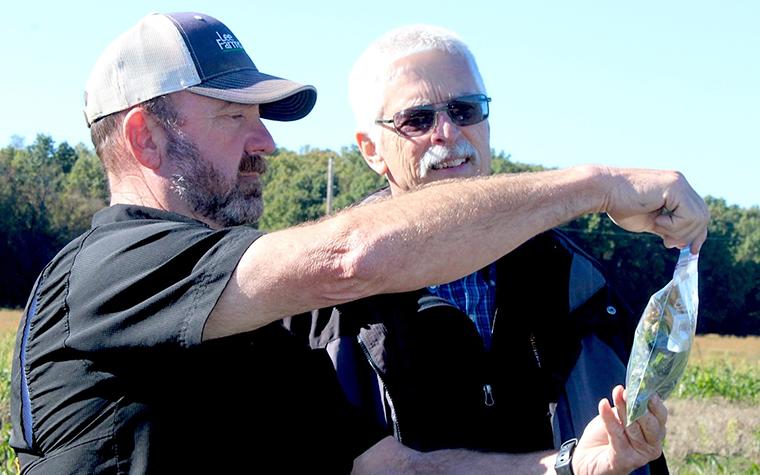 MU Extension specialists Rusty Lee and Gene Schmitz tested downed milo for prussic acid or cyanide. Like other sorghum specie forages, prussic acid is present in milo after frost injury. To avoid this, delay grazing for about two weeks after frost to avoid nitrate poisoning in cows. Photo by Linda Geist.
 -
Image
 MU Extension agronomist Rusty Lee, right, shows livestock producer John Chamberlin a simple test kit he carries with him to make testing for prussic acid quick and easy. After frost injury, temporary but toxic levels of prussic acid are present in milo, and livestock grazing should be avoided. Photo by Linda Geist.
GREEN RIDGE, Mo. – University of Missouri Extension specialists find that producers see up to $300 savings in feeding costs per calf when their livestock graze standing milo through the winter.
This is the third year that Green Ridge livestock producer John Chamberlin has worked with MU Extension agronomist Rusty Lee and livestock specialist Gene Schmitz to find how milo can reduce winter feed costs and improve herd health.
Milo is a drought-resistant forage that can be used as a winter livestock feed to save time and labor. It also improves carrying capacity and returns nutrients back to the soil, says Lee.
Saves labor, costs
By grazing the standing milo, producers eliminate grain harvest and transportation costs.
Strip grazing takes cattle to the feed rather than feed to the cattle, saving time and money, says Lee. He has grown milo on his east-central Missouri diversified farm for more than 10 years.
Producers control daily feed allocation by creating strips with polywire electric fencing. This encourages cattle to utilize the fodder leaves and portions of the stalk in addition to the high-energy grain head of the plants.
Chamberlin says strip grazing saves him hours of feeding time daily for the approximately 400 head since it takes only 30 minutes a day to move the polywire instead of the hours it took to unroll hay and fill feed bunks.
Toxicity still a problem after frost
Like other Sorghum specie forages, temporary but toxic levels of prussic acid are present in milo after frost injury. To avoid this, delay grazing for about two weeks after frost to avoid cyanide poisoning in cows.
Chamberlin recently did in-field research to see if he could avoid this prussic acid poisoning window by mowing milo down prior to frost. “The idea was to start the two-week clock for volatilization in an area that would then be usable once the remainder of the field was in the frost-induced grazing restriction,” says Lee.
He left mowed stalks on the ground to dry and waited for MU Extension specialists to test the downed milo for prussic acid or cyanide. Eight days after mowing, their tests still showed that prussic acid levels were still too high to safely turn cattle in to graze.
Lee and Schmitz say that while the head of the plant may be dead, the stalk continues to create regrowth that appears to contain cyanide. While palatable to livestock, it can be deadly.
Post-frost toxins
Risk is highest immediately after the first fall frost, primarily due to the stress-induced breakdown of cyanogenetic compounds into prussic acid or hydrogen cyanide, says MU Extension veterinary toxicologist Tim Evans.
When Sorghum species like milo are stressed by frost, they tend to accumulate a compound called dhurrin. When frost-damaged plant tissues break down in the rumen, the dhurrin quickly converts to the highly toxic prussic acid.
Prussic acid interferes with the body’s ability to use oxygen to generate cellular energy, with the oxygen remaining unused in the typically cherry red blood, leading to symptoms such as muscle twitching, staggering and even death. Ruminants are more susceptible to prussic acid poisoning than other animals because cud chewing and rumen bacteria help release the cyanide from plant tissue.
Additionally, frost can cause nitrate accumulation in some plants by hindering their ability to convert nitrates into proteins.
Despite the lack of success in reducing the two-week wait after frost to graze, Lee says MU Extension specialists continue to look for ways to move cows onto milo quicker.
High production, high utilization
Strip-grazing standing milo eliminates the costs associated with harvesting and transporting feed grains. This results in lower daily feed costs compared to the traditional winter hay feeding program. Lee estimates the milo utilization rate at 75%.
Composite forage tests of all plant parts consumed show total digestible nutrient values (TDN) of 73%-75% and crude protein of 7%. That is adequate energy but requires protein supplementation, says Lee. Various commodity feeds like soybean meal or high-quality hay can provide this.
An average milo yield of 120 bushels per acre is 6,720 pounds of grain. Taking into consideration the observed feeding losses of 25% as the cattle graze, that leaves 5,040 pounds per acre into the mouths of cows. Allocating 12 pounds of grain per cow per day yields a possible carrying capacity of 420 cow days per acre.
Savings of $300 per calf
Chamberlin says he gets 400 cow days per milo acre, letting him run more cows per acre. He estimates that he reduces the acres/cow ratio from 4 to 3, a significant savings of resources.
His figures point to milo saving him $300 per calf compared to hay. With a 400-head herd, that’s about $120,000 in savings, says Lee.
Chamberlin remains a firm supporter of grazing standing milo. “I have nothing but praise for this,” he says. “If you’re not already grazing standing milo, start.”
Breeding rates improve
Lee says milo provides a consistent, high-energy feed for breeding fall-calving cows or late spring-calving cows with calves at side when used with a protein supplement.
Calving rates improve when moving cows from fescue fields to milo as little as 30 days before breeding season, he says. Lee recommends putting cows on milo two weeks after a killing freeze, typically Nov. 1. This works well with fall-calving program of bull turn-in between Thanksgiving and Dec. 1.
Nov. 1 to Valentine’s Day
Typically, a Nov. 1 start allows grazing all winter until planted acres are consumed. While it is possible to graze milo until spring pasture green-up, March winds and deteriorating stalk strength make it a good idea to conclude milo grazing by Valentine’s Day, says Lee.
Available resources
Lee is an author of MU Extension publication Strip-Grazing Milo as a Low-Cost Winter Forage, which is available for free download. He recommends the Grain Sorghum Planning Budget.
Lee was part of a Dec. 3 University of Nebraska Extension webinar on grazing standing milo. Contact Aaron Berger at aberger2@unl.edu or 308-235-3122 for possible access to a recording of this free webinar.
Photos
Chamberlin. John Chamberlin is a firm supporter of grazing standing milo. He is in his third year of working with MU Extension to save feed and labor costs on his east- central Missouri diversified farm. Photo by Linda Geist.

Chamberlin-Lee milo head. Composite forage tests of all plant parts of milo shows a TDN of 73%-75% and crude protein of 7%. That is adequate energy but requires protein supplementation, says MU Extension agronomist Rusty Lee. Allocating 12 pounds of grain per cow per day yields a possible carrying capacity of 420 cow days per acre. Photo by Linda Geist.

Chamberlin-Lee-Schmitz checking. MU Extension specialists Rusty Lee and Gene Schmitz tested downed milo for prussic acid or cyanide. Like other sorghum specie forages, prussic acid is present in milo after frost injury. To avoid this, delay grazing for about two weeks after frost to avoid nitrate poisoning in cows. Photo by Linda Geist.

Chamberlin-Lee test kit. MU Extension agronomist Rusty Lee, right, shows livestock producer John Chamberlin a simple test kit he carries with him to make testing for prussic acid quick and easy. After frost injury, temporary but toxic levels of prussic acid are present in milo, and livestock grazing should be avoided. Photo by Linda Geist.
