Image
Reviewed
This publication is designed to be a useful reference for diagnosticians, turfgrass managers, industry representatives and others who want to learn how to diagnose and manage common turfgrass diseases caused by plant pathogenic fungi.
Reviewed
This guide provides turfgrass recommendations for athletic fields, emphasizing irrigation, traffic-tolerant cultivars, and effective seeding methods.
Reviewed
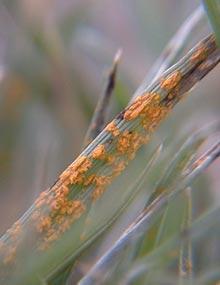
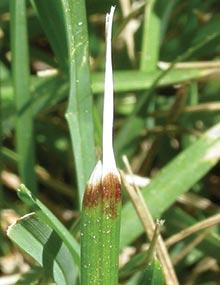
Rust occurs to some extent on all turfgrasses, but the rust fungi are generally host specific. Rust is most severe on susceptible cultivars of Kentucky bluegrass, tall fescue, perennial ryegrass and zoysiagrass. Rust symptoms usually appear in late August to early September and continue through the fall months.
Reviewed
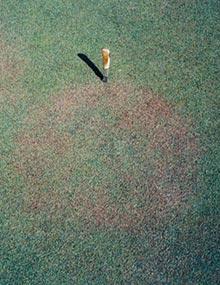
Take-all patch of creeping bentgrass is a soilborne disease caused by a darkly pigmented, ectotrophic root-infecting fungus. The disease is most common on new greens. It also occurs on reconstructed greens, especially when methyl bromide had been used in the renovation.
Reviewed
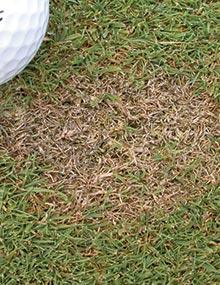
Ascochyta leaf blight results in the rapid development of large irregularly shaped, straw-colored patches on Kentucky bluegrass and occasionally on tall fescue and perennial ryegrass during the summer. Because Ascochyta spp. are primarily foliar pathogens, diseased turfgrass usually recovers relatively quickly.
Reviewed
Dead spot is a disease of new sand-based bentgrass greens or renovated greens where methyl bromide was used in the renovation. The disease first occurs one to four years after construction or renovation, gradually disappearing one to three years after its first occurrence.
Reviewed
Editor’s note
The following abstract describes a publication that is only available as a downloadable PDF.
Reviewed
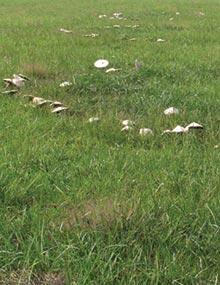
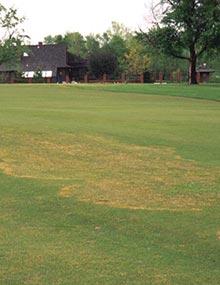
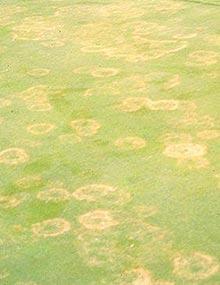
Fairy ring is caused by more than 60 basidiomycete fungi, including those producing the familiar puffballs and toadstools. The rings result from the activities of these fungi growing radially through the thatch or soil, rather than from a direct parasitic relationship with the turfgrass.
Reviewed
Large patch is a cool-season disease of warm-season grasses. Symptoms are most common when these grasses are either entering or coming out of dormancy.
Editor’s note
The following abstract describes a publication that is only available as a downloadable PDF.
Revised
Reviewed
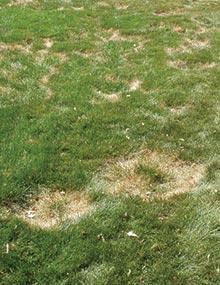
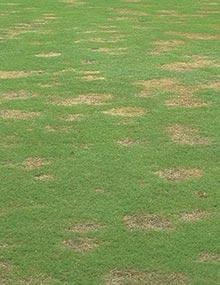
Necrotic ring spot is a destructive disease of Kentucky bluegrass, but may also occur on red fescue and annual bluegrass. The disease is particularly damaging to bluegrass.
Reviewed
Spring dead spot is a destructive disease of common bermudagrass and bermudagrass hybrids throughout the northern range of its adaptation in the U.S.
Reviewed
Yellow patch is a cool-season disease that occurs on bentgrass and annual bluegrass putting greens and sometimes on higher-gut Kentucky bluegrass.
Reviewed
Establishing a healthy lawn enhances your landscape and benefits the environment. Learn best practices to protect water quality during lawn establishment.
Reviewed
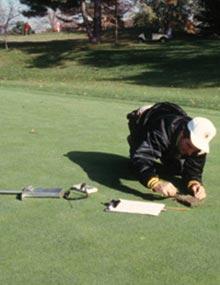
Learn to diagnose turfgrass diseases by identifying host plants, assessing environmental conditions, and observing damage patterns for effective management.
Reviewed $40
This manual contains information that applicators must be familiar with to become a certified sewer line root control applicator.
Reviewed
Raccoons have adapted to urban areas, causing damage to property and posing health risks. Learn how to manage and prevent raccoon problems.
Reviewed
Armadillos are becoming more common in Missouri. Visit our site for our Armadillos in Missouri: Techniques to Prevent and Control Damage resource.
Reviewed
Reviewed
Muskrats can damage ponds and crops through burrowing and feeding. This guide outlines effective control methods.
Reviewed
Voles in no-till fields can reduce corn and soybean stands by up to 100%. Learn to identify damage and manage vole populations before planting.
Reviewed
Striped and eastern spotted skunks inhabit diverse environments and may cause issues like lawn damage, poultry predation, and unpleasant odors.
Reviewed
Norway rats are stocky burrowing rodents that were unintentionally introduced into North America by settlers who arrived on ships from Europe. Also called brown rats or sewer rats, these destructive pests are found in and around towns and farms throughout Missouri. This guide provides information on how to recognize and manage a rat infestation.
Reviewed
Snakes often become displaced after a storm or flooding event. As a result, many of these animals are seeking shelter and food in areas close to people. Read more to find out what to do when you encounter one.