The bean leaf beetle, Cerotoma trifurcata (Förster) (Coleoptera: Chrysomelidae), is one of the most important soybean pests in the United States, particularly in Missouri. Both larvae and adults can injure soybeans. Larvae feed on soybean nodules and roots, while adults feed on foliage and pods. The second generation of this pest can cause significant damage to pods, reducing seed quality and yield.
Description and life cycle
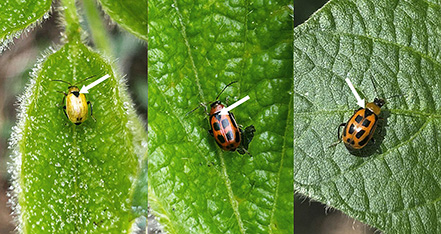
Adult bean leaf beetles are red, yellow, or light tan, approximately 1/4 inch in length, with markings (dots, stripes, or both) that may vary among individuals or populations. Despite variations in color and markings, all adults have a black triangle at the base of their forewings (Figure 1). Eggs are small, orange-colored, and about 1/32 inch long, and laid on the soil surface. Larvae are whitish with a brown head and measure less than 1/2 inch long. Pupae are soft-bodied, white, and about 3/16 inch long typically found in the soil.
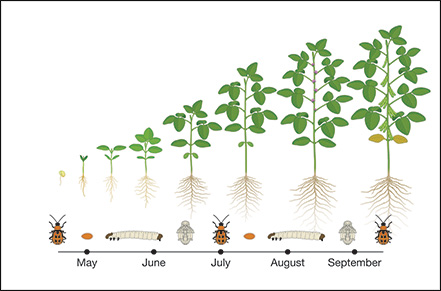
Bean leaf beetle overwinters as adults beneath leaf litter in wood lots adjacent to soybean fields. Once spring temperatures reach 50 to 55 degrees Fahrenheit, adults become active and seek available host plants (such as grasses, soybean plants, and other legumes). Female beetles lay their eggs adjacent to plant stems in the upper 5 inches of the soil. After hatching (5-7 days) from their eggs, bean leaf beetle larvae feed on underground plant parts (Figure 2). Depending on soil temperature, larvae may feed for 3 to 6 weeks before pupating. About a week later, adults emerge (beginning mid-July) to feed, mate, and lay eggs. There are two in-season generations per year in Missouri, the second of which generally emerges in September. These adults will feed on soybean or other host plants before moving into overwintering sites sometime in October.
Damage
Both bean leaf beetle larvae and adults possess chewing mouthparts. Larvae may feed on roots and root hairs but show a preference for root nodules, but rarely show negative impact on yield. The adult feeding damage to foliage and particularly pods is economically important. In rare scenarios, first generation beetles can cause stand losses on seedling plants. Negative economic impact from bean leaf beetles is commonly associated with large percentages of defoliation during the soybean reproductive stages.
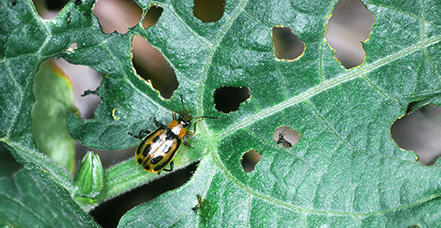
Defoliation by adult bean leaf beetle is identifiable by the small spherical holes between the major leaflet veins (Figure 3). T his damage differs from the larger, irregular holes or jagged leaflet margins caused by caterpillars and grasshoppers. When population density is high, bean leaf beetles can cause rapid defoliation which makes scouting for bean leaf beetle imperative. High defoliation levels during the key reproductive stages of soybean can cause indirect yield losses due to delays and maturity and inhibition of sunlight for pod development. Majority of past research suggest that yield losses associated from defoliation are the most economical impactful, but many observations from university entomologist suggest that injury from pod feeding may result in greater losses.
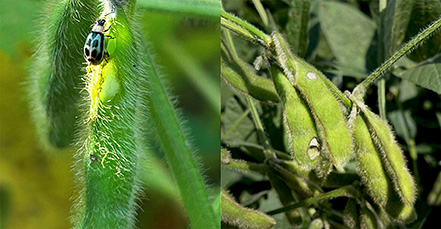
Based on current research, pod damage by adult bean leaf beetles is a direct yield loss and considered the most economically impactful injury they can inflict. (Figure 4). T his damage can cause complete pod loss when adults feed at the base of the pod. This type of injury is referred to as “pod clipping.” Adult damage to the outer pod wall also leads to the formation of pod lesions. Moisture can then enter through these pod lesions, and this increased moisture level permits the entry of secondary pathogens. Seeds damaged by these pathogens become shrunken, discolored and moldy. Several primary pathogens (e.g., bean pod mottle, cowpea mosaic and southern bean mosaic viruses) also can be transmitted by adult beetles.
Scouting procedures and techniques
As soon as soybean seedlings emerge, it is important to scout fields weekly for bean leaf beetle infestations. Scouting procedures are targeted at the adult stage because sampling for the larvae is expensive, labor intensive and time consuming. Direct observations along with stand counts can be used early in the season. By midseason, either sweep nets or drop cloths are effective sampling tools. Adult bean leaf beetles will drop to the ground or onto lower leaves when disturbed. When caught in a sweep net, they usually remain at the bottom of the net, hiding underneath leaves or within the folds of the net. Counts of adults as well as damaged pods are useful tools for determining insecticide applications later in the season.
Management
The impact of bean leaf beetles on yield has been quantified in several different studies. Overall, a reduction of 0.6 pound per acre can occur when beetles number one or more per row foot. In bean leaf beetle pest management, various sampling tools are used to trigger insecticide applications. In Missouri, economic threshold levels are based upon damage to the aboveground structures on the plants and vary according to the soybean growth stages.
- Seedling stage: five or more bean leaf beetles or one damaged plant per foot of row
- Past seedling stage to bloom: 10 or more bean leaf beetles per foot of row and more than 30 percent defoliation
- Bloom stage until seed maturity: 10 or more bean leaf beetles per foot of row and 20 percent defoliation OR at least 15 bean leaf beetles per foot of row and at least 10 percent pod damage.
Precaution
Before you select and apply an insecticide, review the manufacturer’s label for information on its safe use. Additionally, some states have reported pyrethroid failure for controlling bean leaf beetles. Though it has yet to be documented in Missouri. In addition, many different parasitoids and predators attack bean leaf beetles and other soybean pests. The diversity and abundance of this beneficial insect complex should be considered before applying an insecticide. The most common parasitoid enemy of bean leaf beetles is the tachinid fly, Calatoria diabroticae (Shimer). It attacks the adult stage but is difficult to detect under most circumstances.