The soybean tentiform leafminer, Macrosaccus morrisella (Fitch) (Lepidoptera: Gracillariidae), has recently emerged as a new pest of soybean, Glycine max (L.) Merrill (Fabales: Fabaceae), in the United States. This oligophagous microlepidopteran is native to North America and was historically restricted to two legume species, American hogpeanut, Amphicarpaea bracteata (L.) Fernald (Fabales: Fabaceae), and slickseed fuzzybean, Strophostyles leiosperma (Torr. & A. Gray) Piper (Fabales: Fabaceae). The first detection of M. morrisella feeding on soybeans occurred in Québec, Canada, in 2016. New detections have been documented in commercial soybean fields in Minnesota, South Dakota, North Dakota, Iowa, and Nebraska. In 2025, M. morrisella was confirmed for the first time feeding on soybeans in Cooper County, Missouri.
Insect description
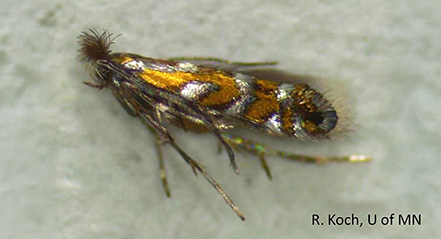
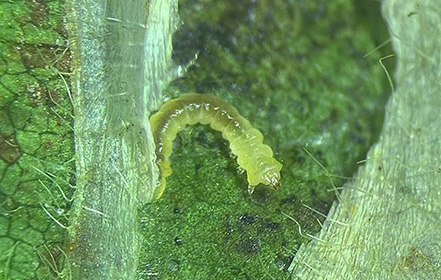
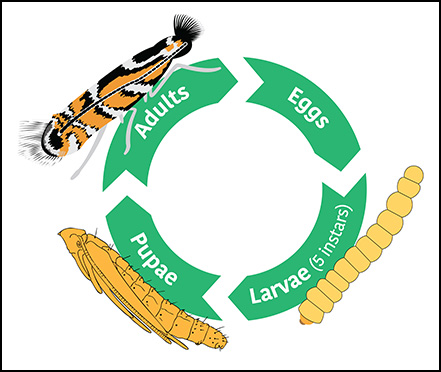
Macrosaccus morrisella adults are small moths (wingspan 6–7 mm) with orange, white, and gray-black wing markings (Figure 1). Eggs are deposited on the abaxial surface of leaves. Larvae (Figure 2) are whitecolored when young, turn pale-green in color when more mature, and reach approximately 4.7 mm long. Early instar larvae are sap-feeding, causing serpentine mines, which then expand into whitish blotch-like mines on the abaxial side of the leaves. Late instar larvae are tissue-feeding, and the whitish blotch eventually becomes tentiform. Multiple larvae can be found in the same mine. The larvae pupate inside the tentiform mines. Macrosaccus morrisella undergoes five larval instars, and laboratory studies indicate an immature developmental period from egg to adult emergence of approximately 25 days at 25 °C (Figure 3).
Damage
The potential damage that M. morrisella can cause to soybeans is still unknown. Injury is caused by the larval stage, which feeds within soybean leaves, hollowing out the tissue between the upper and lower epidermis to create serpentine tunnels that expand into white blotchy “tentiform” mines (Figure 4). These mines are typically most visible on the underside of leaves and are concentrated in the mid- to lower canopy. Feeding by M. morrisella reduces the photosynthetic area of soybean leaves. The larvae physically consume leaf tissue within the mine, and the remaining mined areas subsequently die, which can also reduce photosynthetic capacity.
Scouting and management
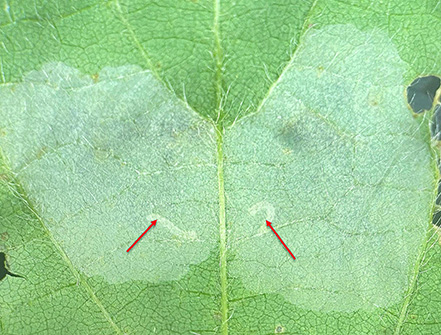
Scouting for soybean M. morrisella involves monitoring soybean fields, especially field edges bordering wooded areas. Look for the characteristic white, tentiform blotch mines on the undersides of leaves created by larval feeding within leaf tissue. Currently, there are no established economic thresholds for this pest. Therefore, defoliation threshold levels established for other soybean defoliators (30% in vegetative and 20% in reproductive stages) can serve as a reference. Management options are still being developed, but initial research shows that insecticides with translaminar properties can reduce M. morrisella populations and mined leaf area in field trials. Additionally, screening of soybean genotypes identified certain cultivars less suitable for oviposition or larval survival, suggesting potential for breeding resistance traits. Because this is a recently recognized soybean pest, ongoing research will refine scouting methods, thresholds, and management recommendations to minimize yield loss.
The author thanks Dr. Robert Koch for reviewing this publication.