Riley France and Peng Tian
Plant Diagnostic Clinic
Japanese pachysandra, also known as Japanese spurge, is a popular ornamental plant used as groundcover in shady areas. This fragrant-blooming plant can help reduce erosion and keep areas cool while enhancing their aesthetic appeal. However, as spring rains encourage their growth, the dense planting of this Pachysandra also encourages the growth of an unsightly pathogen – Volutella leaf blight.
Symptoms
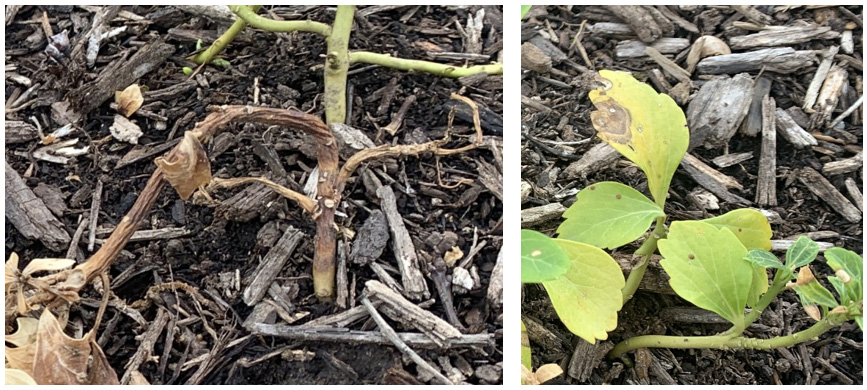
Volutella leaf blight infections start out mild and can go undetected for years. It manifests as tan to dark grayish, water-soaked lesions on both stems and leaves. As stem lesions age, they will dry and form dark, cracked cankers of dead tissue that cut off water and nutrients to the rest of the stem. Leaf lesions grow in size, developing irregular concentric rings. In particularly wet seasons or if the plant is experiencing other stresses, the severity of the infection can increase, resulting in dead patches in the stand.
Causal organism
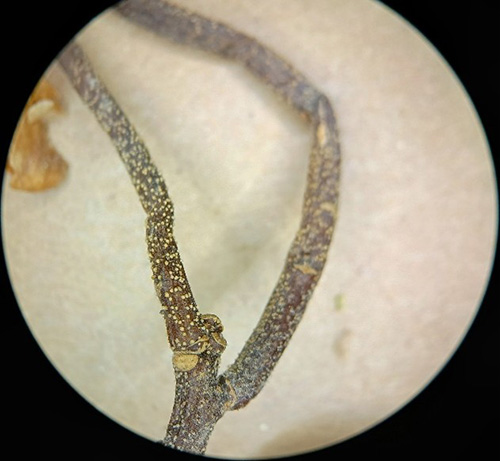
Volutella blight is caused by a fungal pathogen called Coccinonectria pachysandricola (anamorph Volutella pachysandricola). It favors humid and wet environments. As raindrops fall on infected stems and leaves, the water picks up spores and carries them to uninfected tissues by splashing or dripping water. The fungus overwinters in dead plant tissues. C. pachysandricola is also a capable saprophyte, meaning it can survive on dead plant tissues while waiting for an appropriate living host.
Notable host species
The host range for Volutella leaf blight caused by C. pachysandricola is relatively narrow. It affects the genera that contain spurge as well as sweet boxwood plants, both of which are planted as vegetative ornamentals.
Control practices
The best way to control Volutella leaf blight is to prevent its establishment in the first place. Do not plant too densely or in areas with too much sun or poor drainage. You may utilize preventative fungicides, such as copper hydroxide early in the season. Remove dead leaf debris when possible and cut back and thin out stands to increase airflow. Japanese pachysandra stands can also be replaced with similar plants such as Allegheny pachysandra, a similar-looking native that is resistant to Volutella blight, or wild ginger, an unrelated plant with large, kidney-shaped leaves.
In the case of active infection, prune, remove, and destroy blighted tissue while plants are dry. If an infection is beyond the scope of cultural controls, the plants can be cut back and all dead tissues removed from the plot to start fresh next growing season.
Sources
- “Volutella Blight.” Gina Muscato and Brian Hudelson. Wisconsin Horticulture, Marc 02, 2024. Accessed June 17, 2026.
- “Volutella Blight of Pachysandra : Landscape : Center for Agriculture, Food, and the Environment (CAFE) at UMass Amherst.” Angela Madeiras and Nicholas J. Brazee. February 12, 2026.