Peng Tian & Pierce Taylor
MU Plant Diagnostic Clinic
Oak Wilt is a fungal pathogen infecting oak trees, primarily of the Red Oak family. The causal agent is a fungus called Bretziella fagacearum that infects and kills oak trees in parks, woodlands, and residential areas across Missouri. Oak wilt was first detected in Wisconsin during the 1940’s and has since spread across the United States. Red oaks, trees with pointed leaf lobes, are affected more than white oaks, trees with round lobes. This pathogen is usually fatal to oak trees, with death occurring within the season following infection.
Symptoms and signs
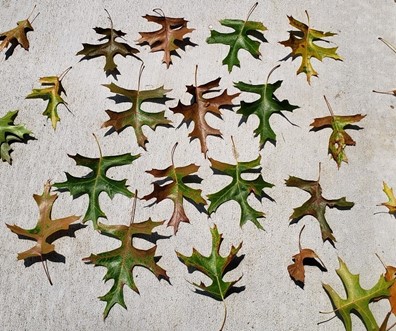
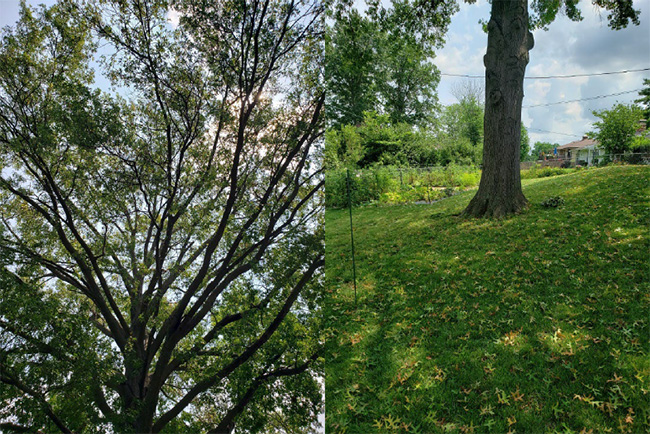
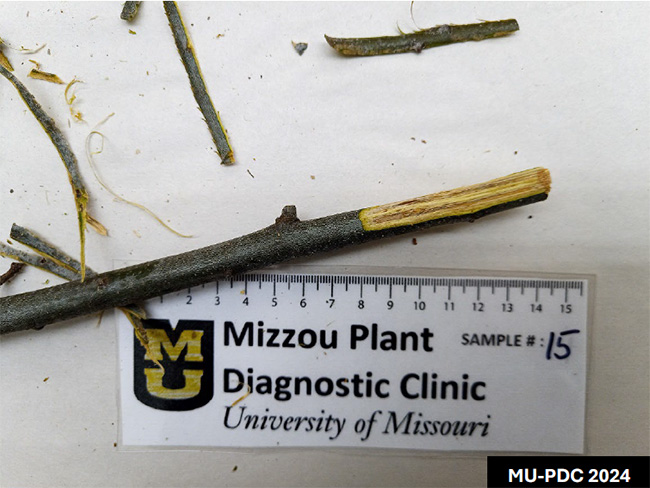
Oak wilt affects the vasculature of the tree, resulting in a timely decline. In Red oaks, symptoms generally appear in late spring or early summer and include sectional canopy dieback at the top of the tree and thinning of the entire canopy (Figure 2). As entire sections of branches die off, leaves begin curling and desiccating from the outside inward (Figure 1). Leaves die due to a lack of vasculature within the branches of the tree, and by the end of the summer most leaves will fall off (Figure 2). In branches affected by Oak Wilt, brown staining can be observed under the bark as shown above (Figure 3). In White Oaks, symptoms are generally milder. Flagging of the leaves occurs in scattered patches and leaves generally become light brown in color. White Oak trees may die after one year of infection, but it can take several seasons for the tree to slowly decline.
Causal agent
The fungus causing Oak Wilt is Bretziella fagacearum which feeds upon the vascular tissue of susceptible trees. The pathogen is spread by root grafts formed between healthy and infected trees in the same area, as well as by sap-feeding insects who carry the disease to healthy trees. Once a tree is infected, tyloses and gums begin to form within the vascular tissue of the trees. These tyloses are ballon-like structures that block the flow of water and nutrients to the leaves, leading to branch dieback and leaf wilting.
Diagnosis
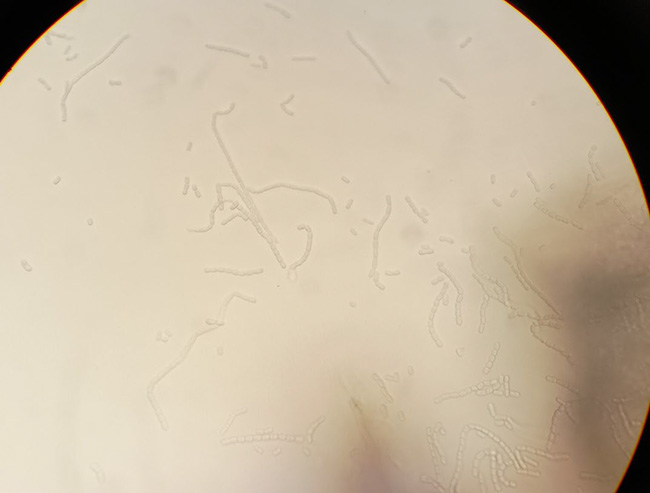
To see if a sample needs to be tested for Oak Wilt, a branch of current season sapwood 10-12 inches long and 1-3 inches in diameter can be collected from an area of the tree where dieback is occurring. Please use a sharp knife, carefully remove the bark and outer layers of the branch. If brown streaking, like the streaking shown below is observed, then the sample can be sent to the MU PDC the same day they are collected to confirm the presence of the Oak Wilt causal agent. Oak trees will discolor when they are cleared of bark, and the streaking should be present as soon as the bark is removed. If staining occurs after 20-30 minutes, it is not a symptom of Oak Wilt but a natural stress response to bark removal. B. Fagacearum is susceptible to high temperatures, so keep the sample cool while in transit. Ship samples overnight or next-day delivery at the begging of the week to allow for accurate diagnosis. Samples will be plated onto selective media at the MUPDC. It takes several days (7-10) for the fungus to produce fruiting bodies identifiable by microscopy, so expect one to two weeks for diagnosis (Figure 4). In the event diagnosis needs to be expedited (for tree removal or treatment), the MU PDC offers molecular diagnosis for an additional fee.
Disease management
There is no complete control or cure for Oak Wilt, but proper tree care, cultural, and chemical management practices can help to prevent the spread of the disease.
Cultural management practices
Avoid pruning trees in spring and early summer. The insect vectors that transmit oak wilt are attracted to open wounds, and these freshly cut branches can act as a pathway for the pathogen to enter the tree. In Missouri, April, May, June, and July are the months when insect vectors are most active. Prune in dormancy to avoid risk of infection by insect vectors, and if pruning cannot be avoided seal wounds with latex-based paints to prevent insect feeding.
Removal of diseased trees can be necessary to prevent the spread of the fungus by root grafting to trees nearby within the stand. It is prudent to assess the damages caused by near-by infected trees early to decide whether removal of the entire stand is necessary. Consult a trained arborist for removal and management practices near high-value trees. Trenching of the infected roots should be preformed shortly before or after removal of infected trees to lower the likelihood of disease transmission to healthy trees within the stand.
Chemical management
Fungicide injections with chemicals such as propiconazole can be used as a preventative measure to protect high-value healthy trees. Tree injections should be maintained regularly (every 12-18 months) by a trained arborist in trees deem susceptible to Oak Wilt. Some companies offer treatment by fungicide for infected trees, but the efficacy of these techniques is subjective and have not been studied clinically, so the results may vary. It is likely that fungicide applications to species of White Oaks would be more effective as their decline from Oak Wilt is not as rapid as is seen in trees within the Red Oak family.
Removal of infected trees
Infected trees should be removed promptly after diagnosis, and the roots of these trees should be trenched if they are near a stand of other high-value oak trees. This trenching will break potential root grafts, preventing nearby trees from infection. Trenching can be accomplished by chemical or mechanical means, whichever is more affordable and recommended by your arborist. The use of diseased trees for firewood is not recommended, as decaying material can be used by the fungus to propagate, leading to the dispersal of spores by insect hosts. If the tree is to be used as firewood, it is essential to debark, split and stack the wood to ensure rapid drying of the wood. Wood that has been debarked and stored in a dry place for more than 12 months will not become a source of infection.
References
- Oak Wilt in Eastern Forests, Penn State University Extension Program.
- Plant Clinic Fact Sheet: Oak Wilt, University of Illinois Urbana-Champaign, University of Illinois Plant Clinic.
- Oak Wilt, Iowa State University, Extension and Outreach.
- Oak Wilt, Wisconsin Department of Natural Resources.