How flooding, saturated soils affect crops
-
Image
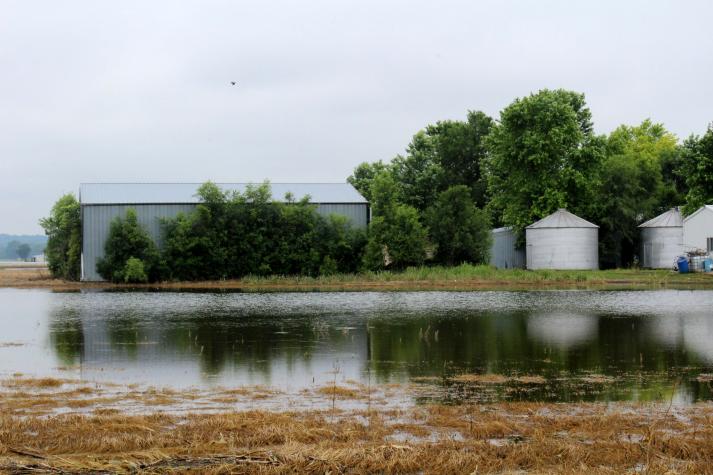 In this 2019 file photo, flooding in crop fields leaves behind debris and submerged plants that may die or suffer yield damage. Photo by Linda Geist.
 -
Image
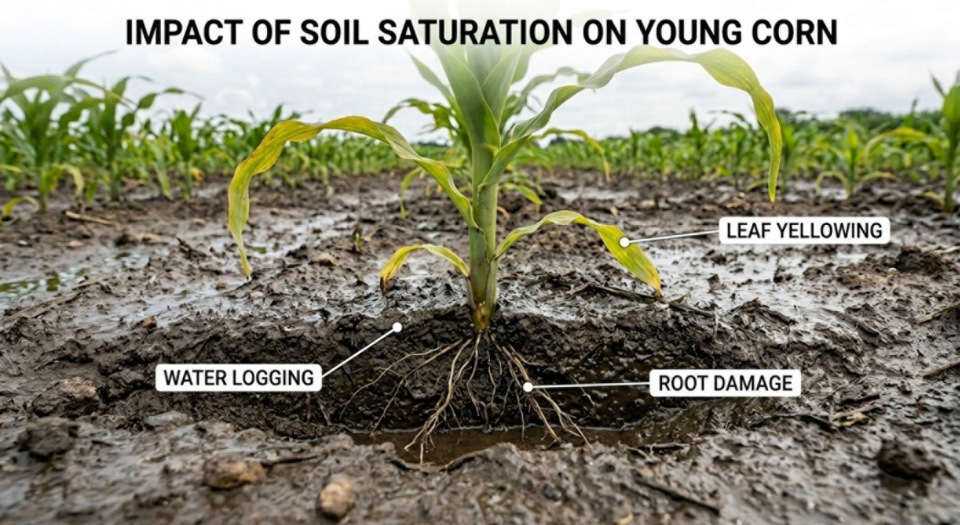
 Impact of soil saturation on young corn. Illustration courtesy of Gurbir Singh.
 -
Image
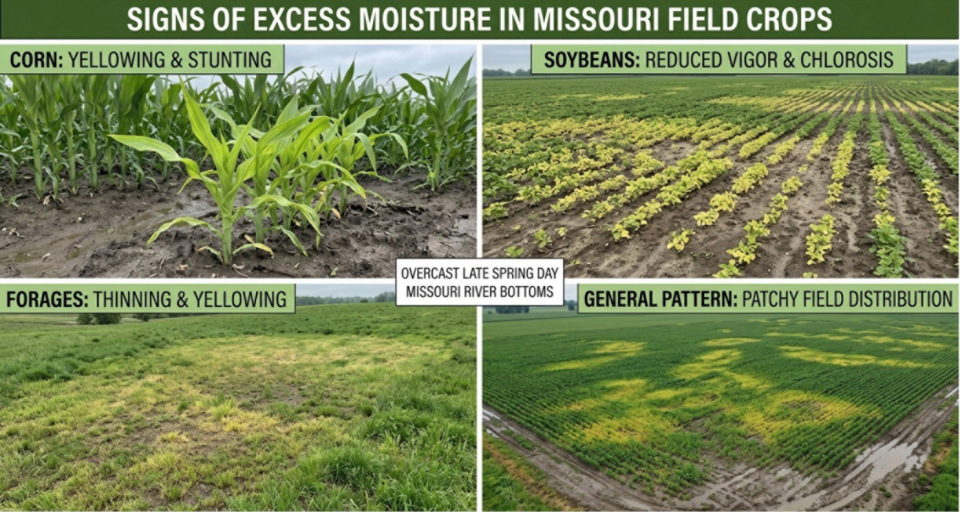
 Signs of excess moisture in Missouri field crops. Illustration courtesy of Gurbir Singh.
NOVELTY, Mo. – Heavy rainfall is becoming more frequent across Missouri, leaving producers dealing with saturated soils, ponded fields and flooding even before the 2026 growing season began.
Understanding how excess water affects crops—and what steps can help in the short and long term—can protect yield potential and improve field resilience, says University of Missouri Extension state soil science specialist Gurbir Singh.
Missouri corn and soybean growers are no strangers to excess moisture. According to the National Oceanic and Atmospheric Administration, Missouri experienced nine billion-dollar flooding disasters from 1980 to 2024, accounting for roughly 23%–27% of weather-related economic losses statewide. The frequency of these floods tripled from 2020 to 2024, increasing risk for agriculture.
Excess moisture delays planting and fieldwork. In wet years, Missouri farmers average two to three fewer suitable field days per week during peak planting, increasing replant risk and late-plant yield penalties.
Missouri soils drain slowly
Most Missouri soils—such as silt loams, silty clay loams and claypan soils—drain slowly. When soils stay saturated, air is pushed out and roots lose access to oxygen. This slows root growth and can lead to stunted plants or even plant death. Even after soils dry, damaged roots often struggle to take up water and nutrients, limiting recovery, says Singh.
Waterlogging often appears in patches due to restrictive soil layers (especially common in northeastern Missouri), low-lying areas, compaction from traffic or tillage, poor surface drainage and heavy residue from winter cover crops.
Flooding or waterlogging?
Flooding happens when all or part of a plant is underwater and may involve complete submergence or saturated soils. Waterlogging occurs when soils are saturated without standing water. In both cases, oxygen is limited, stressing plant roots.
Corn more sensitive to waterlogging
Corn is highly sensitive to waterlogging early in the season. Oxygen deprivation can occur within 24–48 hours, limiting root growth and nitrogen uptake. Prolonged flooding can reduce yield potential by 7%–20%, depending on growth stage and duration.
Soybeans generally tolerate short periods of saturation better than corn, but they still suffer yield losses under prolonged flooding. Heavy rainfall in 2025 led to delayed planting, poor stands and early-season stress across much of Missouri.
Research shows flooding can affect crops at all growth stages, but early growth stages are most vulnerable due to shallow root systems and limited energy reserves. The most critical stages include:
- Corn: VE–V6 (emergence to early vegetative)
- Soybean: Germination–V3
- Wheat: Early spring growth and tillering
Nitrogen loss
Saturated soils increase nitrogen loss through denitrification and leaching, particularly in poorly drained soils. Nitrogen is the most critical nutrient for corn and wheat production, says Singh.
After soils dry, producers should evaluate stands and soil conditions before applying supplemental nitrogen to corn. Rescue applications are most effective where plants survive and where a split nitrogen program was already used. Additional nitrogen may not be economical in single-application systems.
Symptoms to watch for
- Corn: Yellowing (especially lower leaves), stunted growth and purpling
- Soybean: Yellowing, reduced vigor, uneven stands, and leaf drop in severe cases
- Forages: Reduced growth, thinning and patch die-off
Symptoms often appear in patches that correspond to wetter parts of the field.
After excess moisture, watch for diseases favored by wet conditions. Soybeans may develop Pythium, Phytophthora and sudden death syndrome. Corn may be affected by Fusarium rots, crazy top (downy mildew), gray leaf spot or common smut. In wheat, prolonged wet weather increases the risk of Fusarium head blight, also called scab.
When it dries
Delay field operations until soils are fit to avoid compaction. Manage weeds promptly, as stressed crops are less competitive. Foliar nutrients may help where deficiencies appear. In fields with low erosion risk, interrow tillage can improve soil air exchange and support recovery.
MU Extension has resources for flood and drought.
Improving soil structure, drainage and organic matter increase infiltration and reduce the duration and impact of flooding. Diversified crop rotations and reduced compaction also improve root recovery under saturated conditions.
Images
Impact of soil saturation on young corn. Illustration courtesy of Gurbir Singh.
Signs of excess moisture in Missouri field crops. Illustration courtesy of Gurbir Singh.