-
Image
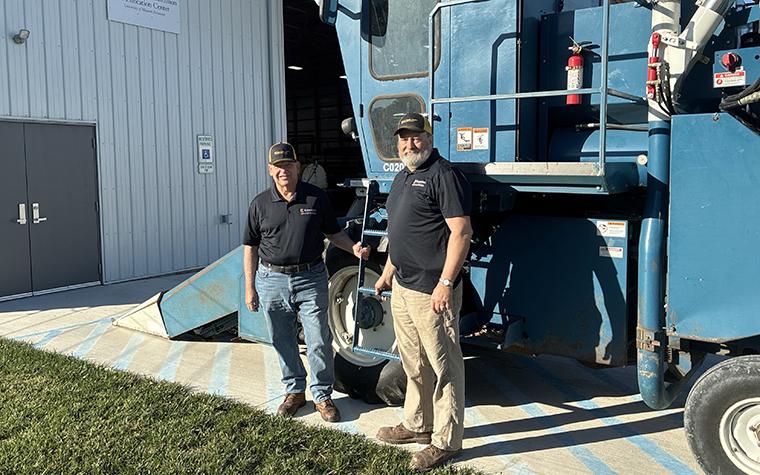 Graves-Chapple Center director Jim Crawford, right, and MU Extension agronomist Wayne Flanary in front of the center’s new plot combine. Photo courtesy of Jim Crawford.
 -
Image
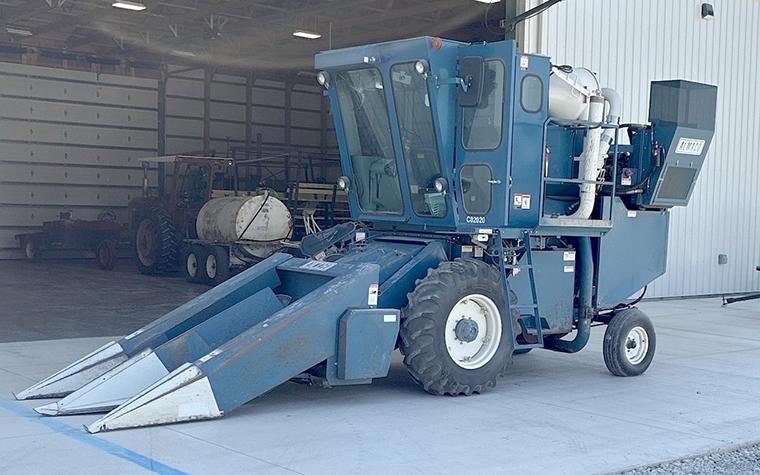 A new plot combine at the MU Graves-Chapple Extension and Education Center will provide greater precision and reliability in work on the center’s research and demonstration plots. Photo courtesy of Jim Crawford.
FAIRFAX, Mo. – At the Graves-Chapple Extension and Education Center near Rock Port, a refurbished combine is shaving hours off harvest time, detailed soil maps are helping researchers apply fertilizer more precisely, and even a new mower is freeing up staff time for more research and outreach.
The recent upgrades are helping the 200-acre University of Missouri research farm expand its capacity for agricultural research, demonstrations and educational programs. Ultimately, this will help farmers make smarter decisions about what they plant and how they manage their fields.
“We can work more efficiently, be more productive,” said Jim Crawford, director of the center. “It lets us do better research, more accuracy in the data we collect and the programs that we run. It also lets us increase the volume and the number of projects.”
A one-time $5 million boost in state funding to support MU Extension paid for much of the recent improvements. “We set aside part of that money to do some infrastructure development and capacity-building at our extension education centers around the state,” said Rob Kallenbach, MU Extension senior program director for Agriculture and Environment.
New combine cuts harvest time
Last fall, Graves-Chapple added a refurbished plot combine designed specifically for harvesting small research plots and collecting detailed yield data. The upgraded combine reduced harvest time for small research plots by roughly 60% last fall while improving the reliability and consistency of research data, Crawford said.
Unlike large commercial combines built to harvest fields as quickly as possible, plot combines are designed for precision research work. When researchers want to compare the performance of different seed varieties, fertilizer rates, planting methods or other variables, the combine allows them to measure yields plot by plot with greater accuracy.
The center replaced its 55-year-old combine with a refurbished plot combine for just under $200,000. Crawford said a similarly equipped new machine could cost more than $500,000. The combine was built by Iowa-based ALMACO, which specializes in agricultural research equipment.
Crawford said having a modern plot combine on-site also makes Graves-Chapple more attractive to MU researchers who otherwise might need to haul equipment several hours to northwestern Missouri.
“If I have somebody from campus say, ‘I’d really like to do a project up there, but I don’t want to bring a combine up,’ now we can say, ‘Let’s talk about it,’” Crawford said. “It really enhances the research and demonstrations and trials that we do here.”
Grid sampling guides smarter nutrient decisions
The funding also enabled Graves-Chapple to complete comprehensive grid soil sampling across the farm, allowing researchers and farm managers to apply fertilizer based on the specific nutrient needs of different parts of a field.
Rather than relying on a handful of composite soil samples from large sections of a field, the center sampled roughly one-acre blocks across the property. The data was used to create detailed nutrient maps showing how phosphorus, potassium and other soil characteristics vary throughout a field.
“Instead of going in and hoping that random sample was right and applying 100 pounds of phosphorus to every acre, there are parts of the field that need 100 pounds per acre and there are parts that need 20 pounds per acre,” Crawford said.
Crawford said the precision approach should reduce fertilizer costs over time by avoiding over-application in areas that do not need additional nutrients while ensuring other areas receive enough fertility support. The soil maps also help researchers avoid placing trials across areas with major differences in soil conditions that could skew results. In turn, this ensures the research will deliver reliable guidance for farmers.
Decades of data inform farming practices
Located near Rock Port at the toe slope of the Loess Hills, Graves-Chapple focuses on research and teaching related to crop production, conservation tillage, soil health and water quality in the unique soils and climate conditions of extreme northwest Missouri. The center hosts projects involving corn, soybeans, forage systems, fertilizer management, seed treatments, planting practices and precision agriculture technologies.
The center also contains some of the region’s longest-running continuous no-till research plots, providing researchers with decades of soil health data.
“You don’t just go out and toss some stuff on and suddenly have healthy soil,” said Rob Kallenbach. “It takes decades to develop that.”
Long-term studies like these offer farmers with real-world evidence on how management decisions affect soil health and profitability over time.
Additional recent improvements at Graves-Chapple include a utility vehicle trailer, mowing equipment and upgraded seating for field days and educational events. Crawford said many of the purchases are relatively modest but make a noticeable difference in day-to-day operations.
A new finishing mower, for example, cuts several hours off mowing time, while a utility vehicle trailer allows staff to move equipment more efficiently between fields separated by Interstate 29.
The center also hosts educational programs for producers, agricultural professionals and students, giving farmers direct access to the latest research findings and management strategies they can apply on their operations.
Graves-Chapple Field Day set for Aug. 25
The 37th annual Graves-Chapple Field Day, 7:30 a.m.-noon Tuesday, Aug. 25, will offer tours and demonstrations on research conducted at the center. Presenters from MU and around the state will provide information on fertility, weeds, fungicides, variety selection and other topics important to growers to help them maintain their profitability. Presenters will discuss some of the latest trends in agricultural technology.