Households aged 65 and older have seen strong growth in net worth.
-
Image
 Adobe stock photo.
 -
Image
COLUMBIA, Mo. – Older Americans today generally have more wealth than previous generations, giving many retirees the ability to keep spending, investing and supporting local economies long after leaving the workforce, according to a new Missouri Economy Indicators brief from University of Missouri Extension.
The brief, Wealth and Migration Among Older Households, examines trends among older Americans and what those trends could mean for Missouri communities.
While rising prices and healthcare costs can reduce purchasing power, households led by adults age 65 and older have seen substantial gains in wealth over the past several decades, said Alan Spell, MU Extension assistant extension professor, who co-authored the report with MU Extension specialist Luke Dietterle.
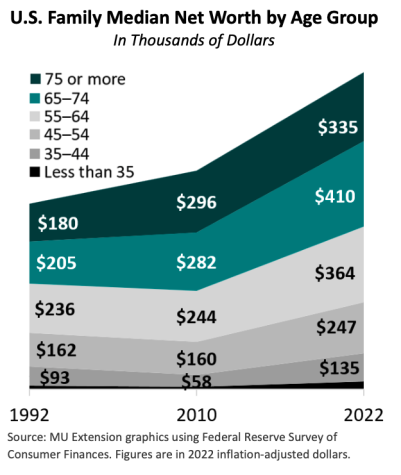
In 2022, the median net worth of households age 65 and older was about twice what it was in 1992 after adjusting for inflation. Since 2010, net worth has increased across all age groups, though younger families have not seen gains comparable to households 65 and older, Spell says.
“Since 2010, net worth has increased across all age groups, but rising home values and retirement assets have helped older households accumulate significantly more wealth than previous generations,” Spell and Dietterle write.
This growing wealth means many retirees remain an important economic force in their communities, Spell says. In some cases, older adults who sell homes in higher-cost areas and relocate to more affordable communities can bring significant purchasing power with them.
Missouri could have an edge in attracting some of those retirees because of its relatively low cost of living. According to the brief, rural communities near larger metropolitan areas could be especially appealing to older adults seeking lower costs while remaining close to family, friends and services.
“Greater wealth allows many older households to continue spending significantly in their local communities even into retirement,” the report states. “Attracting older residents can benefit local businesses and economic growth, but communities also need accessible housing, quality health care and other amenities to meet the needs of an aging population.”
The report also found older adults make up a larger share of nonmetro Missouri’s population, and recent migration patterns suggest that share may continue to grow. Recreation-dependent counties have emerged as especially strong magnets for older migrants.
The Missouri Economy Indicators series, which is produced by MU Extension’s Exceed – Regional Economic and Entrepreneurial Development program, explores economic, demographic and workforce trends affecting Missouri communities.
You can explore these trends in greater detail in the Missouri Map Room on MU Extension’s All Things Missouri, a free online platform designed to support decision-makers in accessing, analyzing, and visualizing data about their communities.