-
Image
 Adobe stock photo
Joshua Shaw is an MU Extension field specialist in agronomy serving the counties of Vernon, Bates, Cedar, Cass, St. Clair and Jackson.
NEVADA, Mo. – With the earlier corn harvest and the moisture we have received there have been several calls about grazing volunteer corn. Concerns have been nitrate, quality of forage, and fertility removal.
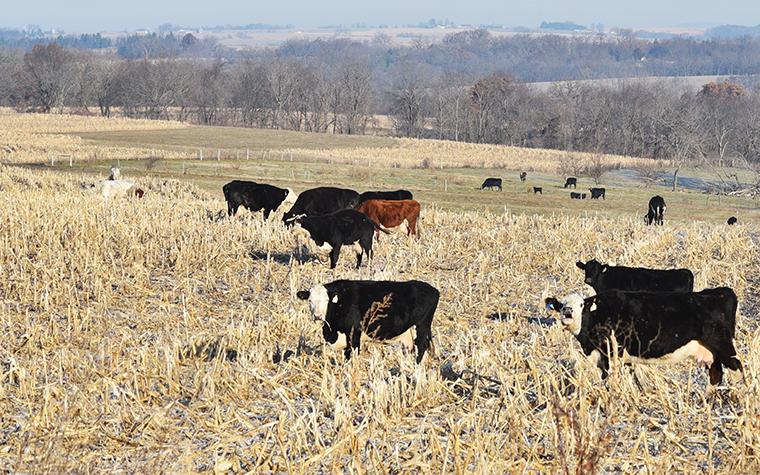
Grazing corn stalks is a good way to clean up residue from corn harvest. One bushel of corn there is up to 6 pounds of cobs, 18 pounds of stems and 15 pounds of husks. That means on 150 bushels corn field average there could be almost 6,000 pounds of dry matter per acre left in the field. The husk, cob and stalk will only average 4% protein, but the leaf and grain will average 9% protein. In comparison, fescue hays average 8% protein. Corn stalks are an inexpensive and beneficial forage to stretch our hay.
Nitrate had been the biggest concern on farmers’ minds with volunteer corn. Nitrate builds up in the plant when the plant cannot convert the nitrate into protein. That can happen for many reasons, such as excess nitrogen application, cold weather or drought conditions. When rain takes the plant out of drought stress, it takes two weeks to return the plant to nitrate levels safe for consumption.
The safest way to see if your corn plant is safe for your livestock is to run a test on the stalk. To run a test, you will need to harvest 10-20 corn stalks. Leave the bottom 6 inches of stalk closest to the ground and collect the next 6-8 inches. After harvesting the stalks, bundle them in a plastic bag and bring them to your local MU Extension center to be sent off for testing. The test will show us how much nitrogen is in the plant.
Nitrogen levels break into four classes: “Safe” can be feed at 100% diet. “Caution” can cause problems with pregnancy and young livestock. This should not exceed 50% of diet. “Danger” should not be fed more than 25% of the animal’s diet. The last is “toxic,” which should not be fed under any circumstances.
The last concern is remembering how much fertilizer is in the plant we are taking off. Actual units of fertilizer in one bushel of corn takes off 0.9 nitrogen, 0.45 phosphorus and 0.30 potassium. Corn silage takes off in actual units of fertilizer per ton: 9 nitrogen, 3.6 phosphorus and 9 potassium. Every animal takes different nutrients from the forage they are eating, but we lose over 50% of that fertility in the production of livestock. Before we open the gates, we need to make sure we are willing to put back the fertility that animal is taking off that acre.
Related publications and articles
- Nitrate Problems in Livestock Feed and Water
- Corn Residue: Cheap Grazing for Cattle
- Beef Cow Nutrition Through the Year: Managing for Efficient Reproduction
Related video
If you have questions on these topics, contact me at jtshaw@missouri.edu, call the Vernon County MU Extension Center at 417-448-2560, or contact your local MU Extension center.
Source: Buchholz, D.D., 1983. Soil Test Interpretation and Recommendations Handbook, MU Department of Agronomy.