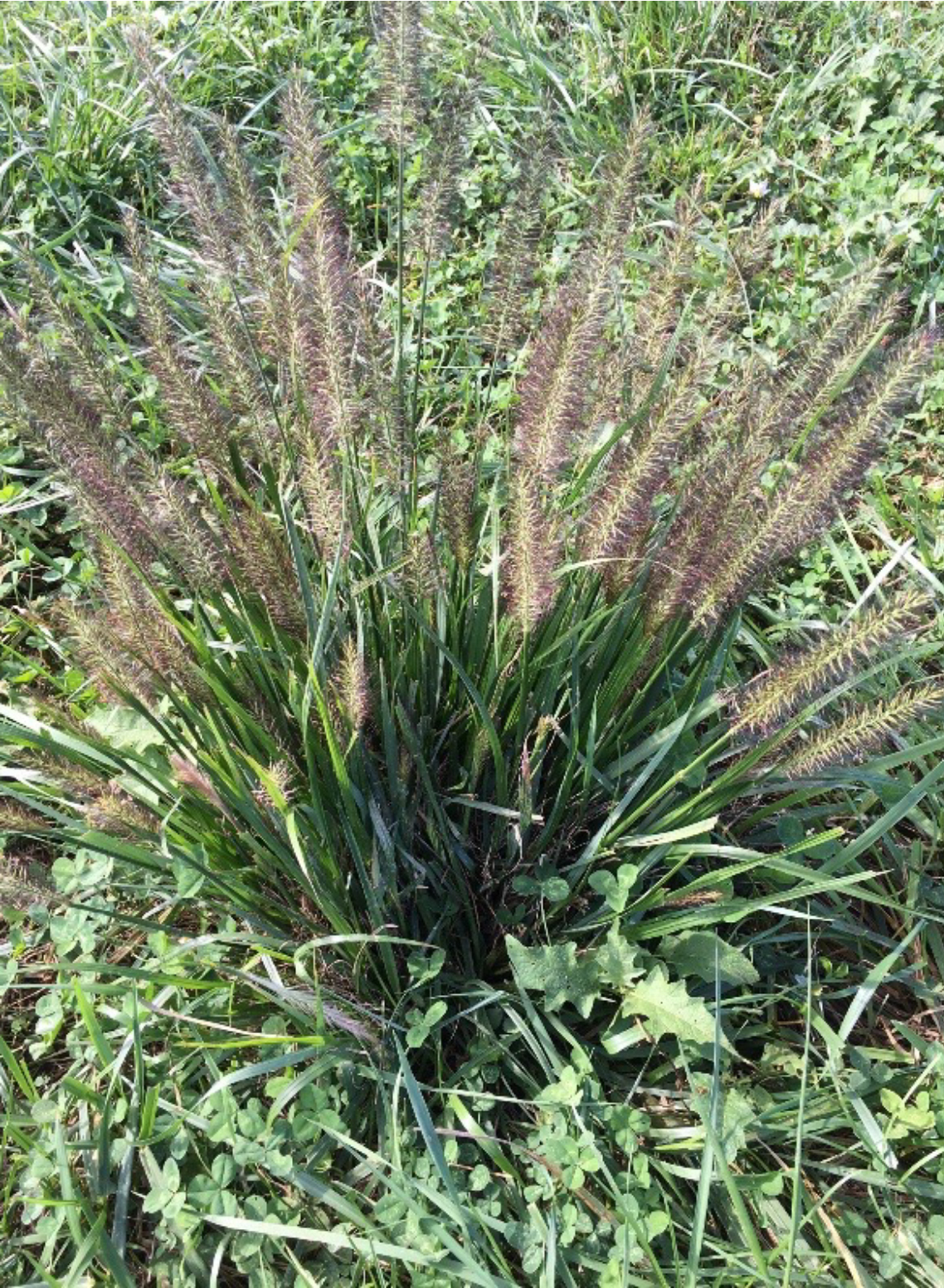
Purple seed head is most visible in October.
-
Image
 Chinese fountain grass in a tall fescue pasture. University of Missouri photo.
JACKSON, Mo. – Over the past 10 years, University of Missouri Extension specialists across the state have received calls about grass with purple bottlebrush seed heads spreading across pasture and hayfields, says MU Extension agronomy field specialist Anthony Ohmes.
MU Extension specialists including horticulturist David Trinklein and weed scientist Kevin Bradley have identified the species of grass as Chinese fountain grass, Cenchrus alopecuroides (formerly Pennisetum alopecuroides).
Bradley says the grass appears to be a growing problem in other states as well. He has received calls about the invasive grass from weed scientists and agronomists in Arkansas, Tennessee, Illinois, Kentucky and Virginia.
In 2019, Bradley published an article that provides detailed information about how to identify the invasive grass.
Unlike ornamental cultivars that have a high degree of sterility, Chinese fountain grass produces viable seed that spreads across Missouri pasture and hayfields each year.
The key identifying feature is the purple bottlebrush seed head easily identified in October. The seed awns stick to animal fur and clothing. The lightweight seed can move short distances by wind. It also will hitch a ride on equipment such as mowers and balers.
Chinese fountain grass is a perennial with a fibrous root system and short rhizomes, Ohmes says.
Livestock avoid grazing its tough, waxy leaves and stems. Mowing provides little to no control, only offering limited seed head suppression. Mowing typically results in a shredded plant that will continue to produce a seed head below mowing height.
MU Extension has offered consistent recommendations on how to manage Chinese fountain grass since publishing the 2017 research:
- First, scout your pasture fields in October for the purple bottlebrush seed heads.
- Avoid mowing or baling to reduce seed spread.
- For a single plant or a few scattered plants, consider mechanical removal of the entire plant with rootstock.
Bradley’s research trials show that broadcast or spot spraying glyphosate has provided good control. Quinclorac (Facet L) can also provide good control as a spot spray treatment. “Unfortunately, by the time it can be seen and reported, stands of this grass are often too dense and thick to do spot spraying logistically,” says Bradley.
Ohmes recommends spot spraying in the fall up to a week before a killing frost with an application of glyphosate. If numerous spots exist, consider using spray grade dye to mark and identify what has been sprayed, he says.
If the field is taken over with no underlying grazable forage, consider a broadcast application and complete renovation of the field, says Ohmes.
Seeds are viable for several years, so Ohmes recommends marking locations in the field for next season’s monitoring and management.
Photo
Chinese fountain grass in a tall fescue pasture. University of Missouri photo.