-
Image
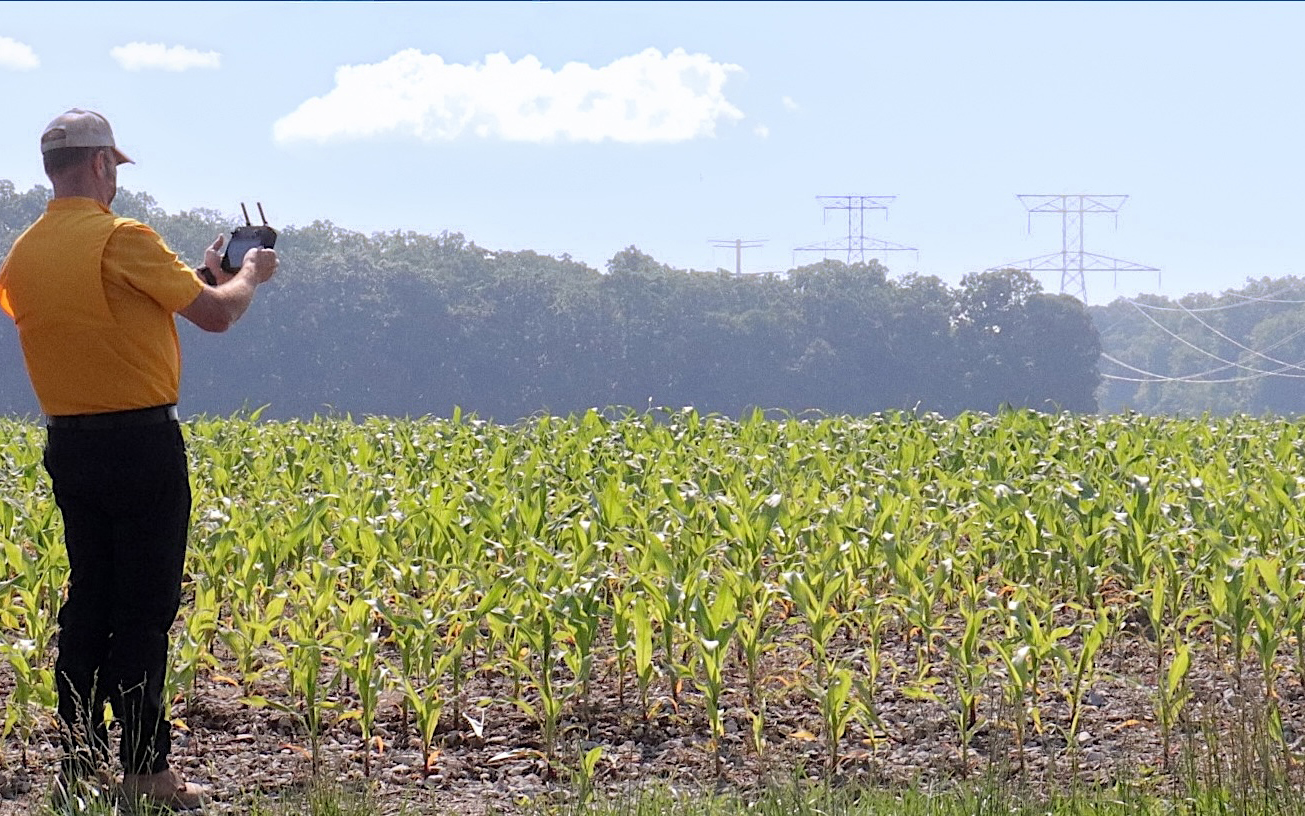
 Rusty Lee, MU Extension field specialist in agricultural systems technology, used AI and drone technology last season to diagnose irregular corn stands caused by a malfunctioning toolbar on a producer’s anhydrous ammonia applicator. Photo by Linda Geist.
MONTGOMERY CITY, Mo. – Rusty Lee, a University of Missouri Extension agricultural systems technology specialist, used artificial intelligence and drone technology last season to diagnose irregular corn stands.
The problem was caused by a malfunctioning toolbar on a Montgomery County producer’s fertilizer applicator. When the corn reached the V-5 stage, the producer observed problems across the field. An inspection of the equipment, combined with visible stretches of pale, weakened plants, confirmed large patches of nitrogen-deficient plants. Realizing the damage likely extended throughout several plots, he contacted MU Extension for assistance.
Lee, who has taught drone operation statewide over the past year, saw the situation as an opportunity to show how drones can help diagnose early-season stress in corn. He flew the drone over the 73 acres of corn, using multispectral imagery to identify yellowed, nitrogen-deficient areas. The images were stitched together, creating a map to guide rescue applications of nitrogen, which kept yields close to normal in affected areas.
Before adopting drone technology, farmers would have trouble pinpointing where nitrogen application was lacking. Mapped data allows producers to apply nitrogen to chlorophyll-deficient corn only where needed, saving money on fertilizer and labor, protecting the environment and helping the crop regain lost yield potential.
MU Extension research shows that nitrogen benefits corn yields at any time it is applied before tassel. In the test areas where no rescue nitrogen was applied, yields were diminished.
Lee says the outcome underscores the value of early assessment and precision agriculture as tools for improving yield and profitability. In the past four years, technology has advanced to allow farmers to measure fertilizer need and apply at variable rates even within the same field.
Previously, farmers relied on hand-held sensors, which was time-consuming, labor-intensive and not very accurate. They also could use chemical analysis in a lab, which was expensive. Neither would have been practical for the large-scale application in most operations, says Lee.
Lee’s on-farm work coincides with an MU study led by Fengkai Tian, a Mizzou doctoral student who works in the lab of Jianfeng Zhou, an associate professor in the College of Agriculture, Food and Natural Resources. Zhou’s research team includes experts in statistics, computer science, artificial intelligence, mechanical engineering and plant sciences. Zhou also serves as a co-director at Mizzou’s Digital Agriculture Research and Extension Center.
Estimating Corn Leaf Chlorophyll Content Using Airborne Multispectral Imagery and Machine Learning was published in Smart Agricultural Technology in March 2025. The study was a collaboration between Mizzou and the Agricultural Research Service, the chief scientific research agency for the United States Department of Agriculture.
Related story: Drones can more efficiently measure the health of corn plants, study finds
Drone training offered by MU Extension is made possible by a grant from the Missouri Department of Higher Education and Workforce Development through the College of Agriculture, Food and Natural Resource, the Digital Agriculture Research and Extension Center and MU Extension. Jay Chism, director of the Southwest Research, Extension and Education Center, spearheads the program.
Photo
Rusty Lee, MU Extension field specialist in agricultural systems technology, used AI and drone technology last season to diagnose irregular corn stands caused by a malfunctioning toolbar on a producer’s anhydrous ammonia applicator. Photo by Linda Geist.