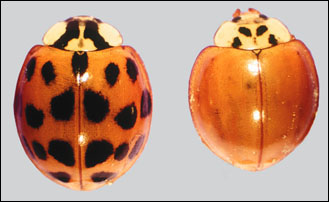
 Figure 1
The multicolored Asian lady beetle varies greatly in color and pattern. It can have anywhere from 0-21 spots, but most commonly has 19.
Throughout much of the country, the multicolored Asian lady beetle (Harmonia axyridis) has become an unwanted houseguest, especially during the spring and fall months. Adult individuals can be quite diverse in size, color, and spotting. They are usually about one-quarter inch long, oval in shape and about four-fifths as wide as they are long. The color of the wing covers (the domelike shell over most of the body) can range from beige to yellow to yellowish orange to bright reddish orange; a few individuals may even appear mostly black. They are adorned with anywhere from 0 to 21 black spots, but 19 is most commonly seen (Figure 1). The area just behind the head and in front of the wing covers is white with a black M-shaped mark.
From 1916 to the late 1970s, scientists attempted to introduce this species to agricultural areas throughout the United States and Canada because of its great value as a biological control agent. The first individuals were found in Missouri in 1979. The Asian lady beetle is a very beneficial insect during the growing season because both the larval and adult stages feed on aphids, mealybugs, scale and other soft-bodied insects that infest many important crops and plants.
Why are they in houses?
During October and November, the adult beetles seek out protective sites and congregate at these locations to spend the winter in clusters. They are in diapause, a state of paused growth and low activity, while overwintering. In their native home of eastern Asia (including China, Japan, Mongolia, and southern Siberia), these beetles are attracted to vertical surfaces and enter diapause together in the mountains. Unfortunately, the vertical symmetry of houses and other buildings appears to attract the beetles as suitable overwintering areas where mountains are unavailable, and they often congregate on a home's outside walls, windows, doors or porch decks that are light-colored and have a south or southwest exposure.
The beetles will enter buildings through poorly fitting window screens and doors, crevices, and vents. They tend to overwinter in dark, undisturbed areas such as attics and wall voids. In March and April when temperatures become warmer and the days are longer, the beetles will try to move outside in search of food. They are most likely to be seen inside homes in the months before and after diapause.
Are they harmful?
Multicolored Asian lady beetles do not sting, carry human diseases, or bite (although folks will report feeling light nibbles in rare cases). They’re also not known to feed on wood, clothing, or human food, and they do not reproduce indoors during the winter months. However, their presence on walls and ceilings is often unwelcome. There is also a small chance for humans to develop seasonal allergies to the compounds emanating off the beetles in their homes.
It should also be noted that these beetles may release a unpleasant-smelling liquid when handled or crushed which can stain walls and fabrics. Using a vacuum cleaner to collect the beetles can help avoid such problems.
Control
The best way to prevent home invasion by Asian lady beetles in the fall is to block their entry into the structure. This can be done by sealing all outside cracks and crevices around doors, windows, siding, utility pipes and other openings with a good quality silicone or silicone-latex caulk. Window screens should not have any tears and should fit snugly inside the window frame. Install insect screening over attic and exhaust vents.
Inside the home, the beetles can be easily vacuumed or swept up in a dustpan and released outside, preferably in a sheltered spot well away from the house. If you vacuum up large numbers of beetles, empty the bag relatively soon afterward. The beetles will die within a day or so and, if not removed, may impart a permanent odor that will be noticeable each time the vacuum cleaner is started for several weeks or months afterward.
References
Chapin, J. B., & Brou, V. A. (1991). Harmonia axyridis (Pallas), the third species of the genus to be found in the United States (Coleoptera: Coccinellidae). Proc. Entomol. Soc. Wash, 93(3), 630-635.
De Quattro, J. (1995, March). Gotcha!: Tiny lady beetles have big biocontrol potential. Agricultural Research, 43(3), 4-8.
GBIF Secretariat. (2023). Harmonia axyridis (Pallas, 1773). GBIF Backbone Taxonomy.
Gordon, R. D. (1985). The Coccinellidae (Coleoptera) of America North of Mexico. Journal of the New York Entomological Society, 93(1), i–912.
[Harmonia axyridis specimens collected by R.A. McKinney]. (1979). Enns Entomology Museum (Coleoptera Polyphaga Coccinellidae, Box 11), University of Missouri, Columbia, MO, United States.
Koch R. L. (2003). The multicolored Asian lady beetle, Harmonia axyridis: A review of its biology, uses in biological control, and non-target impacts. Journal of Insect Science, 3(32).
Nakazawa, T., Satinover, S.M., Naccara, L., Goddard, L., Dragulev, B.P., Peters, E., & Platts-Mills, T. A.E. (2007). Asian ladybugs (Harmonia axyridis): A new seasonal indoor allergen. The Journal of Allergy and Clinical Immunology, 119(2), 421-427.
Nendick-Mason, H., Moisset, B., McLeod, R., Quinn, M., Moyer, T., M, G., M, R., Haines, R. D., Parker, H. S., Bailey, J., Parker, A., KenW, & September, B. L. (2021). Species Harmonia axyridis—Asian lady beetle.
Sloggett, J.J., Magro, A., Verheggen, F.J., Hemptinne, J., Hutchison, W.D., & Riddick, E.W. (2011). The chemical ecology of Harmonia axyridis. BioControl, 56, 643–661.
Tedders, W. L. & Schaefer, P. W. (1994). Release and establishment of Harmonia axyridis (Coleoptera: Coccinellidae) in the southeastern United States. Entomological News, 105(4), 228-243.