The fall armyworm, Spodoptera frugiperda (Smith) (Lepidoptera: Noctuidae), is native to the Americas and can cause severe damage to Missouri hayfields, pastures, and alfalfa. Fall armyworm does not overwinter in Missouri. Annual infestations result from northward migration of adults originating from overwintering populations along the Gulf Coast. Under favorable conditions, rapid larval development and overlapping generations can lead to significant defoliation.
Description and biology
This species is highly polyphagous and has been documented feeding on more than 300 plant species. Hosts of importance in Missouri include tall fescue, bermudagrass, crabgrass, orchardgrass, sorghum sudangrass, smooth bromegrass, ryegrass, pearl millet, sorghum, and alfalfa. Actively growing pastures, particularly during late summer are attractive oviposition sites. In Missouri, fall armyworm moths usually arrive in late June and early July.

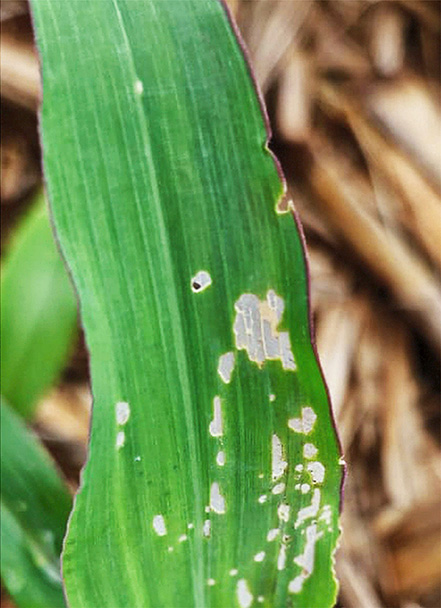
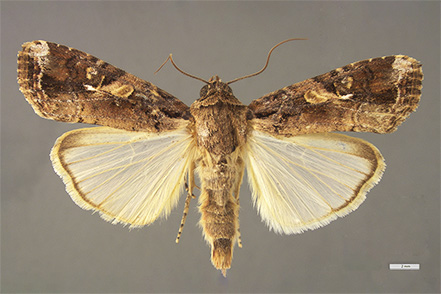
Adult moths are gray to mottled brown with a 1½-inch wingspan. Their forewings are gray to dark brown, while hindwings are silver-white with a narrow dark border (Figure 1). Eggs are tiny (less than 1/32 inch) and laid in masses covered with a fuzzy, grayish coating of moth scales. Egg masses can vary in color from grey, brown, white/cream, to even pale green/blue. A single female can lay approximately 1,500 eggs during its lifetime. With warmer weather, eggs hatch in two to five days. Newly emerged larvae feed on the underside of the leaves, resulting in small, whitish or translucent “windowpane” lesions before larvae disperse and begin consuming larger amounts of plant tissue. Fall armyworm larvae pass through six instars before pupation, and most of the leaf consumption occurs in the last larval stages. Fully grown larvae burrow into soil to pupate. If conditions are favorable, moths will emerge, mate, and start a new generation.
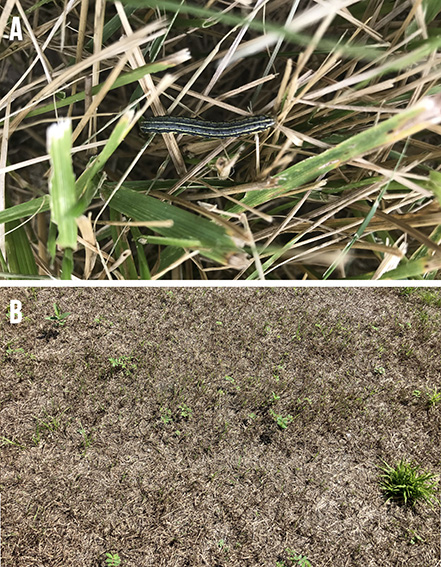
Larva color varies from light green to tan, brown, or nearly black. Two key larval identification features are a distinct inverted white “Y” on the head and four dark spots arranged in a square on the second-to-last abdominal segment (Figure 2). These characteristics are most evident in fourth instar and older larvae.
It takes about 30 days for the fall armyworm to complete one generation, but development rates can vary depending on environmental conditions. Because this insect cannot survive Missouri winters, infestations depend on annual migration. Outbreak severity varies with migration timing, temperature, and forage availability. Warm late summers can favor multiple generations and increase the risk of damage to pastures.
Damage to pastures
Small larvae feeding results in a “windowpane” in grass blades (Figure 3), while larger larvae eat entire leaves and stems. Heavy infestations leave fields with a drought-stressed or brown appearance. Severe infestations may remove nearly all green growth, especially in new or thin stands, reducing yield and possibly killing seedlings (Figure 4).
Scouting and treatment thresholds
Begin scouting in late June or early July and continue through September or early October, examining several areas in each field. Growers are advised to scout fields early in the morning or late in the evening, when larvae are most active. Use a one-square-foot sample frame (e.g., wire hoop) to count larvae. Treat when two to three or more larvae per square foot are present.
Insecticides work best when larvae are ½ inch-long or smaller. Large larvae near pupation are harder to control. Fall armyworm populations from the southern United States have evolved resistance to pyrethroids, diamides, and growth regulator insecticides. Although it has not yet been confirmed in Missouri, fall armyworm infestations originate from these southern populations each year, and producers should not rely on a single mode of action. Other management options include harvesting hay or grazing heavily infested fields, followed by an insecticide application if fall armyworms are still prevalent. The decision on whether to spray an insecticide, harvest, or graze depends on the forage, the height of the forage, and the resources available.
The author thanks Dr. Andie Miller for reviewing this publication.