Purpose
Use this guide to improve your knowledge and application of the Missouri Sunshine Law. This document identifies the types of boards subject to the law. It further helps public boards understand the requirements for meetings, records, notices, and policy.
How to use this guide sheet
- Read the complete guide.
- Check out the link to the closed meeting exceptions.
- Evaluate your board’s operations using this guide as they pertain to meetings, records, notices, and policy.
Introduction
The Missouri Sunshine Law was established to promote transparency in government. It is essential for public boards and quasi-public boards along with their employees to understand the application of the law as it pertains to meetings, records, meeting notices, policy, and record requests. The law was established in August of 1973 and has had many revisions.
The law and who it covers
The Missouri Sunshine Law is about openness in government. Meetings, records, votes, actions, and deliberations of a public governmental body are open to the public unless otherwise provided by law.
This encompasses any meeting at which public business is discussed or decided. So, what is public business? All matters related to a public body’s functions or the conduct of its business and includes subsets of the public body such as committees. The conduction of this business can be in various forms of communication including phone conferences, Internet discussions and emails.
Who is considered a public governmental body?
All state and local government bodies including entities formed under state statute. Specific types of entities:
- State departments, state boards and commissions, city Councils, county commissions
- School boards
- Special districts: such as fire, townships, and ambulance
- Subcommittees and advisory boards
- “Quasi-public” bodies
- Private entities that contract with public bodies or perform services
There is sometimes confusion that nonprofits in general are required to also follow the Missouri Sunshine Law. While this is not required for many nonprofits, it is required for those who take public funds. The nonprofit could receive these funds through sources such as grants, contracts, or tax revenue.
Meetings
What determines if a meeting is open or closed?
The Sunshine Law does not require a closed meeting for any business. However, it does provide specific exceptions under which you can close meetings to the public. Confidentiality should be the primary consideration when closing a meeting. There are currently 29 exceptions to the law which allow for a closed meeting. See Missouri Revisor of Statues for exceptions.
How is a closed meeting conducted?
Closed meetings may be conducted as a stand-alone meeting, or as a portion of an open meeting. A board member can motion to close a meeting and if there is a second to that motion then a roll call vote must be taken. A vote to go into a closed session must be a roll call vote with names included. Likewise, a vote to come out of closed session is done the same way. Votes taken in closed session must also be roll call votes. The meeting notice must have identified the exception for which the meeting could be closed. The meeting must be announced in advance at an open meeting. Members can object to closure of a meeting, and still vote in closed session.
What might an open meeting look like?
Meetings of a public body must be reasonably accessible to the public. The location must be large enough to accommodate anticipated attendance, or location can be moved if issues arise such as an unusually large crowd or if the location becomes unsuitable such as if the furnace goes out. If the meeting is in some other format like teleconference or Internet, designate a location where the public can join.
It does include luncheon meetings as determined by The Kansas City Star v. Shields, 771 S.W.2d 101 (Mo. App. 1989). Also included are any electronic (e-mail, text or otherwise) votes or decisions in lieu of holding a public meeting.
Open meetings do NOT include an informal gathering of members of a public governmental body for ministerial or social purposes, however, no board business should be conducted at these social gatherings.
Meeting notices
Notice of a public entity’s meeting should be posted at their main office. If no office exists, post at meeting location. Post notice on website and Facebook if meeting is to be conducted via the computer. The meeting notice should be posted at least 24 hours in advance of meeting. This is 24 business hours so weekends and holidays do not count. In the case of the rare emergency meeting, less than 24 hours’ notice can be given so long as there is good cause which must be stated in the minutes.
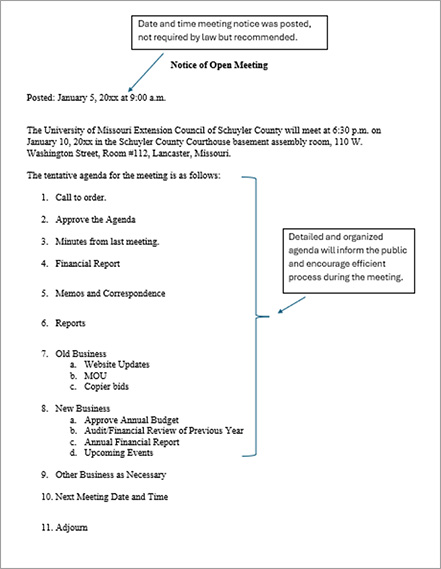
How do open and closed meeting notices compare? Both require:
- Date and time of meeting
- Place of meeting
- Tentative agenda
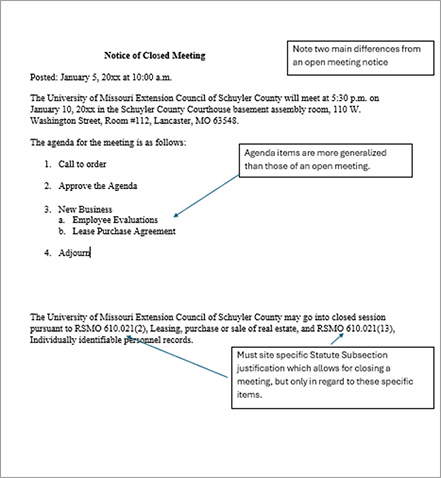
There are two basic differences in the open and closed meeting notices. First, the agenda items for the open meeting notice should be more detailed. The agenda item(s) for a closed meeting can be more general due to the confidential nature of the business. For example, instead of stating ”Discussion of Lease Purchase agreement with city of XXX for property located at 225 North Campbell Street” you would simply put “Discussion of Lease Purchase Agreement”.
The second, more critical component for a closed meeting notice is the reference to the specific provision of law listed in Section 610.021, that allows the meeting to be closed. For instance, if hiring, firing, disciplining or promoting personnel then Section 610.021.3 would be cited. No other topics could be discussed in closed session unless that provision was also cited.
It is recommended, though not required by law, to add the date when the meeting notice was posted and the initials of who posted it.
Records
What minutes are required?
Minutes of open and closed meetings must include:
- Date and time of meeting
- Place of meeting
- Members present and absent
- Record of votes taken
Records that are open to the public Include minutes and records of public bodies, along with any documents used to conduct the meeting or make decisions. Meeting minutes are the official written record that captures key decisions, action items, and discussions from any meeting, turning conversations into accountability. They serve as the single source of truth for what happened, who's responsible, and what comes next.
In addition, any record retained by a public body, and emails from a member to a quorum of a public body which require a copy be sent to the custodian.
Written policy
Every entity subject to the Missouri Sunshine Law needs a written Sunshine Law policy. This policy should contain the name and detailed contact information for the custodian of records; the entity name; fees charged for copying records; and procedures allowing for public recording of meetings.
Two additional items that are not required in the policy, but facilitate effective operations in this regard, include a records request form and record retention schedule. The records request form helps to identify who the request is for and exactly what records are being requested. The Attorney General has a records request form available on their website. The retention schedule will assist with keeping the necessary records and eliminating those that aren’t needed. Following this schedule will be useful if there is administrative turnover or limited storage space.
Record request and fees
A custodian of records is an employee or official designated by the governing body to maintain, manage, and oversee the integrity of an organization's records. This person responds to record requests.
The custodian maintains and safeguards the governmental entity’s records. A public board may allow members of the public to view records in their office without a charge.
The following flowchart outlines the duties and process for an organization’s custodian of records.
|
|
|
|
Enforcement of the law
The Missouri Attorney General interprets this law. They also provide training, forms, publication updates, and answer questions.
If a governmental body isn’t sure about a procedure or if something should be an open or closed record, they can ask for a ruling from the Attorney General’s office.
The process for enforcement of the Missouri Sunshine Law
| Who can file suit | Where it is done | What penalty | When it occurs |
|---|---|---|---|
| Aggrieved individuals Missouri taxpayer or citizen Prosecuting attorney Attorney General |
Circuit Court in the County where the entity mainly conducts business | Unknowing Violation up to $1000; Purposeful Violation up to $5000 + court costs + attorney fees | Action must be taken within two years of the alleged violation |
| *Penalties can be assessed against a board member or the entire governmental board. | |||
Conclusion
The Missouri Sunshine Law is the foundation of transparent and accountable government in the state. This law affirms the public’s right to access government meetings, records, and decisions. Its primary goal is to ensure that the workings of public governmental bodies remain open and accessible, fostering trust and participation in civic affairs.
Whether you're a public official, board member, or engaged citizen, it is essential to know your rights and responsibilities under the Missouri Sunshine Law. By understanding the law, we can all help uphold transparency and good governance.
Sources
Missouri Attorney General. (2026, May). Missouri Sunshine Law: Open Meetings and Records Law.
Missouri Municipal League. (2025, December).
Missouri Association of Counties. (2025, December).