-
Image
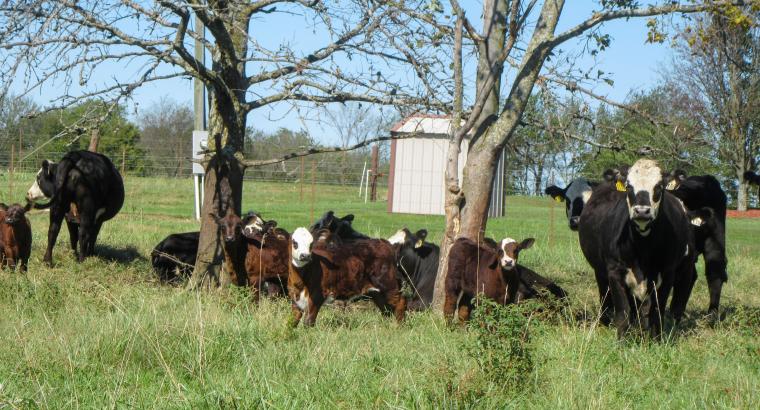 Heifers with their first calves on the ground. File photo.
COLUMBIA, Mo. – “Each fall we receive questions about small, weak-born calves in fall-calving herds,” says Craig Payne, director of veterinary extension at the University of Missouri. “There is rarely a simple explanation for why these problems occur, and several factors may be involved.”
Payne, along with Tim Evans, MU Extension state specialist in veterinary toxicology and animal health, and Jamie Courter, MU state beef genetics extension specialist, look at three factors that may contribute.
Heat stress
Most of the research evaluating heat stress during late gestation has been conducted in dairy cattle, where cows were either heat-stressed or cooled during the final 45 to 60 days before calving. Research has shown that calves born to heat-stressed cows weigh 9 to 15 pounds less at birth than calves born to cooled cows, and many continue to lag in growth through weaning, says Payne.
Research has also demonstrated other effects, including lower blood oxygen in the calf at birth, reduced efficiency of antibody absorption from colostrum after birth, and changes in immune function that persist beyond the neonatal period. Several studies have also reported gestation lengths that were three to four days shorter, but this finding has not been consistent.
Although the amount of research in beef cattle is much smaller, studies in Brangus and Angus-cross cows have reported similar findings, including lighter calves, greater sensitivity to heat after birth and immune changes that persist into the feedlot.
Why do we see these effects? “Research has consistently shown that prolonged heat stress during late gestation reduces blood flow to the uterus and placenta,” says Payne. “Over time, this can impair placental growth and function, reducing the transfer of oxygen and nutrients to the developing fetus. Because approximately 70% of fetal growth occurs during the last trimester, even modest reductions in oxygen and nutrient delivery during this period can affect fetal development and may contribute to lower birth weights and other changes associated with heat stress during late gestation.”
While the impact of heat stress on birth weight is well documented, there is less evidence linking it to weak-born calves, stillbirths or abortions. Large observational studies in dairy cattle have reported an increased risk of stillbirths during periods of severe environmental heat. However, in controlled studies, that finding has not been consistent, and there is little direct evidence linking heat stress to weak-born calves or abortions. This is not to say heat stress cannot increase the risk of these outcomes, only that current research provides limited evidence that heat stress alone is responsible, says Payne.
Where fescue may fit
“If your herd grazes toxic tall fescue, the picture may become even more complicated,” says Evans.
Toxic fescue contains ergot alkaloids, primarily ergovaline, which constrict blood vessels throughout the body. In cattle, this is best known for reducing blood flow to the tail and feet. However, research has also demonstrated constriction of the uterine blood vessels, suggesting reduced blood flow to the developing fetus during late gestation. This may further reduce oxygen and nutrient delivery to the fetus during a critical period of development.
Evidence that toxic fescue directly causes abortions or stillbirths is much stronger in horses than in cattle. Pregnant mares grazing toxic fescue commonly experience little to no milk production, prolonged gestation, difficult foaling, and stillborn or weak-born foals. Cattle appear less sensitive, likely because some of the toxin is degraded in the rumen before it is absorbed. That is not to say toxic fescue cannot contribute to abortions, weak-born calves or stillbirths in cattle, only that research directly demonstrating that relationship is limited.
Could genetics also play a role?
There is one other factor worth mentioning. Jamie Courter, MU Extension beef genetics specialist, says one of the most common questions she receives during producer meetings is whether selecting for calving ease is also contributing to lower birth weights than intended.
“Many producers select bulls for low birth weight, either by choosing a favorable birth weight expected progeny difference (EPD) or considering the bull’s own birth weight,” Courter explains. “But low birth weight is not the same as calving ease and should not be used as a substitute for selecting for calving ease.”
The genetic correlation between calving ease direct and birth weight is only about 0.30, meaning the traits are related but can be selected for independently. Producers can identify bulls with favorable calving ease while maintaining moderate, acceptable birth weights.
Continually selecting for the lowest birth weight generation after generation may drive birth weights lower than necessary. When combined with factors such as shortened gestation and late-gestation heat stress or fescue toxicosis, this may help explain why some fall-calving producers observe calves that are substantially smaller or less vigorous than expected. The goal, Courter emphasizes, is not to produce the smallest calf possible. It is to select for calving ease while maintaining an appropriate birth weight.