-
Image
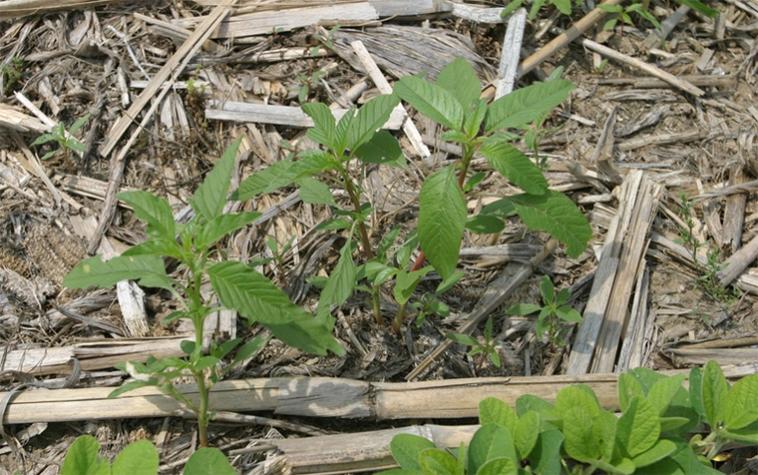 Common waterhemp. MU file photo.
COLUMBIA, Mo. – Missouri is the fourth state to confirm the presence of waterhemp resistant to labeled rates of dicamba herbicide.
University of Missouri Extension weed scientist Kevin Bradley says this is not surprising but adds to concerns about declining control options.
Bradley’s lab on the MU campus grew the resistant plants from seeds collected from a field in Saline County in 2023. The plants did, however, remain susceptible to glufosinate and 2,4-D, for now.
Bradley has spent more than two decades educating growers about waterhemp’s growing herbicide resistance.
Bradley’s research points to ALS (2), glyphosate and PPO resistance in every soybean-producing county in Missouri. His latest research shows resistance to ALS (2), glyphosate, PPO (14), PSII (5) and 2,4-D in five counties, and ALS (2), glyphosate (9), PPO (14), PSII (5) and HPPD (27) in another five counties.
More resistance could be on its way in 2026. Three dicamba products are pending EPA approval for broadleaf weed control in 2026 following a one-year hiatus.
Bradley notes that 2,4-D resistance is increasing, and resistance to Group 15 herbicides has increased in Illinois. There is no “official” glufosinate resistance yet, but several states are investigating populations. Metabolic resistance is the predominant mechanism in the “newest” types of resistance, says Bradley.
Herbicide-resistant waterhemp is being documented farther north and east in the United States, says Bradley.
Waterhemp’s remarkable ability to adapt to selection pressure imparted by herbicides has resulted in resistance to many different classes of herbicides. Waterhemp populations have evolved resistance to atrazine; ALS-inhibiting herbicides such as Pursuit and Classic; PPO-inhibiting herbicides such as Blazer, Cobra, Flexstar and Phoenix; and glyphosate.
For too long, farmers have relied almost exclusively on herbicides, relying on one herbicide until it doesn’t work and then moving to the next, says Bradley.
Growers cannot continue to expect the next new herbicide to control waterhemp for years into the future, says Bradley.
Resistance and cost make that approach unsustainable to combat this fast-growing, prolific seed producer.
Growing resistance and rising chemical costs will push the agricultural industry to consider an integrated weed management (IWM) approach that blends technology with herbicides, he says.
Bradley’s team has researched technologies such as weed electrocution and seed-destruction devices that attach to combines. There is also ongoing research on how cover crops affect populations in row crops.
As drone and robot technology improve, options for economical, effective IWM will open, Bradley says. Technology-driven solutions such as see-and-spray drones and autonomous robots that can till, electrocute, spray or blast weeds with a blowtorch will change how weeds are removed from crops.
“Much of this is already occurring in vegetable and specialty crops,” he says. “It’s just a matter of time before these technologies make it into row crop production systems.”
Bradley started sounding the warning bell on waterhemp in the early 2000s. By 2010 he cautioned that “herbicide-resistant weed populations are evolving rapidly as a natural response to selection pressure imposed by modern agricultural management activities.”
By 2018, a waterhemp population was identified in Missouri that was resistant to 2,4-D, atrazine, chlorimuron, fomesafen, glyphosate and mesotrione. Bradley continued to write articles about the fast-growing weed with similar but more urgent messaging every year.
By 2023, he called glyphosate the “silver bullet that wasn’t” as he and weed scientists across the United States and Canada documented growing resistance to it for two decades. Use of glyphosate continued to increase, but its effectiveness did not.
For more information, visit MU’s Integrated Pest Management website.