-
Image
 Adobe stock photo
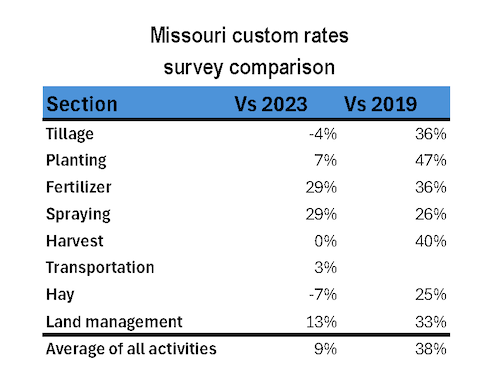
COLUMBIA, Mo. – The cost of hiring fieldwork in Missouri has risen an average of 9% since 2023, according to an update to University of Missouri Extension’s Custom Rates for Farm Services in Missouri.
|
Section |
vs. 2023 |
vs. 2019 |
|---|---|---|
|
Tillage |
-4% |
36% |
|
Planting |
7% |
47% |
|
Fertilizer |
29% |
36% |
|
Spraying |
29% |
26% |
|
Harvest |
0% |
40% |
|
Transportation |
3% |
|
|
Hay |
-7% |
25% |
|
Land management |
13% |
33% |
|
Average of all activities |
9% |
38% |
Notable changes include increases in fertilizer and chemical application rates. Since 2023, reported charges in these categories have risen almost 30%.
“Over the past five years, farmers have seen significant increases in insurance premiums across many types of coverage,” said survey coordinator Drew Kientzy, an MU Extension senior research analyst. “Spraying and fertilizing operators are likely to carry substantial insurance policies to cover potential crop and environmental damage. I expect that rising fixed costs, such as insurance, contribute significantly to higher rates.”
Kientzy also noted that these operations often require more labor. “To maintain efficiency, a second operator is typically needed to tender water, chemicals and fertilizer. According to the USDA, farm labor costs in the Corn Belt increased by 32% from 2019 to 2025, reaching an average of $20.91 per hour. With multiple workers involved, rising labor costs are likely to contribute to higher service rates.”
Custom harvesting rates in Missouri averaged no change from the rates reported in 2023. “Used combines, especially those between 5 and 15 years old, are abundant on dealer lots and auction yards across the corn belt,” Kientzy said. “An abundance of machines has created a buyer’s market relative to the resale prices of similar machines 2-4 years ago. While today’s used combine prices may not directly impact the cost of custom services, more affordable used machines make combine ownership more attractive for farmers who might otherwise rely on custom work. Custom operators are then pressured to remain competitive, since they depend on covering a certain amount of acreage every year.”
Kientzy attributed the modest 7% increase in planting costs to the used equipment market as well. “Planting technology came a long way in the first two decades of the 21st century and drove many farms to update regularly to retain the latest seed saving and yield boosting features,” he said. Many large 16- and 24-row planters have been orphaned by their original owners on the used market, with few interested buyers simply due to their size and requirements for technology-capable tractors with massive hydraulic capacities. “Some farms taking the leap to these larger machines at a fair price can plant their acres inexpensively and be very competitive in the local custom work marketplace.”
“Custom Rates for Farm Services in Missouri” is available for free download.