Simple strategies can help businesses spark career interest, confidence and engagement among young people.
-
Image
 Adobe stock photo
Kellie Seals, Ed.D., is a University of Missouri assistant extension professor and 4-H state specialist in college and career pathways.
As schools gear up to welcome students, fall is an ideal time for industry partners to plan presentations and tours for local youth. Simply schedule an event with a teacher or counselor, bring candy, and you’re done, right? Almost! Here are some simple practices organizations and schools can implement to help ensure investments in engagement don’t end in bored faces and vague guesses about effectiveness.
Establish a purpose for youth outreach
A fundamental reason to engage with youth via tours and presentations is to help them gain awareness of your organization or industry: what it does, who it’s for, and how to prepare for a career one day. Even if youth don’t ultimately choose to pursue a career within your organization, possessing awareness is invaluable. These will be active members of the community in the future. They’ll vote, serve on boards, talk to their families and friends, and spend their time and money in the community. Knowing about your organization and the value it brings to the community helps them make all kinds of decisions, not just ones related to careers. For this reason, the youth engagement work you’re doing is important, no matter how basic. Don’t cut youth engagement out of your budgets and schedules.
Though most businesses and organizations ultimately would like to recruit young people into their organization or industry, career decision-making is a complex process, and one experience doesn’t always lead a 13-year-old to automatically choose a career path. But career development science tells us there are things we can do to influence the development process, including generating interest (or “sparks,” as 4-H calls them), fostering self-efficacy and helping youth personally identify with a career. This is where the magic happens.
Highlight relatability
Relatability helps young people envision themselves in the career space you are sharing with them. When a child thinks, He or she is like me, they’re more likely to conclude, If he or she can do it, so can I. If they can’t identify with you, they might have a hard time identifying with your career.
Relatable connections can be established in many ways. If a presenter attended the same school as a child, have them wear the school shirt or hat and share a story. Consider having an employee who grew up locally be involved, or if possible, invite a student’s family member to present.
Engaging employees from a variety of backgrounds (e.g., age, gender, ethnicity, culture) also boosts relatability. Research by Linda Gottfredson tells us that children as young as 6 start to attach certain career fields to particular genders and social statuses and will begin to narrow their options. Therefore, exposing them to people in nontraditional gender roles and from a variety of backgrounds can help break those stereotypes.
If none of these suggestions are possible, get creative. Find a non-career-related connection to the youth so they can see themselves in your shoes.
Finally, relate your work to something in their lives: an activity, product or past experience. Engage by asking questions and incorporating their answers. Seeing a connection between the industry and their real lives establishes relevance, boosting engagement and interest.
Get ‘hands on’
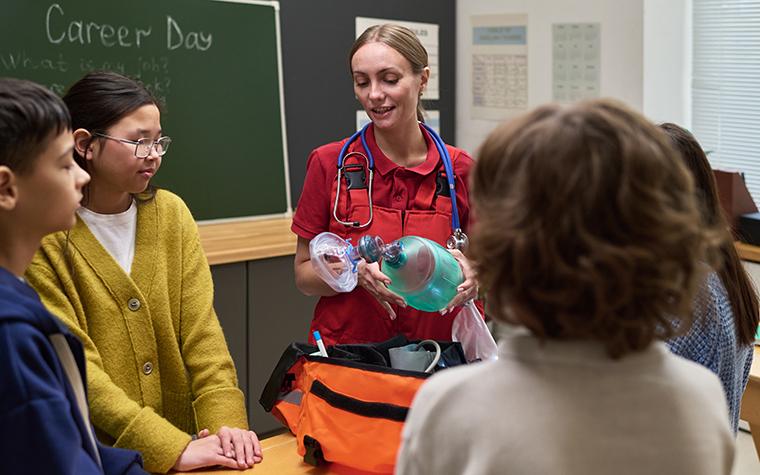
What does hands-on even mean, and why is it important? Any kind of experience that is interactive, in which youth do something that stimulates multiple senses, could be considered “hands-on.” No matter how elementary the activity, the brain will build stronger connections to the topic when the senses are activated. Hands-on work experience simulations exist on a continuum and depend on safety, budgets, time and resources. It is not possible to have young visitors fly a real plane or use welding rods. Flight and welding simulators are the next best options, though popsicle sticks and paper airplanes will absolutely do the job.
This past summer, I took high school-aged 4-H’ers to a student and faculty panel on health sciences. I enhanced the visit with a simple balloon activity from MU Extension’s Taking Care of You curriculum to demonstrate stress. When the youth debriefed the activity with peers, they mentioned the balloon activity more than anything else.
Refer to a youth specialist or educator in extension or with the school you’re working with for help creating a “hands-on” experience for your visit.
Tell the whole messy story
Be sure to have your presenter or guest share their personal career path story. Young people tend to be exposed solely to formal college and career pathways and are often encouraged to start planning early. This can be both exciting and stressful. However, educational and career journeys are rarely direct, and decisions and opportunities are affected by personal life events and preferences. Ask your guest presenters or tour guides to talk about experiences that helped them get where they are today, especially unexpected ones. The more human and personal, the better. Emphasize transferable skills learned, and reiterate that both planning and adaptability are necessary to navigate one’s career trajectory.
Fine-tune for the audience
An important component of the career decision-making process involves self-efficacy – the belief that one can succeed – during career exploration experiences. Fine-tune the presentation or tour to be challenging and educational without going too far above their heads. Communicate with the teacher or youth leader to find out what they already know. Teach vocabulary or substitute industry jargon with age-appropriate terminology your young audience can comprehend. Relate products made or work experiences with common experiences in that age group. For example, when discussing project management, ask the youth if they’ve ever planned a birthday party or group project at school. As you tie successes to familiar experiences, you’re helping boost their self-efficacy while establishing relatability.
Measuring the effectiveness of engagement
Unless your audience consists of upperclassmen high schoolers, avoid asking closed-ended questions about their intent to pursue a career in the topic area. Instead, assess their interest development by asking questions about engagement (how much they enjoyed and interacted with the experience) and willingness to visit again or to learn more. You can assess self-efficacy as well, though a sense of efficacy is reflected in their intent to pursue more. Ask about growth in awareness of the organization or career opportunities as well as the perceived value of the organization or industry. Finally, consider asking degree to which they envision themselves working in the field someday.
Don’t worry if young people decide that, because of the experience with your business or industry, they are not interested. Helping young people figure out what is not a good fit for them should be considered a success!
Final thoughts
When deciding what age to engage with, rest assured that all grades would be influenced by career exploration experiences. However, middle schoolers are particularly ripe for such experiences as they begin to try on various interests and identities. Recent research from the National Academies of Sciences, Engineering, and Medicine tells us that adolescents’ brains are still quite malleable. We have the power and tools to change minds and ignite sparks. It’s not too late to pique their interest in pursuing a career in the field you’re passionate about.
Be sure to contact your local 4-H youth specialist for help designing or fine-tuning your youth engagement experiences this season.
Additional readings
Hidi, S., & Renninger, K. A. (2006). The four-phase model of interest development. Educational Psychologist, 41(2), 111–127.
Lent, R. W., & Brown, S. D. (2019). Social cognitive career theory at 25: Empirical status of the interest, choice, and performance models. Journal of Vocational Behavior, 115, Article 103316.
National Academies of Sciences, Engineering, and Medicine. 2019. The promise of adolescence: Realizing opportunity for all youth. Washington, DC: The National Academies Press.
Tomek, J. & Williams, M. J. (1999). Ages and stages of 4-H youth development. University of Missouri Extension.