-
Image
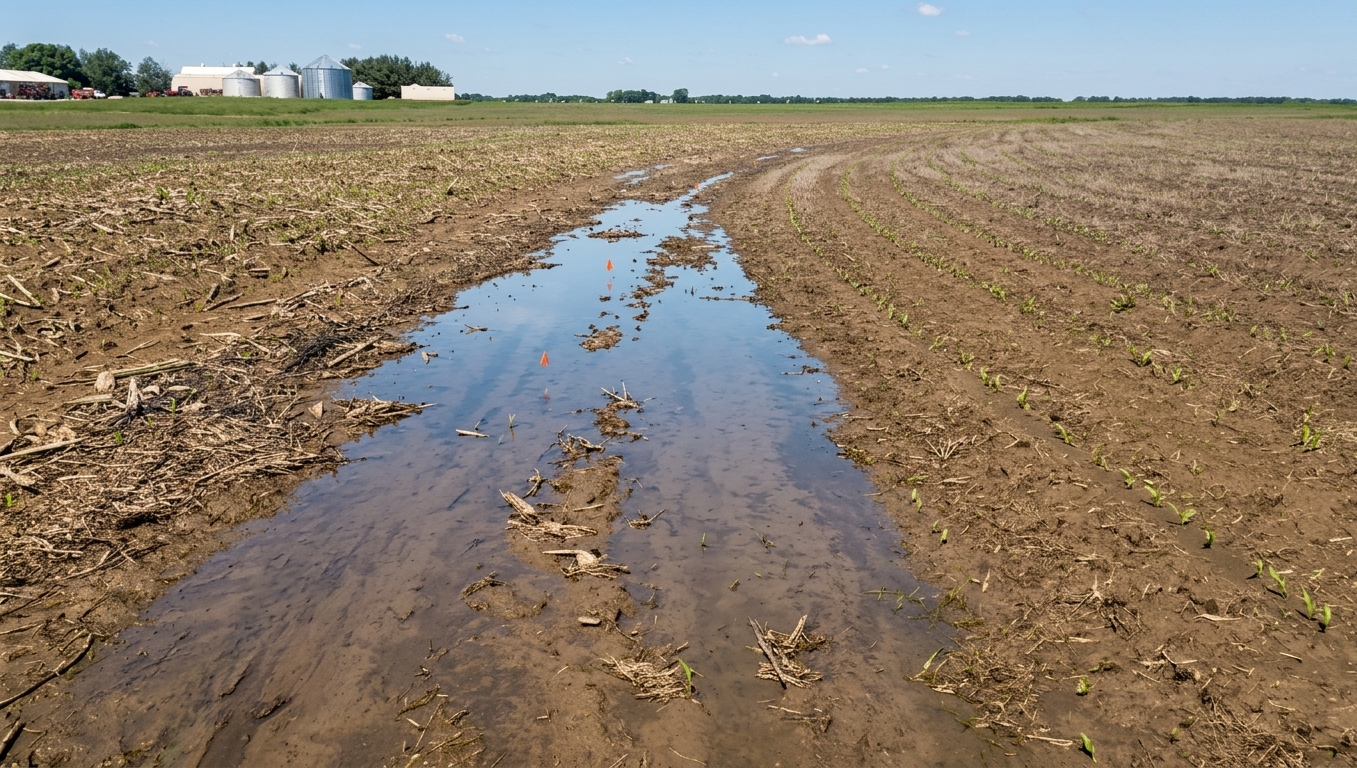
 Corn is especially sensitive to flooding during growth stages VE–V6. Oxygen deprivation can occur within 24–48 hours, reducing root growth and nitrogen uptake. Prolonged flooding can cut yield potential by 7%–20%. Photo courtesy of Gurbir Singh.
 -
Image
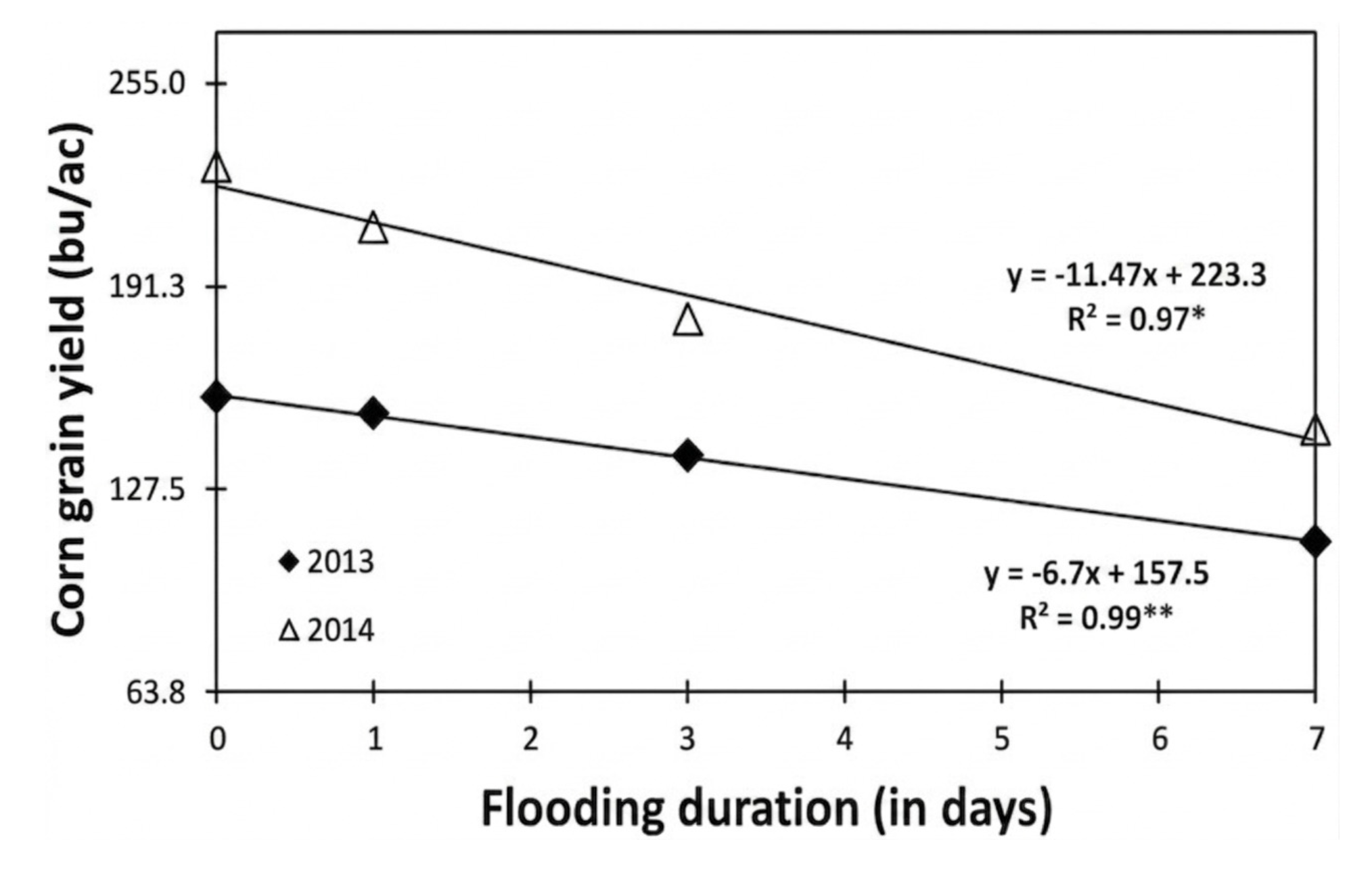
 Decrease in corn grain yield due to flooding duration in poorly drained claypan soils in northeastern Missouri. From Kaur, G., Zurweller, B. A., Nelson, K. A., Motavalli, P. P., & Dudenhoeffer, C. J. (2017) and published in “Soil Waterlogging and Nitrogen Fertilizer Management Effects on Corn and Soybean Yields” in Agronomy Journal, 109(1), 97-106.
NOVELTY, Mo. – Waterlogging and flooding are among the most damaging weather-related stresses in crop production worldwide, and their impacts are increasing as extreme rainfall becomes more frequent. Flooding ranks second only to drought among abiotic stresses.
Research by Gurbir Singh, a soil scientist with University of Missouri Extension at MU’s Lee Greenley Jr. Memorial Research Farm, along with Gurpreet Kaur, assistant research professor in the MU School of Natural Resources, and others, shows how excess water affects crops, soils and nutrient management, and outlines strategies farmers can use to reduce losses.
Flooding submerges plants, while waterlogging fills soil pores with water.
Both limit oxygen in the root zone, disrupting growth and reducing yields. Survival depends on seed quality, flood duration, water temperature, drying speed and growing-point location.
In Missouri’s claypan or floodplain soils even short saturation can cause nitrogen loss, reduce root growth and lower plant vigor because of slow drainage, plant roots need air exchange, says Singh.
Timing, crop, duration matter
Crops are most vulnerable during early vegetative and reproductive stages, and each additional day of flooding lowers yield potential. Warm temperatures intensify stress and plant diseases.
Corn is especially sensitive during VE–V6. Oxygen deprivation can happen within 24–48 hours, reducing root growth and nitrogen uptake. Prolonged flooding can cut yield potential by 7%–20%.
Soybean plants tolerate short saturation from germination to V3 but still lose yield with prolonged flooding. Evaluate seedlings after the water recedes and check for discoloration, rotting or damping-off.
Early growth stages are most vulnerable because of shallow roots and limited energy reserves.
Flooding in soybeans at the early growth stages (V2-V5) can result in 1-3 bushels per acre per day of yield loss, largely due to reduced plant population, with 1,000 to 3,200 plants lost per acre per day of flooding.
Nitrogen loss is key
Waterlogged soils accelerate denitrification, leaching and runoff, reducing plant-available nitrogen and fertilizer efficiency, says Singh.
Nitrogen rate, timing and placement affect uptake and loss. A single early-season application increases risk under waterlogged conditions. Split applications can help reduce losses, though decisions should consider timing, duration and expected returns.
MU Extension agronomist Kelly Nelson says corn may still benefit from rescue nitrogen if earlier applications are lost. His research shows that applications can help up to silking, though they do not fully restore yield potential.
Research also shows minimal yield loss (about 3%) when nitrogen is delayed until V12–V16, and post-flood urea applications with NBPT can significantly boost yields after short-term waterlogging.
Consider replant decisions
If extended flooding kills plants and reduces soybean population, it is time to consider replanting, says MU Extension specialist Andre Reis. The replanting decision must consider not only the presumed yield penalty from the reduced stand, but also the cost and likely lower yield potential associated with a later planting date. Often, stand uniformity is a better indicator of the need for replanting than population itself. Relatively uniform stands with low populations have better yield potential than higher-population stands with heterogeneous plant distribution.
Reis warns that early-season flooding may cause problems later if followed by summer drought, due to restrictions on root development and potential harmful effects on soybean nodulation.
He advises scouting fields and using the 2025 MU Extension replant worksheet and guide, which outlines seven steps to consider: determine cause, assess stand, estimate yield and revenue (current vs. replant), calculate replant cost and decide cost-effectiveness.
Scout fields for disease
Watch for diseases favored by wet conditions, says Peng Tian, director of the MU Plant Diagnostic Clinic.
Soybean seedlings are at risk to Pythium, Phytophthora and Rhizoctoniainfections, says MU Extension plant pathologist Mandy Bish. While the pathogen that causes sudden death syndrome (SDS) also infect seedlings now, symptoms typically remain hidden until later in the season. In wheat, prolonged wet weather increases the risk of mycotoxin accumulation associated with Fusarium head blight (wheat scab).
Weed management issues follow
MU Extension weed scientist Kevin Bradley says flooded fields today can affect herbicide and weed management practices. He discusses these issues in an article, Weed Management Issues Related to the Flooding and Wet Conditions in Missouri, on the MU Integrated Pest Management website.
You can read the entire journal article on waterlogged or flooded soils at doi.org/10.1002/agj2.20093.
Singh discusses flooding and waterlogging in the MU Extension news release When fields stay wet.
Find more information on the MU Extension flood resources page.
Graph
Decrease in corn grain yield due to flooding duration in poorly drained claypan soils in northeastern Missouri. From Kaur, G., Zurweller, B. A., Nelson, K. A., Motavalli, P. P., & Dudenhoeffer, C. J. (2017) and published in “Soil Waterlogging and Nitrogen Fertilizer Management Effects on Corn and Soybean Yields” in Agronomy Journal, 109(1), 97-106.
Photo
Corn is especially sensitive to flooding during growth stages VE–V6. Oxygen deprivation can occur within 24–48 hours, reducing root growth and nitrogen uptake. Prolonged flooding can cut yield potential by 7%–20%. Photo courtesy of Gurbir Singh.