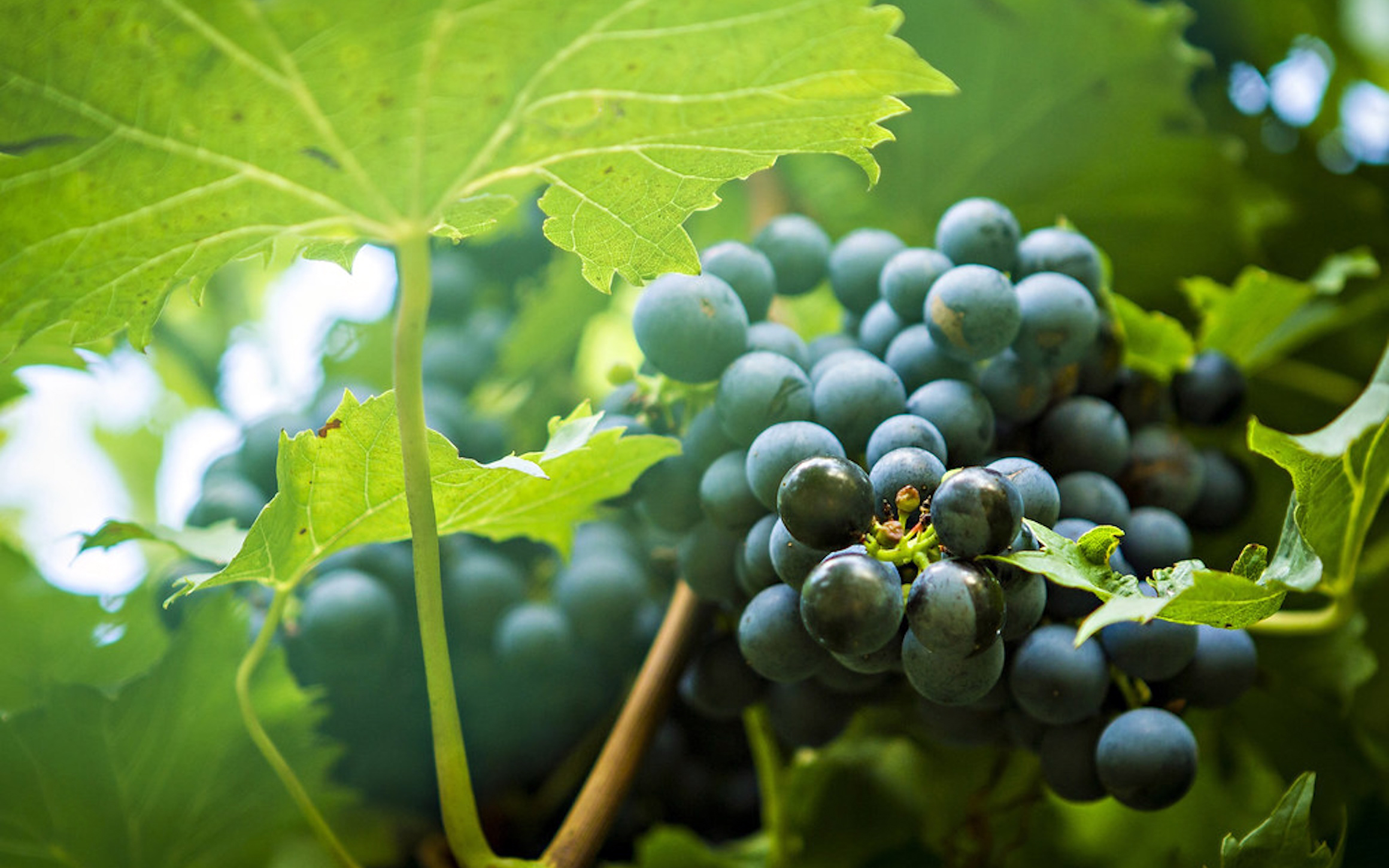
Harvest begins in Missouri in late August.
-
Image
 Grapes have shaped human history for over 8,000 years. Grape harvest in Missouri begins in late August. Photo courtesy of University of Missouri College of Agriculture, Food and Natural Resources.
COLUMBIA, Mo.—Long before they became a delectable feature of fruit trays or the essence of a respectable vintage, grapes were busy proving that good things come in bite-sized, sweet packages, said University of Missouri Extension horticulturist David Trinklein.
“Whether enjoyed fresh from the vine, dried into chewy raisins or poured from a bottle, these unassuming little berries have shaped human history for over 8,000 years,” Trinklein said. “Since grape harvest in Missouri begins in late August, the time seems ‘ripe’ to take a closer look at the world’s No. 1 fruit, based on tonnage produced.”
Grape growing, or viticulture, is probably as old as civilization itself, he said. Archaeological evidence suggests humans began growing grapes as early as 6500 B.C., during the Neolithic Era. By 4000 B.C., grape growing expanded from Transcaucasia to Asia Minor and through the Nile Delta of Egypt. Later, the Greeks and Phoenicians extended grape growing to Carthage, Sicily, southern Italy, Spain and France. Under the influence of the Romans, grape production spread throughout Europe.
After the fall of the Roman Empire, grape culture and winemaking were primarily associated with monasteries. Later, the use of wine extended beyond religious rites and became entrenched in culture as a social custom. This increased demand for grapes, and grape culture grew steadily from the 16th century on.
The three primary uses for grapes are for wine, raisins and fresh table grapes.
The world produces about 7 billion gallons of wine each year, making it by far the most prevalent use of grapes. Production varies from year to year due to weather. Top producers like Italy, France and Spain make nearly half of the world’s wine.
Raisins represent a formidable use of grapes as well. Worldwide raisin production averages about 1.3 million metric tons per year. Since it takes about 4 pounds of grapes to produce a pound of raisins, the raisin industry uses about 4.5 million to 5 million tons of grapes each year.
Fresh (table) grapes account for less than 12% of global grape production. Since fresh grapes are highly perishable and transportation costs are high, they are consumed primarily in the country of their production. Europe and North America lead in fresh grape consumption. The average American consumes about 9.5 pounds of fresh grapes each year.
Grapes belong to the Vitaceae (grape) plant family, which contains 11 genera and about 600 species. The genus Vitus is the only food-bearing genus in the Vitaceae family and contains about 60 species. These species are grouped into one of four different categories:
Native grapes. When the first Europeans visited North America, they found grapes growing so abundantly that they named the new land “Vineland.” Grape species native to North America include Vitus labrusca, V. aestivalis, V. riparia, V. berlandieri. Native species are known for their cold-hardiness and disease resistance. Unfortunately, their fruits have lower sugar content, higher acid content (a poor combination for making good wine) and are “slip skin,” referring to the tendency of the skin to separate from the remainder of the berry when eaten fresh. Concord, a cultivar with V. labrusca parentage, arguably is the most popular American-derived grape, although Norton (Cynthiana), Catawba and Niagara also are widely planted.
European grapes. The European grape (Vitus vinifera) is the species most often associated with the word “grape” and accounts for most of the world’s wine production. The chemical composition of its fruits is superior to that of native North American grapes for winemaking, but European grape cultivars lack cold hardiness and are susceptible to several troublesome diseases. Today, production of V. vinifera in the United States is limited to regions with mild winters, long growing seasons and summers that are fairly dry with low relative humidity.
French-American hybrids. The quest to produce grapes with superior wine-making qualities coupled with cold hardiness and disease resistance led to the development of French-American hybrids. Most arose by crossing species of European grape with various species of North American grape. These crosses gave rise to very productive hybrids produced in the Midwest with adequate cold hardiness and the ability to tolerate many troublesome diseases. French-American cultivars such as Vignoles, Chambourcin and Vidal Blanc have helped to revitalize Missouri’s wine industry.
Muscadine grapes. Muscadine grapes (Vitus rotundifolia) are noted for their small berries that have a bold, musky flavor. They are nearly immune to insects and diseases but have growing season of 200 days or more. Muscadine grape production is limited to states with mild winters such as Florida, Mississippi, Louisiana and North Carolina.
“The humble grape proves that good things truly do come in small, sweet, and wonderfully juicy bunches,” said Trinklein.
Photo
Grapes have shaped human history for over 8,000 years. Grape harvest in Missouri begins in late August. Photo courtesy of University of Missouri College of Agriculture, Food and Natural Resources.