How Excelsior Springs brought neighbors together with help from MU Extension.
-
Image
 Excelsior Springs challenged residents to get to know their neighbors through the Mayor's Block Party Challenge.
 -
Image
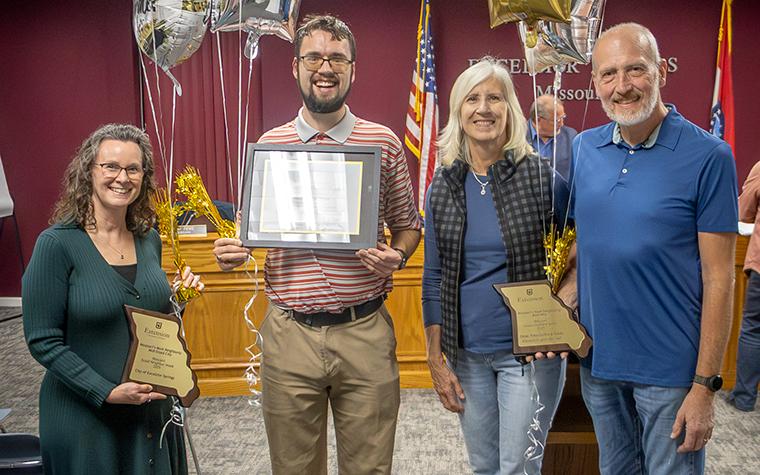 From left, Excelsior Springs neighborhood specialist Laura Mize; Robbie Farabee, who was named one of Missouri’s most engaged neighbors; and Linda and Jodi Pasalich, owners of Other Trails – Coffee & Goods, which was recognized as one of the state’s most engaged businesses.
 -
Image
 Excelsior Springs neighborhood specialist Laura Mize, left, and Mayor Mark Spohn.
 -
Image
 In the Mayor’s Block Party Challenge, Excelsior Springs set a goal of hosting 50 block parties between Easter and Halloween. Fifty-one parties were officially recorded during that interval.
 -
Image
 MU Extension community development specialist David Burton started the Engaged Neighbor Program in 2019.
EXCELSIOR SPRINGS, Mo. – When Laura Mize stepped into her new role as neighborhood specialist for the city of Excelsior Springs, a town of about 11,000 people 30 miles north of Kansas City, what she sensed, both personally and professionally, was isolation.
“In my neighborhood, I had lived there for several years before any neighbor approached us and welcomed us to the neighborhood,” Mize said. “I realized I probably could have been the one to initiate that.”
That changed when she discovered University of Missouri Extension’s Engaged Neighbor Program and its Neighboring 101 course.
“Once I discovered Neighboring 101, it became a lifeline for me professionally,” Mize said.
The Engaged Neighbor Program began in Greene County in 2019 and has since expanded statewide. It combines research, practical tools and peer networking to help residents and local leaders strengthen relationships block by block. Through Neighboring 101, a monthly Zoom-based course, participants explore the science and art of neighboring, hear from practitioners and researchers across the country, and join a statewide Engaged Neighbor Network focused on increasing safety, belonging and social connection.
Through monthly Zoom sessions and access to a statewide network, Mize learned how other communities were building connections. She organized a Mayor’s Block Party Challenge. With support from Mayor Mark Spohn and the city council, Excelsior Springs set a goal of hosting 50 block parties between Easter and Halloween.
“By Halloween, we actually had 51 block parties,” Mize said. “We just got tremendous feedback. They felt the neighbors were more connected with each other after having that experience than they had been before.”
A $2,013 mini-grant from the Neighborhood Leadership Academy helped make it happen. The Neighborhood Leadership Academy, a program of MU Extension and University of Missouri–St. Louis, provides hands-on leadership training and connects residents with facilitators to develop and implement neighborhood projects.
The grant funded customizable door hangers so hosts could easily invite their neighbors, along with a kit of yard games such cornhole and horseshoes that residents could check out for their events.
The momentum surprised even her. “We started hearing more buzz about people wanting to do block parties,” she said. “It kind of snowballed. That was really exciting to hear from neighbors that connection was happening, because that was the whole goal.”
“Laura has done a tremendous job,” said David Burton, an MU Extension community development specialist and originator of the Engaged Neighbor Program. “The city leadership has been really open to new ideas as well. There are some cities I have visited with whole feel that the sole role of the city is water, sewer, streets and fire protection, and not much of anything else.”
But there are real, practical benefits to helping neighbors forge connections among one another, Burton said.
“Excelsior Springs has really seen how increasing social capital and connection among neighbors helps improve trust with the city,” he said. “And it helps improve trust among neighbors and residents. And when more people start to have trust, they done some really great things, like volunteering more and running for office and organizing neighbors for social-capital-building events like block parties. And those things work together. In the long run, it’s going to make your city more efficient and run better.”
Business connections and civic benefits
For Mayor Spohn, the impact has been visible across the community.
“What I noticed before working with MU Extension was a certain disconnection in our community, neighbor to neighbor,” Spohn said. “And that sometimes translates into distrust.” But through events such as the Mayor’s Block Party Challenge and partnerships with MU Extension, he saw attitudes shift.
“After working with MU Extension, I saw people begin to be more comfortable around one another,” he said.
“We live in a society where social media so divides us,” he said. “When you bring food and drink into that component, it knocks down barriers and walls and promotes more meaningful conversation.”
Excelsior Springs also engaged with MU Extension through the Connecting Entrepreneurial Communities Conference, which brings business owners, local leaders and residents together to strengthen local economies through collaboration and community-based strategies. “It was very instrumental in helping our businesses get connected,” Spohn said.
The benefits extend beyond good feelings. “The value of neighboring translates into many different benefits, such as safer neighborhoods, cleaner neighborhoods, less code enforcement, less policing, less strain on city budget,” Spohn said. “Neighbors learn to trust one another.”
Meeting needs close to home
Mize also points to mental health. One Neighboring 101 session highlighted research on the damage caused by isolation, particularly during and after the COVID-19 pandemic.
“It can have an incredibly negative effect on your mental health if you’re not communicating and you’re not engaged with people face to face,” she said. “One of our major goals is to find those people in our neighborhoods who are not able to get out and meet that need with the people who live closest to them.” One example is the city’s Snow Angels program, which matches volunteers with residents who cannot shovel snow themselves.
Recognition and renewed pride
Excelsior Springs’ efforts have drawn statewide recognition. In both 2024 and 2025, the city was named one of Missouri’s Most Neighborly Cities during Missouri Good Neighbor Week, winning in the medium-size category.
“The first time it happened was pretty cool,” Spohn said. “But it was very affirming the second time around.”
Mize said the recognition matters not just for the city’s image, but for its residents. “Some of the most pessimistic people about your city tend to be the people who actually live there,” she said. “I really hope our residents hold on to that and use that to move forward in getting connected with their neighbors.”
The city also celebrated individual honors: Robbie Farabee was named one of Missouri’s most engaged neighbors for his sidewalk chalk art that “blesses” local businesses and residents. s. “They engage with bicyclists, with runners and with gamers,” she said. “It’s become a fixture downtown that brings people together in a lot of different ways.”
For Mize, the transformation underscores the value of partnership.
“I gained the tools to do that,” she said of MU Extension. “I’m really thankful to have had that partnership and that benefit. It’s invaluable what that can do for our community.”
About the Engaged Neighbor Program
The Engaged Neighbor Program began in Greene County in 2019 and has grown to a statewide program. Efforts under the Engaged Neighbor Program name include classes, special events, presentations, partnerships, publications and an award-winning newsletter. “Being an Engaged Neighbor improves the safety and connectedness of our neighborhoods and communities, increases social capital and showcases asset-based community development,” says David Burton, an MU Extension community development specialist and originator of the program.
Neighboring 101. This ongoing program is for anyone wanting to improve their neighborhood or community as well as their personal life and health. Since 2020, almost 1,200 people from 36 states have enrolled in Neighboring 101.
Engaged Neighbor Pledge. You can help make your neighborhood clean, safe, and friendly by learning about and pledging to pursue the “Engaged Neighbor” principles. Start by joining almost 900 other people who have taken the pledge to work toward becoming an engaged neighbor.
Missouri Good Neighbor Week. Missouri Good Neighbor Week, celebrated each fall, encourages acts of neighboring and celebrates those who make a difference where they live. To date, more than 40,000 acts of neighboring have been reported from 86 cities across the state; 15 cities have issued official Missouri Good Neighbor Week proclamations.
Show-Me Neighborhood Art Month. Show Me Neighborhood Art Week, held by MU Extension and Creating Whole Communities, seeks to empower public art made by residents as a contribution to the area’s sense of place. In 2025, there were 78 art installations of public art made by/for neighbors.
Mo Neighborhoods: This startup effort meets quarterly on Zoom with the goal to connect neighboring specialists working for cities and counties in Missouri.