New data-driven resource from MU Extension helps communities assess strengths, identify needs.
-
Image
 File photo by Abbie Nell Lankitus, University of Missouri.
 -
Image
ST. LOUIS, Mo. – A few years ago, Claire Rippel came across the term “civic muscle,” referring to a community’s capacity to take action to address shared goals and challenges.
“The term stuck with us,” said Rippel, who leads University of Missouri Extension’s community development team. She first encountered the term when community development state specialist Sarah Hultine Massengale shared Thriving Together, a national initiative focused on helping communities support well-being and long-term stability. “It captured something we see every day in communities, but don’t always have the tools to measure,” Rippel said.
Rippel reached out to Jamie Kleinsorge and Angela Johnson at MU Extension’s Center for Applied Research and Engagement Systems (CARES), which specializes in translating research and public data into practical tools communities can use for planning and decision-making.
The idea was to use data to assess civic muscle. “These are not just soft and squishy things,” Rippel said. “You can actually measure them.”
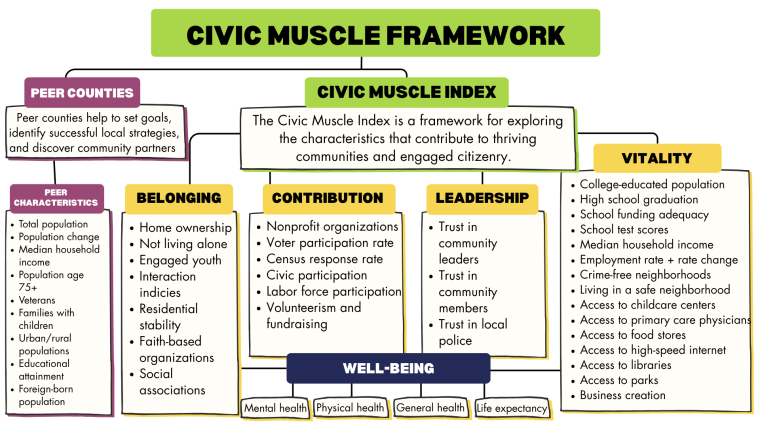
Last fall, MU Extension launched the Civic Muscle Index, a free interactive tool that helps communities assess civic strength across four key domains: belonging, contribution, leadership and vitality. The index complements traditional economic measures such as jobs, income and productivity by adding insight into the social and civic conditions that help communities thrive.
Each domain draws on multiple indicators drawn from publicly available data to provide a clearer picture of civic life:
- Belonging focuses on how connected people feel to their community. Indicators include measures such as residential stability and membership in social associations and faith-based organizations.
- Contribution looks at how residents give their time, voice and resources. Measures include rates of volunteering, participation in civic and community activities, and charitable giving.
- Leadership reflects a community’s capacity to work together and make decisions. Indicators include trust in local institutions and decision-makers.
- Vitality captures conditions that support long-term community health. Measures include factors related to education stability, business activity, housing and health.
Together, these measures allow users to generate county-level reports, compare peer communities and explore how different aspects of civic life interact, Rippel said. While most data are available at the county level, the Civic Muscle Index also offers ZIP code–level data for the city and county of St. Louis, allowing for a more detailed neighborhood-level view.
The Civic Muscle Index can be used by local officials, nonprofits and other community stakeholders to inform planning, guide investments and spark more grounded conversations about community priorities. For each domain, a “Take Action” feature connects users to relevant MU Extension programs, such as the Engaged Neighbor Program, the Neighborhood Leadership Academy and Creating Entrepreneurial Communities, helping communities move from data to action.
About CARES
The University of Missouri Extension Center for Applied Research and Engagement Systems (CARES) supports communities by translating research and public data into practical tools for planning, decision-making and evaluation. CARES works with Extension professionals, local leaders and organizations to strengthen community capacity and improve quality of life across Missouri and beyond.