Editor’s note
You can read this publication on this page or download the PDF.
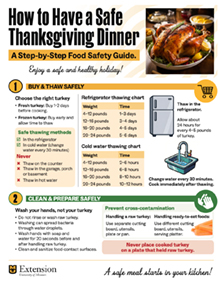
Thanksgiving is a time to gather with family and friends and enjoy a delicious holiday meal. Keep your celebration safe by following these food safety steps for buying, thawing, preparing, cooking, serving and storing turkey and leftovers. Learn how to prevent cross-contamination, use a food thermometer to ensure your turkey reaches 165°F, keep hot foods hot and cold foods cold, and refrigerate leftovers within two hours. Use this step-by-step guide and food safety checklist to help protect your family and guests throughout the holiday.
The printed version is a two-page 8.5-by-11 inch handout.
Topics
- Contamination
- Hygiene
- Food Safety
- Food temperatures
- Refrigeration
Pages
- 2
See guide sheet content below.
1. Buy & Thaw Safely
Choose the right turkey
- Fresh turkey: Buy 1-2 days before cooking.
- Frozen turkey: Buy early and allow time to thaw
Safe thawing methods
- In the refrigerator
- In cold water (change water every 30 minutes)
Never
- Thaw on the counter
- Thaw in the garage, porch or basement
- Thaw in hot water
Refrigerator thawing times
- 4-12 pounds: 1-3 days
- 12-16 pounds: 3-4 days
- 16-20 pounds: 4-5 days
- 20-24 pounds: 5-6 days
Thaw in the refrigerator.
Allow about 24 hours for every 4–5 pounds of turkey.
Cold water thawing times
- 4-12 pounds: 2-6 hours
- 12-16 pounds: 6-8 hours
- 16-20 pounds: 8-10 hours
- 20-24 pounds: 10-12 hours
Change water every 30 minutes. Cook immediately after thawing.
2. Clean & Prepare Safely
Wash your hands, not your turkey
- Do not rinse or wash raw turkey.
- Washing can spread bacteria through water droplets.
- Wash hands with soap and water for 20 seconds before and after handling raw turkey.
- Clean and sanitize food-contact surfaces.
Prevent cross-contamination
Handling a raw turkey:
Use separate cutting board, utensils, plate or pan.
Handling ready-to-eat foods:
Use different cutting board, utensils, serving platter.
Never place cooked turkey on a plate that held raw turkey.
3. Cook the Turkey Safely
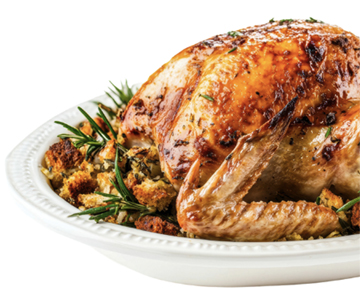
Use a food thermometer.
It’s the only way to know for sure your turkey is safely cooked.
Do not rely on:
- Brown skin
- Clear juices
- Cooking time alone
- Meat color
Cook to 165°F
Check the temperature in:
- Thickest part of the breast
- Innermost part of the thigh
- Center of the stuffing (if cooked inside the bird)
All checked locations must reach 165°F.
4. Serve Safely
Keep hot foods hot (140°F or higher)
- Use slow cookers, chafing dishes, warming trays or a warm oven.
- Examples: turkey, stuffing, gravy, casseroles.
Keep cold foods cold (40°F or lower)
- Keep in the refrigerator until serving.
- Use ice-filled trays or bowls.
- Examples: salads, deviled eggs, fruit trays, cheese trays.
The 2-hour rule
- Refrigerate leftovers within 2 hours.
- Throw away perishable foods left out longer than 2 hours.
5. Store Leftovers Safely
Cool foods quickly
- Slice turkey from the bone.
- Divide large amounts into shallow containers.
- Refrigerate promptly.
Leftover storage guide
- Turkey, Stuffing, Gravy, Cooked Vegetables, Casseroles, Pumpkin Pie
- Refrigerate (40°F or below) for 3–4 days
Reheat safely
- Reheat to 165°F before serving.
- Use a food thermometer to check the temperature.
Remember these four numbers!
20 seconds
Wash hands with soap and water.
40°F cold foods
Keep cold foods at or below 40°F.
140°F hot foods
Keep hot foods at or above 140°F.
165°F turkey
Cook turkey, stuffing and leftovers to 165°F.
Food Safety Checklist
- Turkey thawed safely
- Turkey not washed
- Hands washed often
- Separate cutting boards
- Turkey reached 165°F
- Stuffing reached 165°F
- Hot foods held 140°F
- Cold foods below 40°F
- Leftovers refrigerated 2 hours
View the source article, The Recipe for a Safe Thanksgiving, from the U.S. Department of Agriculture.