 Pyramid Pyramid video
The MyActivity Pyramid for Adults is modeled after the USDA's MyPyramid and is based on the 2018 Physical Activity Guidelines for Americans. The handout is designed to help adults ages 18-64 meet the 2018 Physical Activity Guidelines for active adults. The 8.5 by 11-inch handout was piloted with more than 140 adults. There is a poster version available as well.
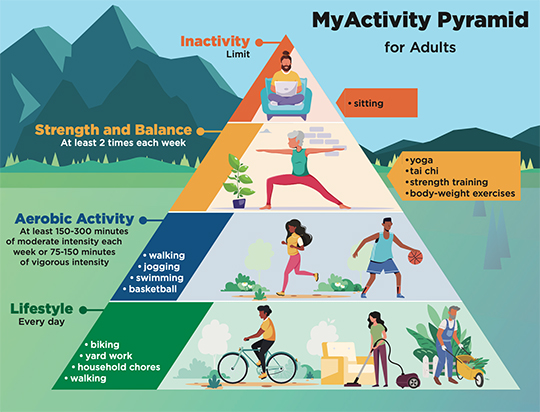
MyActivity Pyramid
Lifestyle activities
As often as possible
- Pick an activity you like and one that fits your life.
- Some physical activity is better than none.
Exercises
- biking
- yard work
- household chores
- walking
Aerobic activity
At least 150–300 minutes (2.5 to 5 hours) of moderate intensity each week
Or 75–150 minutes (1.25 to 2.5 hours) of vigorous intensity each week
Or do a combination of moderate- and vigorous-intensity activities. Aerobic activities should be spread throughout the week.
What is a moderate-intensity activity?
- You can talk while you do it, but you can't sing.
What is a vigorous-intensity activity?
- You can only say a few words without stopping to catch your breath.
Exercises
- walking
- jogging
- swimming
- basketball
Strength and Balance
At least two times each week
Aim for at least 10 minutes per day of stretching exercises to increase range of motion and flexibility.
Strength
- include all major muscle groups
- moderate or greater intensity
Balance
- include activities that challenge balance, such as standing on one leg, walking backwards, tai chi, or using a wobble board.
Exercises
- yoga
- tai chi
- strength training
- body-weight exercises
Inactivity
Limit
- Screen time (television, computer, video games).
- Sitting longer than 60 minutes.
Research
Major research findings about the health benefits of physical activity from the Physical Activity Guidelines for Americans:
- Regular physical activity reduces the risk of many adverse health outcomes such as heart disease, type 2 diabetes, and some cancers.
- Most health benefits occur with at least 150 minutes (2 hours and 30 min.) a week of moderate-intensity physical activity.
- For additional health benefits, adults should increase their aerobic physical activity to 300 minutes (5 hours) a week of moderate-intensity, or 150 minutes a week of vigorous-intensity aerobic physical activity, or a combination of both. Additional benefits include lower risk of colon and breast cancer and prevention of unhealthy weight gain.
- People with disabilities and chronic conditions can also benefit from physical activity.
Physical Activity Guidelines are also available for the following:
- Children and adolescents
- Women during pregnancy and the postpartum period
- Adults with disabilities
- Adults and older adults with chronic conditions or disabilities benefit from physical activity and should follow these guidelines as much as possible. If unable to meet them, they should remain as active as their abilities allow, avoid inactivity, and consult a healthcare professional about appropriate types and amounts of activity.
Learn more about these guidelines. (Office of Disease Prevention and Health Promotion)