 Gurbir Singh, Rajinder Kaur, Harpreet Kaur, Kelly A. Nelson,
Gurpreet Kaur, Rasel Parvej and Tim Reinbott
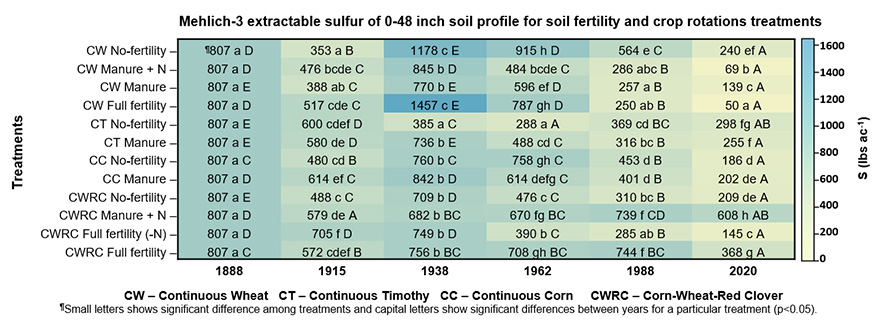
Where is Sanborn Field?
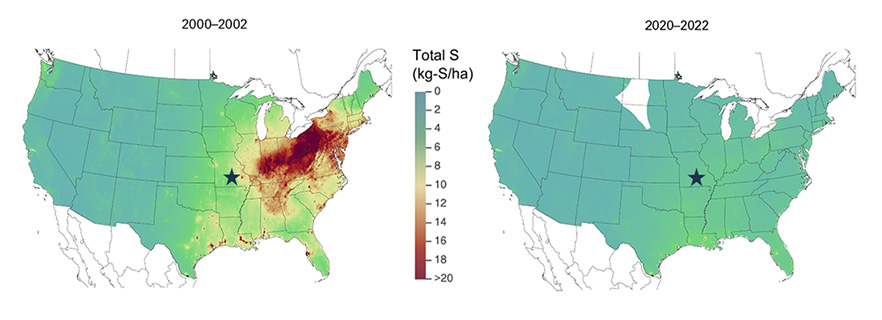
Established in 1888, Sanborn Field at the University of Missouri is a long-term agricultural research site with more than 130 years of continuous management. The supplied dataset contains 0–48-inch soil depth Mehlich-3 extractable sulfur observations from 12 cropping and fertility treatments measured in 1888, 1915, 1938, 1962, 1988 and 2020.
Why does sulfur matter?
Sulfur is essential for protein and amino-acid synthesis, chlorophyll formation, enzyme activity, crop quality and yield. Because sulfur deficiency can resemble nitrogen deficiency, current soil and plant testing is important for diagnosis and nutrient-management decisions.
What the Sanborn Field data tell us?
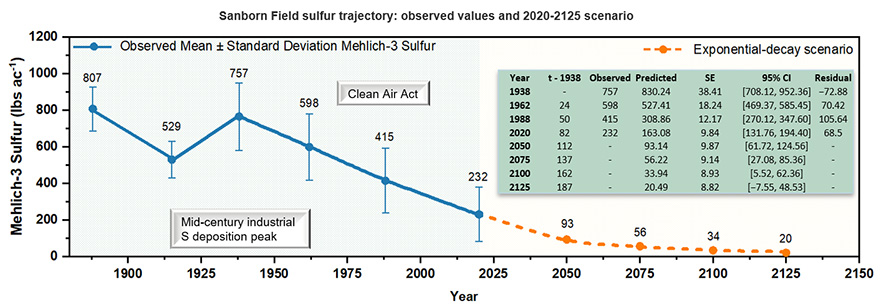
Mean Mehlich-3 extractable sulfur across all 12 treatments
| Year | 1888 | 1915 | 1962 | 1988 | 1888 | 2020 |
|---|---|---|---|---|---|---|
| Sulfur (lbs ac-1) | 807 | 529 | 822 | 598 | 415 | 232 |
Key observations
- All treatments started at 807 lbs S ac-1 in 1888 (based on Tucker Prairie soil samples).
- The means reached 822 lbs S ac-1 in 1938, then declined to 598 in 1962, 415 in 1988 and 231 in 2020.
- The long-term record shows substantial divergence among cropping and fertility systems.
What may be driving the decline?
The supplied material identifies reduced atmospheric sulfur deposition after clean-air regulations, sulfate leaching, crop sulfur removal, and modern high-analysis fertilizers with little or no sulfur as important factors.
Bottom line: Sulfur supply has changed substantially over time, and the Sanborn record shows that cropping systems and fertility management strongly influence extractable sulfur remaining in the soil profile.
Crop rotation and soil fertility management matters: Not all systems are equal
| Treatment | 1888 | 1938 | 2020 | 2020/1888 |
|---|---|---|---|---|
| CW No-fertility | 807 | 1178 | 240 | 30% |
| **CW Manure + N | 807 | 845 | 69 | 9% |
| CW Manure | 807 | 770 | 139 | 17% |
| **CW Full fertility | 807 | 1457 | 50 | 6% |
| CT No-fertility | 807 | 385 | 298 | 37% |
| CT Manure | 807 | 736 | 255 | 32% |
| CC No-fertility | 807 | 760 | 186 | 23% |
| CC Manure | 807 | 842 | 202 | 25% |
| CWRC No-fertility | 807 | 709 | 209 | 26% |
| *CWRC Manure + N | 807 | 682 | 608 | 75% |
| CWRC Full fertility (-N) | 807 | 749 | 145 | 18% |
| CWRC Full fertility | 807 | 756 | 368 | 46% |
|
CW = continuous wheat; CT = continuous timothy; CC = continuous corn; CWRC = corn–wheat–red clover rotation. *Highest 2020 sulfur: CWRC Manure = 608 lbs S ac-1 — about 75% of its 1888 value. |
||||
Predicting the next 100 years
Exponential-decay scenario
Model: S(t) = 830.24 ± 38.41 × e-0.019874 ± 0.001203 (t-1938)
Fitted to the 1938–2020 mean trends with S half life of 34.88 yrs.
This is a scenario for continued decline, not a guaranteed future soil-test result. For 1938 outliers were removed.
Projected mean S (lbs ac-1)
2050: 93 | 2075: 56 | 2100: 34 | 2125: 20
What can growers and decision makers do?
Practical sulfur management
- Soil and plant tissue testing using current recommendations.
- Account for crop sulfur removal, especially in high-yield systems.
- Consider sulfur sources such as ammonium sulfate, gypsum, elemental sulfur, manure or sulfur-containing blends when appropriate.
- Pay attention to continuous cropping systems where the Sanborn record shows stronger depletion.
- Use precision application technology to apply sulfur where needed so negative effects of sulfur application don’t hinder crop production.
Soil-testing guidance
Mehlich-3 extraction for Missouri soils and periodic monitoring in high-removal systems for soil nutrient levels is recommended. Note that sulfur can be immobilized in organic matter and sulfates can move below the surface soil profile therefore sulfur fertilizer management should target grain or crop removals.
Important: Sanborn Field values are long-term experimental observations and should not be used as universal sufficiency thresholds for individual fields. Use current University of Missouri recommendations and field-specific soil tests for management decisions.
Data source: Mehlich-3 extractable sulfur from the Sanborn Field experiment, Columbia, Missouri (1888–2020), based on the supplied figure/data. Projection note: the 2020–2125 curve is an exponential-decay scenario fitted to the 1938–2020 mean trend. Actual sulfur availability will depend on weather, crop removal, atmospheric deposition, soil properties and management.
How to cite: Singh, G., Kaur, R., Kaur, H., Nelson, K. A., Kaur, G., Parvej, R., & Reinbott, T. (2026). Sulfur history and future: Lessons from the 132 years of Sanborn Field. University of Missouri Extension publication no. MP939