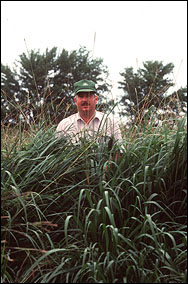
Eastern gamagrass (Tripsacum dactyloides) is a perennial warm-season grass native to the eastern United States and well adapted throughout Missouri. It is particularly suited to bottomlands, floodplains, and soils with periodic wetness, where it often performs better than other native warm-season grasses. A close relative of corn (Zea mays), eastern gamagrass produces large bunches from short rhizomes, with most leaves originating near the base of the plant. Mature plants can form crowns up to 4 feet in diameter, with seed stalks reaching heights of 3 to 9 feet.
Historically, eastern gamagrass was widely distributed and valued as a high-quality forage. However, much of the native acreage was lost due to land conversion and continuous grazing. Unlike modern grazing systems, native herbivores grazed intensively but moved frequently, allowing plants adequate recovery time. This recovery period is essential for eastern gamagrass, which depends on energy stored in its basal tissues for regrowth. Without sufficient rest, stands decline rapidly.
Adaptation and role in forage systems
Eastern gamagrass is one of the earliest native warm-season grasses to begin growth in the spring, often initiating growth in mid-April (Figure 2). Most of its annual production occurs from mid-May through August, making it particularly valuable for filling the summer production gap when cool-season grasses such as tall fescue are less productive.
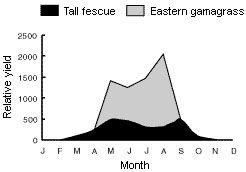
The species can produce high forage yields, commonly between 4 and 7 tons of dry matter per acre under good management, and supports excellent livestock performance. Its tolerance of poorly drained soils further enhances its value in areas where other forages struggle.
Establishment considerations
Establishment remains the most significant challenge associated with eastern gamagrass. The species exhibits strong seed dormancy, which must be overcome to achieve reliable germination. Two primary planting approaches are used.
Spring planting with stratified seed is generally the most consistent method. In this approach, seed is pretreated through cold, moist storage to break dormancy and is planted when soil temperatures reach approximately 65°F, typically from April through May. Alternatively, untreated seed can be planted during the winter months, allowing natural environmental conditions to break dormancy. While this dormant seeding approach reduces seed handling challenges, it introduces greater variability due to dependence on weather conditions.
Recent developments in seed treatment technologies, including chemical priming methods, show promise for improving germination and handling, although availability may vary.
Successful establishment requires careful attention to planting depth and spacing. Seed should be planted 1 to 1.5 inches deep at a rate of approximately 8 to 10 pounds of pure live seed per acre. Wider row spacing, such as 30-inch rows planted with a corn planter, is commonly used, although narrower spacing can improve early ground cover and reduce weed pressure. Because mature plants are large, relatively low plant densities are acceptable; even one plant per square yard can develop into a productive stand.
Weed control during establishment is critical. Seedlings are slow to compete, and annual grasses can quickly dominate if not managed. Strategies may include planting into fields with a history of residual herbicide use (where labeled), using a light nurse crop such as sorghum-sudangrass, or mechanical control. Nitrogen fertilizer should be avoided at planting, as it tends to favor weeds rather than seedlings.
Fertility management
Eastern gamagrass responds well to fertility management like that used for corn silage production. Soil testing should guide phosphorus and potassium applications, with levels maintained in the medium range. Soil pH should be kept between 5.5 and 6.5 for optimal performance.
Nitrogen management is particularly important for maximizing yield. During the establishment year, a modest nitrogen application following seedling emergence can support early growth. Once stands are established, nitrogen is typically applied at green-up in the spring and again following each harvest or grazing cycle. Total annual nitrogen rates commonly range from 100 to 250 pounds per acre, depending on yield goals and management intensity.
Grazing and harvest management
Proper grazing and harvest management are essential for maintaining productive and persistent stands. Eastern gamagrass should not be grazed or harvested during the establishment year, and in some cases, deferring use until the second year may be beneficial.
Grazing can begin when plants reach 18 to 24 inches in height, while hay harvest is best initiated between 24 and 36 inches, prior to the boot stage. Maintaining adequate stubble height is critical; a minimum of 8 to 10 inches should be left after grazing or cutting to preserve the plant’s ability to regrow. Shorter grazing heights reduce vigor and increase the likelihood of weed invasion.
Rotational grazing is strongly recommended. This approach allows livestock to utilize forage efficiently while ensuring that plants receive adequate rest between grazing events. A key principle is to avoid grazing regrowth before plants have replenished energy reserves. Systems that repeatedly graze plants too closely or too frequently will lead to stand decline.
Forage quality and harvest timing
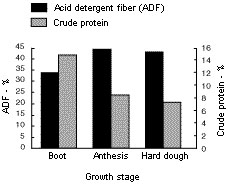
As with most grasses, forage quality declines as eastern gamagrass matures (Figure 3). The most rapid decline occurs after the boot stage, when stems elongate and fiber content increases. Early harvests provide higher crude protein and digestibility, while delayed harvests result in lower forage quality.
A harvest interval of approximately four to six weeks during the growing season generally provides a good balance between yield and quality. Under favorable conditions, this approach can also help distribute forage production more evenly throughout the summer.
To support winter survival and stand persistence, grazing and haying should be discontinued by early September. This allows plants to accumulate energy reserves needed for overwintering.
Additional management considerations
In some systems, prescribed burning can be used in early spring before new growth begins. Burning helps remove accumulated residue, improves uniformity of growth, and can suppress early-season weeds where appropriate and permitted.
Eastern gamagrass also provides value beyond forage production. It offers good wildlife cover and is well suited for conservation plantings, particularly in riparian areas or on marginal cropland.
Summary
Eastern gamagrass is a highly productive and adaptable native grass that can play an important role in Missouri forage systems, particularly during the summer months when cool-season species are less productive. Its strengths include high yield potential, excellent forage quality when properly managed, and strong tolerance to wet soils.
However, successful use requires careful attention to establishment and disciplined grazing management. Producers who invest in proper establishment, maintain adequate fertility, and implement rotational grazing systems can expect long-lived, high-performing stands that contribute significantly to summer forage supply.