Tall fescue (Festuca arundinacea, now more commonly classified as Schedonorus arundinaceus) remains the most widely used perennial forage grass in Missouri. Its persistence under grazing, tolerance of variable soil fertility and moisture conditions, resistance to many insects and nematodes, and extended growing season have made it a foundational species for pasture-based livestock systems across the state. However, the agronomic strengths of tall fescue must be balanced against well-documented animal performance concerns associated with the toxic endophyte present in many older stands.
Most legacy tall fescue pastures in Missouri are infected with the fungal endophyte Epichloë coenophiala (formerly Neotyphodium coenophialum and Acremonium coenophialum). This endophyte lives symbiotically within plant tissues and contributes to the plant’s persistence and stress tolerance. However, it can also produce ergot alkaloids, most notably ergovaline, that negatively affect livestock. Consumption of infected forage is associated with reduced weight gain, decreased reproductive performance, elevated body temperature, and other symptoms collectively referred to as fescue toxicosis.
Tall fescue was introduced to the United States from Europe in the late 1800s. A particularly well-adapted ecotype was identified in Kentucky in 1931, evaluated at the University of Kentucky, and released in 1943 as the cultivar “Kentucky 31.” The species rapidly gained popularity during the 1940s and 1950s because of its ease of establishment, durability under grazing, and dependable forage production. Today, tall fescue occupies more than 40 million acres of pasture and forage land in the United States, including approximately 17 million acres in Missouri.
Early adoption was followed by reports of inconsistent livestock performance on tall fescue pastures. Subsequent research identified the presence of the internal fungal endophyte as the primary cause. The term “endophyte” reflects the organism’s location within the plant (endo = within; phyte = plant). Later work demonstrated that certain endophyte strains produce ergot alkaloids that are responsible for the negative animal responses observed in grazing systems. Contemporary forage management now emphasizes the use of novel or beneficial endophyte cultivars and integrated grazing strategies to capture the agronomic advantages of tall fescue while minimizing animal health risks.
How the endophyte affects grazing animals
The toxins that result from the endophyte create a number of problems for the grazing animal. Animals do not gain and can actually lose body weight despite constant grazing. They also experience reproductive problems such as low conception rates and poor offspring survival. In addition, cattle grazing infected tall fescue have elevated body temperatures and loss of blood flow to the extremities, causing "fescue foot" and other symptoms. In all, it is estimated that the losses to the beef cattle industry alone are well over $609 million a year (1990 data).
Effects of the toxic endophyte on grazing animals
Ergot alkaloids produced by the toxic endophyte (Epichloë coenophiala) can impair animal health and performance when endophyte-infected tall fescue is consumed. The primary compound of concern, ergovaline, causes vasoconstriction and hormonal disruptions that reduce animal productivity. Collectively, these impacts are referred to as fescue toxicosis.
Clinical expression varies with environmental conditions, animal class, and alkaloid intake, but commonly includes reduced voluntary intake, depressed weight gain, impaired reproduction, elevated body temperature, and reduced peripheral blood flow. In severe cases, reduced circulation to extremities can result in necrosis (“fescue foot”). Although precise economic losses fluctuate annually, fescue toxicosis continues to cost the U.S. beef industry hundreds of millions of dollars each year.
Species-specific responses
Cattle
Cattle are highly susceptible to performance losses from toxic endophyte exposure. Consumption of infected tall fescue typically reduces dry matter intake and average daily gain and may also decrease milk production in lactating cows. Additional commonly observed symptoms include:
- Elevated body temperature and respiration rate
- Rough or retained hair coat
- Excessive salivation
- Reduced serum prolactin concentrations
- Poor reproductive efficiency
- General unthrifty appearance
Research across the fescue belt (Table 1) consistently demonstrates substantial reductions in weight gain of stocker cattle grazing toxic endophyte-infected pastures, with losses often approaching or exceeding 50 percent under severe exposure. Alkaloid concentrations are typically highest in seedheads, making late spring a particularly high-risk period.
Reproductive and calving impacts
Exposure during late gestation can reduce milk production (agalactia), which may compromise calf vigor and early growth. In some cases, placental abnormalities and reduced calf survival have been reported.
Bovine fat necrosis
High nitrogen fertilization of tall fescue pastures has been associated with increased risk of bovine fat necrosis, particularly in cows grazing heavily fertilized stands. Elevated nitrogen can also increase ergovaline concentrations, potentially intensifying toxicosis symptoms.
Table 1. Effect of the endophyte on weight gain in steers.
| Research location | Gain | Forage fed | |
|---|---|---|---|
| High endophyte | Low endophyte | ||
| Texas | 0.99 pound per day | 2.14 pounds per day | Pasture |
| Alabama | 1.41 pounds per day | 2.18 pounds per day | Pasture |
| Georgia | 1.02 pounds per day | 1.31 pounds per day | Pasture |
| Alabama | 1.00 pounds per day | 1.83 pounds per day | Pasture |
| Missouri | 0.97 pound per day | 1.41 pounds per day | Pasture |
| Alabama | 0.44 pound per day | 2.12 pounds per day | Seed |
| Alabama | 0.62 pound per day | 1.46 pounds per day | Hay |
Horses
Horses, especially pregnant mares, are extremely sensitive to toxic endophyte alkaloids. Consumption of infected tall fescue during late gestation is strongly associated with equine fescue toxicosis, characterized by:
- Prolonged gestation
- Late-term abortion or stillbirth
- Thickened and/or retained placenta
- Dystocia
- Agalactia (failure of milk production)
- Reduced prolactin and progesterone
Foals from affected mares may be oversized, weak, poorly coordinated, and slow to nurse. Because colostrum production is often reduced, passive transfer of immunity may be inadequate. Even relatively low endophyte infection levels can create significant risk for pregnant mares; therefore, complete removal from toxic fescue during the last trimester remains the standard management recommendation.
Sheep
Sheep generally exhibit fewer and less severe symptoms than cattle or horses but are not immune to toxicosis. Documented responses include:
- Reduced feed intake and weight gain
- Hyperthermia (heat stress susceptibility)
- Reduced wool production
- Reproductive inefficiency
- Occasional cases of fescue foot
Because clinical signs may be subtle, performance losses in sheep grazing infected tall fescue can be overlooked. As with other species, risk increases with higher alkaloid intake and environmental stress.
Life cycle of the endophyte
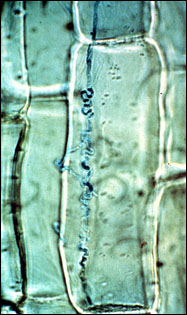
The toxic tall fescue endophyte (Epichloë coenophiala) is transmitted almost exclusively through seed. Endophyte-infected seed contains viable fungal hyphae within the seed tissues at the time of planting. When viable infected seed germinates, the endophyte grows systemically within the developing seedling and persists throughout the life of the plant.
In vegetative growth stages, the endophyte resides primarily in the basal portions of leaf sheaths and stems, where it grows between plant cells without causing visible disease symptoms. As the plant enters reproductive development, the endophyte colonizes elongating stems and ultimately becomes incorporated into developing seed. This vertical (seedborne) transmission cycle allows the fungus to persist across plant generations.
As a result, a well-established field of endophyte-free or novel endophyte tall fescue will remain free of toxic infection unless new infected seed is introduced and successfully established. However, stand thinning due to overgrazing, drought, pest damage, or other stresses can create openings that allow toxic endophyte-infected seedlings to invade. Maintaining dense, competitive stands and using certified endophyte-tested seed are key practices for preserving endophyte status over time.
Identifying tall fescue and determining endophyte status
Tall fescue identification
Tall fescue forms a dense, persistent sod. Although it possesses short rhizomes, the species is primarily bunch-forming and develops a deep, extensive root system that contributes to its drought tolerance and persistence under grazing.
Tall fescue is often confused with ryegrass, but several key features aid identification. During the vegetative stage, tall fescue leaves are folded in the bud, whereas ryegrass leaves are rolled. Under favorable growing conditions, tall fescue can reach 36 to 48 inches or more in height and produces a loosely branching panicle seedhead.
Key identifying characteristics include:
- Leaf blades typically 1/8 to 1/2 inch wide and 4 to 24 inches long
- Upper leaf surface dull with prominent longitudinal veins
- Lower leaf surface smooth, glossy, and slightly keeled
- Leaf margins generally rough to the touch
- Growth habit forming a dense, durable sod
Because plant appearance varies with management and environment, multiple traits should be used together for reliable identification.
Determining whether the toxic endophyte is present
Animal performance problems consistent with fescue toxicosis may suggest the presence of toxic endophyte-infected tall fescue, but field symptoms alone are not sufficient for diagnosis. Many factors can influence livestock performance, and visually distinguishing infected from non-infected tall fescue plants is not possible.
The only reliable method to determine endophyte status is laboratory testing of plant or seed samples. Commercial and university laboratories across the United States offer endophyte testing using validated analytical methods. Producers are encouraged to work with their local University of Missouri Extension center (MU Extension) to identify appropriate testing laboratories and obtain current sampling instructions.
For accurate results:
- Follow the laboratory’s sampling protocol carefully.
- Submit representative samples from the pasture of interest.
- Note whether testing is for endophyte infection rate and/or alkaloid concentration, as both may be relevant for management decisions.
Routine testing is especially recommended prior to pasture renovation, when purchasing seed, or when unexplained livestock performance issues occur.
Management considerations for toxic endophyte–infected tall fescue
Although novel- and endophyte-free tall fescue cultivars are available, management decisions should be based on whole-farm goals, site productivity, and risk tolerance. Historically, producers faced a tradeoff between animal performance and stand persistence: toxic endophyte-infected Kentucky 31 provided excellent persistence but reduced livestock performance, whereas true endophyte-free cultivars improved animal responses but often lacked long-term stand durability under grazing and environmental stress.
Today, novel (beneficial) endophyte tall fescue cultivars provide a widely recommended alternative. These cultivars contain selected endophyte strains that enhance plant persistence while producing little or no toxic ergot alkaloids affecting livestock. For many operations, novel endophyte tall fescue represents the preferred long-term solution when renovation is feasible.
Where toxic endophyte stands remain in use, several management strategies can substantially reduce animal exposure and performance losses.
Grazing management (primary mitigation strategy)
Targeted grazing management is one of the most practical and cost-effective tools for reducing alkaloid intake in existing toxic tall fescue pastures.
Key principles:
- Avoid grazing the bottom 2 inches of vegetative growth.
Ergovaline concentrations are typically highest in the lower stem and sheath tissues. Maintaining a post-grazing residual of at least 2 to 3 inches helps limit animal intake of the most toxic plant parts. - Prevent or minimize grazing of reproductive growth.
Seedheads contain the highest alkaloid concentrations in the plant. Maintaining pastures in a vegetative state through timely grazing or mechanical clipping can significantly reduce toxicosis risk. - Use rotational stocking where possible.
Rotational systems improve grazing uniformity, maintain vegetative growth, and reduce selective grazing of high-risk plant parts. - Provide rest periods during peak heat stress.
Alkaloid effects are amplified during hot weather; reducing reliance on toxic fescue in late spring and summer improves animal performance.
While grazing management does not eliminate toxicosis risk, it can meaningfully reduce animal exposure and improve outcomes in the short to medium term.
Pasture replacement (renovation)
Where economically and logistically feasible, replacing toxic stands remains the most reliable long-term solution.
Recommended approach: the “spray–smother–spray” renovation sequence.
Typical steps include:
- Apply a nonselective herbicide to eliminate existing tall fescue.
- Establish a competitive smother crop.
- Apply a follow-up herbicide treatment if needed.
- Seed the desired forage.
Smother crop selection:
- Prior to spring seeding: winter annual small grains (e.g., wheat or cereal rye)
- Prior to fall seeding: summer annuals (e.g., sorghum-sudangrass or soybean)
Because renovation carries financial and agronomic risk, many producers successfully convert pastures in phases rather than all at once. Partial renovation allows evaluation under farm-specific conditions.
Seasonal rotation
Moving cattle off toxic tall fescue during summer remains a highly effective management practice.
Benefits include:
- Reduced exposure during peak alkaloid stress periods
- Improved animal gains during hot weather
- Better utilization of warm-season forages
Research across the fescue belt shows that performance losses intensify as temperatures rise. Short removal periods (1-2 weeks) are typically insufficient; animals should remain on alternative forages for most of the summer stress period.
Dilution with legumes
Interseeding legumes reduces dietary alkaloid intake and improves overall forage quality.
Common options in Missouri include:
- Annual lespedeza
- Alfalfa
- Birdsfoot trefoil
- Red clover
- White clover
Benefits of legume inclusion:
- Dilutes toxic fescue intake
- Improves animal performance
- Provides biologically fixed nitrogen
- Enhances seasonal forage distribution
Nitrogen fertilization should be minimized in legume mixtures to maintain legume persistence.
Supplementation
Energy supplementation can partially offset performance losses on toxic fescue.
General guidance:
- Moderate supplementation rates can improve gains.
- Excessive starch supplementation may depress fiber digestion.
- Byproduct feeds (e.g., distillers grains) often complement fescue-based diets well.
Supplementation reduces—but does not eliminate—the effects of toxicosis.
Fertility management
Nitrogen management influences both pasture composition and alkaloid dynamics.
Key considerations:
- High nitrogen rates can increase ergovaline concentrations.
- Excess nitrogen suppresses legumes in mixed stands.
- Fertility programs should prioritize legume support where legumes are part of the system.
Balanced soil fertility based on soil testing remains essential.
Grazing for greater utilization and seedhead control
If toxicosis risk is a primary concern, maintaining tall fescue in a leafy vegetative state is critical.
Recommended practices:
- Graze for greater utilization to remove reproductive tillers from vegetative growth
- Timely grazing or clipping to prevent seedhead formation
- Maintain adequate residual height (≥2–3 inches)
- Avoid allowing mature, stemmy growth to accumulate
Seedhead suppression technologies and strategic clipping can further reduce alkaloid exposure during spring.
Summary
Tall fescue remains a foundational forage across Missouri, but management must account for endophyte status. Novel endophyte cultivars generally provide a better combination of animal performance and pasture persistence when renovation is practical. Where toxic stands are retained, integrated strategies, especially targeted grazing management, seasonal rotation, and legume inclusion, can substantially reduce animal exposure and improve productivity.