Assessing the impacts of Fusarium head blight (FHB) or Scab, caused by Fusarium graminearum, begins with scouting for FHB disease symptoms during the growing season. Understanding damage levels prior to harvest can provide a critical first step to reducing yield losses from both damaged grain and Fusarium mycotoxin contamination (specifically deoxynivalenol [DON] or also known as vomitoxin). In addition, regular scouting can provide valuable information regarding fungicide efficacy, especially when the same fungicide regimen is repeated year after year.
Scouting for FHB can generally begin 2–3 weeks post flowering or 2–3 weeks after a fungicide application intended for FHB suppression. Prioritize fields planted with wheat varieties rated as susceptible or moderately susceptible to FHB. To assess FHB levels in a field, complete the following steps:
Step 1
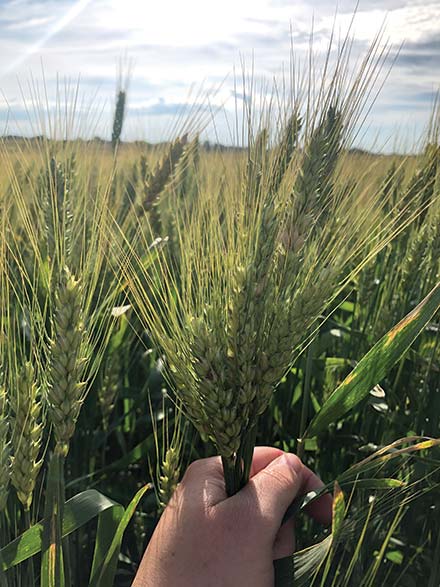
For every 10–20 acre section of field, walk in a “V” or “W” pattern and cut and collect a handful of approximately 10 wheat heads from 10 points and place them in a single bag for assessment (Figure 1). To avoid bias, do not visually select the heads. Our eyes are naturally drawn to heads that look different. In this case, those clearly showing disease. If we “blindly” collect the heads, we are less likely to bias the samples we select.
Clearly label all bags according to field site or field section for reference after completing head collections. Sample bags can be easily transported to any location for further processing of steps 2 through 4. Ideally, samples should be refrigerated and processed within 24 hours of collection.
Step 2
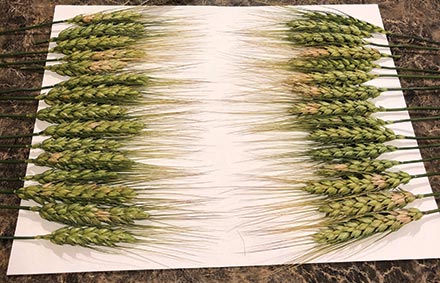
From each collection bag, remove 100 wheat heads and note how many have visible symptoms or signs of FHB (Figure 2). These may include:
- bleaching of single florets or,
- bleaching of whole heads,
- pink or orange spore masses (sporodochia) at the base of the glumes (husks covering the grain).
It does not matter how much of the head is affected, only if it is affected. This measurement is known as the disease incidence, or percentage of heads infected in that section of the field. The calculation is Incidence % = (Number of infected heads / Total number of heads) x 100.
Step 3
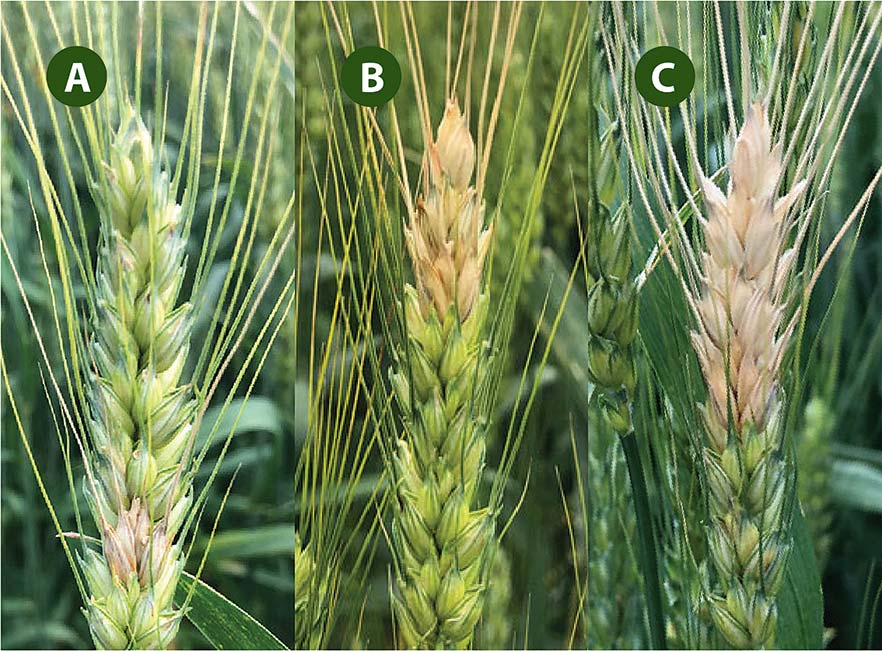
Next, set aside the heads that do not show any symptoms of FHB. Focus on the heads that show FHB symptoms. Estimate how much of the head is infected (Figure 3). A single spikelet (A)? A quarter of the head (B)? Half of the head (C)? This is the percent disease severity and will be a number from 1 to 100.
Step 4
The final step is to calculate the FHB Index (Scab Index). This value represents the overall disease pressure in a particular section of a field by combining how widespread the disease is and how intense the symptoms and signs are. Simply, multiply disease incidence (Step 2) by disease severity (Step 3), then divide by 100 and you are left with what is known as FHB index. For example, if 25% of the heads show symptoms (incidence) and those heads have an average of 10% bleaching (severity), the calculation is: FHB index = (25 × 10) / 100 = 2.5.
A field with an FHB index value of 10 or greater is considered high risk. The higher the index value, the higher the disease and the higher the risk for losses attributed to FHB. There also is a relationship between FHB index and end of season deoxynivalenol (DON or vomitoxin) concentration in the grain. For this reason, it is important to understand which fields or field sections may have higher FHB index values for harvest considerations.
Harvest considerations
Kernels infected by FHB pathogens such as Fusarium graminearum are often lightweight, shriveled, and stick to chaff material. Turning up the blower and slowing down the combine speed can help to reduce the presence of some of these lightweight, contaminated kernels that might otherwise find their way into a grain load. In general, fields that have high levels of FHB should be harvested and stored separately to reduce the possibility of introducing contaminated kernels into an otherwise sound load of grain. The pathogen can continue to grow on contaminated grain and DON levels can increase in the bin. Affected grain should be cooled and dried before storing (less than 15% moisture for short-term storage and less than 13% for long-term storage.)
Do not save seed with high levels of FHB.
Understanding DON and when to test for it
One of the most important factors to consider when making FHB management decisions is DON contamination of the grain. Although DON can be present in the plant as early as when infection begins, DON accumulation in the grain and the associated tissues changes during the season. A test for DON conducted at the Milk stage or Soft Dough stage of growth would not accurately reflect the final DON concentration in the grain at maturity. Testing for DON is most accurate when completed at harvest or grain maturity. Although there is no test that can predict DON concentration at maturity in season, calculating an FHB index value can serve as a valuable indicator for overall risk of Fusarium mycotoxin contamination.
Straw is also known to accumulate DON. Caution should be used in situations where straw is baled from heavily contaminated fields and is intended for use as bedding. This will increase risk of livestock exposure to Fusarium mycotoxins, especially when Fusarium-contaminated grain is used for feed in conjunction with contaminated straw. By scouting for FHB and assessing FHB incidence, severity, and overall incidence on a field by field basis, adjustments can be made to harvest equipment to reduce yield loss due to grain damage and mycotoxin contamination.
For more information on Fusarium Head Blight, visit the Crop Protection Network.