Why third spaces matter more than ever
Across the United States, communities are experiencing rising loneliness, polarization, and disengagement from civic and social life. Many Americans move from home to work and then back home again. In between, they have few regular interactions with other people. This leads to weakened trust, smaller social networks, and fewer chances for meaningful connection.
One powerful antidote is the intentional creation and use of third places. These are everyday gathering places where people can show up, feel welcome, and build community over time.
Sociologist Ray Oldenburg introduced the term “third place” in The Great Good Place (1989). He described third places as the heart of a healthy community. They are neutral and accessible spaces that support connection, conversation, and a sense of belonging. Today, researchers such as Richard Kyte at Viterbo University support Oldenburg’s ideas. Kyte says that third places help reduce stress, strengthen trust, and build the social ties that sustain communities and democracies.
What is a third space?
A third place is a social setting where community life quietly takes root. It is a place that is neither home, our “first place,” nor work, our “second place.” Instead, it is our “third place.” These are environments where people gather informally and comfortably. They often gather without an agenda or obligation. People share conversation, exchange greetings, or simply enjoy each other’s presence.
Across Missouri and beyond, third places take many forms. They may be a cozy neighborhood coffee shop or a sunlit corner of the public library. They may be the familiar hum of a barber shop or the fellowship hall after church services. Third places can also include a bustling community center, a shaded park bench, a friendly diner, or a recreation center filled with activity. Even some co-working spaces can become modern third places when they are designed with connection in mind.
But the defining feature is not the building. It is the behavior inside.
A space becomes a true third place only when people use it to interact, linger, and build relationships. A coffee shop may be full of customers working on laptops. It may be busy, but it is not functioning as a third place for them. Third places come alive only when people connect.
Characteristics of third places
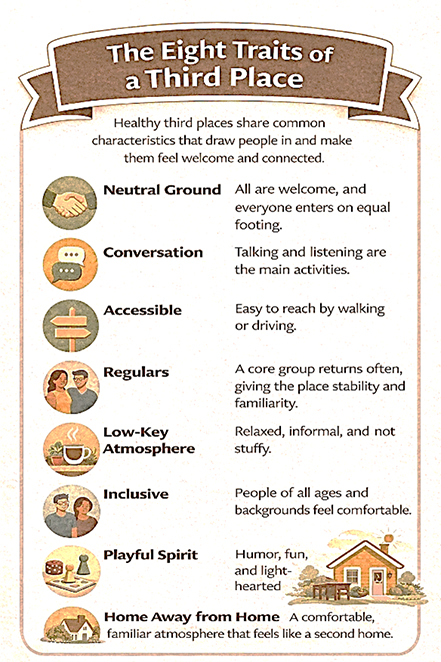
Drawing from the work of Ray Oldenburg, we know that most third places share a recognizable feel. They are neutral ground. These are spaces where no one plays host, and no one arrives as a guest. People enter on equal footing. The titles or roles they carry in the rest of their lives tend to fade into the background. A corporate executive and a retiree can sit at the same table. So can a teacher and a teenager. In these spaces, hierarchy does not shape the interaction. This leveling quality is part of what makes third places feel so refreshing.
Conversation is the heartbeat of these environments. People may come for coffee, books, or recreation. But the real purpose is interaction. Talking is the central activity. It is casual, unplanned, and often meandering. These places are also accessible. They tend to be close to where people live. They are easy to reach and often walkable. Over time, they become a natural part of daily life rather than a special destination.
Most third places have a group of regulars. Their presence helps define the mood and identity of the space. These familiar faces give the setting a sense of continuity. They are proof that this is a place worth returning to. The atmosphere is usually low-key and relaxed. It is not flashy or formal. People feel comfortable lingering, joking, telling stories, or simply enjoying the company around them. There is a playful spirit and a sense of light. This invites humor and spontaneity.
Ultimately, what ties these characteristics together is how these spaces make people feel. A true third place becomes a home away from home. It is a spot where people feel welcome, safe, and at ease. This sense of belonging matters more than any design feature or activity. It is what turns an ordinary location into a true community anchor.
Why third places are declining
Research paints a concerning picture of the state of third places in American life. Even when people live near coffee shops, parks, libraries, or other gathering spots, only about one in four visit them each week. Most Americans—nearly 75 percent—either do not have a third place or are unfamiliar with the term. The youngest adults rank as the loneliest age group. They are also the least likely to take part in activities that build community. These include joining organizations, attending religious services, or taking part in ongoing neighborhood or civic groups.
At the same time, modern conveniences continue to draw people inward. Online shopping, home gyms, and endless streaming entertainment reduce the need to leave our houses. Daily life becomes more efficient. But it also becomes more isolated.
The consequences appear across society. When third places fade from daily routines, loneliness increases. Trust in institutions weakens. Civic engagement declines, and political polarization grows stronger. As Richard Kyte shared in a Neighboring 101 interview, “When third places decline, we interact less with people who are different from us. Over time, distrust grows—and polarization grows with it.” The loss of these shared spaces is more than a cultural shift. It is a civic one. It shapes how we relate to one another and how strong—or fragile—our communities become.
Why third places matter for community health
Third places build social capital. We use this term to describe the networks of trust and cooperation that make communities thrive. Robert Putnam’s research in Bowling Alone highlights how shrinking social capital weakens local economies, schools, volunteerism, and public trust. According to Putman, when we spend time with neighbors or strangers who become friends, we strengthen:
- Mental health (lower anxiety and depression)
- Resilience (people help one another)
- Civic life (people volunteer more and trust more)
- Local economies (people shop nearby)
- Belonging (people feel “at home” in their community)
Simply put: Healthy communities need healthy third places.
The collapse of third places is one of the most damaging problems in American community life. But unlike issues with transportation, housing, or zoning laws, this is a problem that communities can address with ease. Small changes, micro-investments and local partnerships are enough to restart functioning third places. It might even revitalize some Main Streets in rural America if three to four third-places opened.
How to create a third place
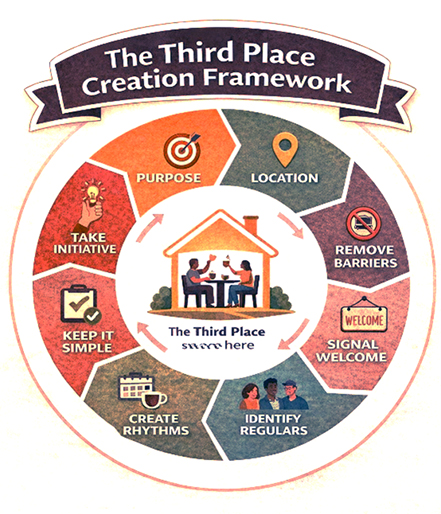
Third places are not created by one type of person or organization. They often emerge through the actions of three groups working together:
- Residents and neighbors, who can start small gathering spaces and regular rhythms.
- Business owners and nonprofit organizations, who can host welcoming environments where people naturally connect.
- City leaders and planners, who can design public spaces and policies that encourage informal gathering.
The steps below apply to all three groups. In some cases, the actions are best suited for residents. In others, they may be more relevant to businesses or local governments. Together, these groups help create conditions where third places can thrive.
1. Start with purpose
Primary audience: Residents, community leaders, and nonprofits
The first step in creating a meaningful third place is to clarify the purpose behind it. Begin by asking what you are hoping to address. Is the goal reducing loneliness in your neighborhood? Is it to reconnect neighbors who rarely speak? Is it to engage young people who lack safe places to gather? Whatever the need, let that purpose guide your design. A clear “why” shapes the “how.” It helps ensure the space you create truly serves the community it is meant to support.
2. Choose or create a location
Primary audience: Residents, business owners, and local planners
Great third places can emerge almost anywhere when they are chosen with intention. Sometimes it starts with something simple, like a shaded spot in a front yard. Neighbors naturally slow down there and feel invited to pause. Other times, it might be a small corner of a coffee shop set aside for conversation. It could also be a shared space behind a church, a circle of benches in a park, a picnic table at a workplace, or a quiet room in the library.
The location matters less than the intention behind it. What matters is how the space is used to spark interaction and belonging. One helpful approach is to drive around your community and look for an existing location. Choose a spot and go there regularly. Go at the same time. On the same day. Every week. Over time, you may create your own third place. Consistency turns a location into a place.
3. Remove Barriers
Primary audience: Businesses and local governments
The next step is removing barriers so people feel comfortable using the space. A third place should be visible and easy to notice. People should be able to stumble upon it as part of their daily routines. It should also be accessible, with clear paths for people of all ages and abilities. The space should be free or very affordable so no one feels excluded. Safety matters as well. A well-lit, thoughtfully designed area helps people feel secure enough to stay.
4. Signal that people are welcome
Primary audience: Residents and business owners
It is important to clearly signal that people are welcome. Small cues can make a big difference. Open seating invites people to join in and makes the space feel relaxed. Simple signs, such as “Sit here!” or “Join us for conversation,” offer gentle encouragement. Visual markers, like turquoise tables or other recognizable features, help the space stand out. Shared items such as cards, puzzles, sidewalk chalk, or community books can spark interaction. These small invitations lower barriers and turn a location into a welcoming social space.
5. Build rhythms, not events
Primary audience: Residents, nonprofits, and businesses
Third places grow through steady rhythms, not one-time events. A weekly coffee hour gives people a reason to return. A standing lunch meetup creates a reliable connection point. Some communities host a monthly game night. Others create something as simple as a daily porch hour. Predictable rhythms help people know when and where to show up. Over time, predictability builds familiarity. Familiarity becomes the foundation for real relationships. When people return to the same place at the same time, community begins to form naturally.
6. Identify regulars
Primary audience: Residents and business owners
Every third-place needs connectors. These are people who greet newcomers and notice when someone is missing. A business might call them “regulars.” In a neighborhood, they might be called block captains. These individuals show up often, invite others, and help people feel welcome. Having regulars is a key feature of a healthy third place.
7. Keep it simple
Primary audience: Everyone
You do not need committees, funding, or complex planning. You need: a place, a time, a purpose, and a willingness to show up. When the activity becomes complex, it ceases to be a third place.
8. Do not wait for someone else
Primary audience: Residents
If no third place exists near you, consider creating your own micro-place. Some ideas to try include:
- Host weekly coffee in your driveway or garage.
- Turn a ping pong table, card table, or front porch into a predictable gathering spot.
- Start a book group that always meets in the same corner of the library.
- Invite neighbors to walk together every Tuesday morning (or any day of the week).
- Pick a locally owned café and become a “regular” — then invite others.
Businesses alone cannot create third places. But they can host them. And residents can anchor them.
Most people today do not have a third place. But every community has ingredients for one. You do not need permission. You do not need a budget. You need intention.
Whether you are a neighbor, business owner, or community leader, the path forward is similar. Pick a place. Pick a time. Create a welcoming environment. Invite others. Then allow the slow work of connection to begin.
Case study: How one neighborhood created a front-yard coffee corner
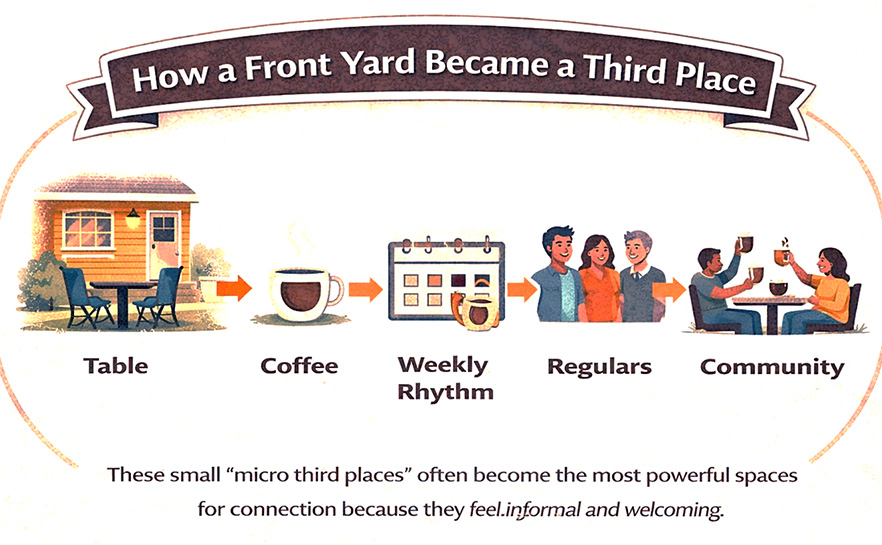
Several years ago, a neighborhood in southwest Missouri noticed something troubling. People lived on the same street for years but barely knew one another. Garage doors opened and closed. People waved from cars. But conversations were rare. One resident, Maria, decided to experiment with a simple idea.
Step 1: Start with purpose
Maria’s goal was simple: help neighbors meet each other and reduce the sense of isolation she noticed on the block. She didn’t want to organize a formal event or start a complicated program. She just wanted a place where people could stop and talk.
Step 2: Choose a location
Maria chose the most visible part of her property—the corner of her front yard near the sidewalk where many neighbors walked dogs or pushed strollers. She placed a small outdoor table there with four chairs. On Saturdays, she brought out a coffee thermos and a simple sign that read: “Neighborhood Coffee — Pull Up a Chair.”
Step 3: Remove barriers
Maria made sure nothing about the setup felt exclusive or complicated. The coffee was free. The chairs faced the sidewalk so passersby could join. The gathering happened in daylight hours so it felt safe and informal. People didn’t need to RSVP, join a group, or stay long. They could simply stop and talk.
Step 4: Signal that people are welcome
At first, neighbors were hesitant. Many waved but kept walking. Maria learned that small signals matter. She began greeting people by name and inviting them to sit for just a minute. She added a few conversation starters on the table: a deck of cards, a neighborhood map, and a small chalkboard that asked a weekly question like: “What is your favorite restaurant in town?” These simple cues helped people feel comfortable joining the conversation.
Step 5: Build rhythms
The most important decision Maria made was consistency. Every Saturday morning at 9:00 a.m., the coffee table appeared. Rain or shine. Even if no one came. After about a few weeks, neighbors began to expect it. Dog walkers started timing their routes to pass by. Parents pushing strollers began stopping for a few minutes. Retirees brought their own coffee mugs and joined the conversation.
Step 6: Identify regulars
Within a couple of months, a few “regulars” emerged. Tom, a retired mechanic, came nearly every week. Angela, a nurse who worked night shifts, stopped by on her way home from work. A middle-school student named Ethan often pulled up a chair and joined the adults in conversation. These regulars helped welcome newcomers and kept the conversation going.
Step 7: Keep it simple
The gathering never became complicated. There was no membership list, no agenda, and no formal program. Sometimes only three people showed up. Other weeks, 10-12 neighbors stopped by throughout the morning. But the purpose remained the same: a place to connect.
Step 8: Watch community grow
Over time, something surprising happened. Neighbors began helping one another. One family organized a walking group. Another neighbor offered to water plants when people traveled. Someone created a neighborhood text group for sharing local updates. The table itself never changed much. But the relationships around it did. What began as four chairs and a thermos of coffee slowly became the neighborhood’s gathering place—a third place where people felt known, welcomed, and connected.
Checklist—Is it a third place?
Use this assessment to determine whether a location is functioning as a third space.
| Criterion | Yes | No | Notes |
|---|---|---|---|
| 1. People interact regularly in this space (weekly or more). | |||
| 2. It is open and accessible to a wide range of people. | |||
| 3. There is no membership, agenda, or required activity. | |||
| 4. People converse informally as the main activity. | |||
| 5. There are identifiable “regulars.” | |||
| 6. You feel comfortable staying without needing to purchase something. | |||
| 7. The atmosphere is relaxed, playful, or home-like. | |||
| 8. The space encourages lingering instead of rushing. | |||
| 9. People from different backgrounds mix easily. | |||
| 10. You leave feeling more connected or known. | |||
|
Score
|
|||
References and citations
“50 Quick Teams.” Town Team.
Kyte, Richard. "Finding Your Third Place: Building Happier Communities and Making Great Friends Along the Way." Tantor Audio. 2025.
Kyte, R. (2023, March). Interview on Neighboring 101: Impact of a "Third Place" on You and America. University of Missouri Extension.
Massengale, S. (Sept. 2020) Interview on Neighboring 101: “The Turquoise Table in Community Development.”
Oldenburg, Ray. The Great Good Place: Cafés, Coffee Shops, Bookstores, Bars, Hair Salons, and Other Hangouts at the Heart of a Community. (Boston: Da Capo Press, 1989).
Oldenburg, Ray. Celebrating the Third Place: Inspiring Stories About the "Great Good Places" at the Heart of Our Communities. Da Capo Press. 2022.
Putnam, Robert D. Bowling Alone: The Collapse and Revival of American Community. New York: Simon & Schuster, 2000. Print.
Schell, Kristin. The Turquoise Table: Finding Community and Connection in Our Own Front Yard. Thomas Nelson, 2017. Audible.