Introduction
This guide, The State of Neighboring in Missouri (2022–2024), explores the evolving dynamics of neighboring within Missouri communities. By examining shifts in attitudes, behaviors, and priorities over time, it highlights key trends such as the growing emphasis on privacy, the decline in deeper social interactions, and the persistent value placed on trust and mutual support. Drawing on survey data, the findings shed light on the challenges and opportunities for fostering stronger neighborhood connections in a rapidly changing cultural landscape. This guide provides actionable recommendations to help communities rebuild trust, engagement, and resilience.
Historical changes in neighboring
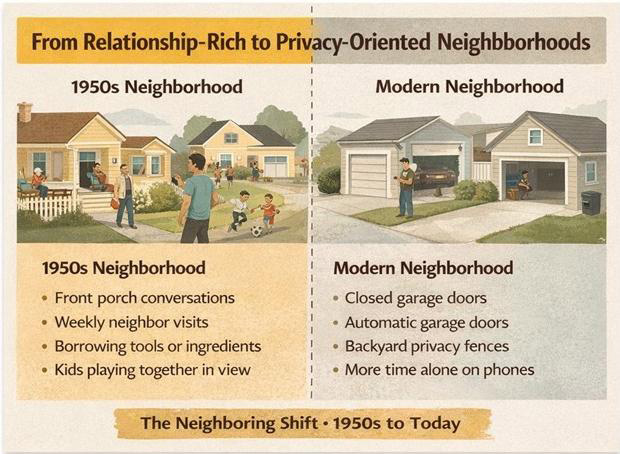
Dr. Richard Schwartz and Dr. Jacqueline Olds, psychiatrists from Harvard, write in their book The Lonely American that they noticed in the 1950s, neighbors were more social. People expected to be welcomed when moving in, to share tools or food, to watch each other’s children, to have neighbors check their house and mail when they were away, and to be invited over for dinner. While nearly half of Americans socialized with neighbors weekly in the 1950s, that rate has steadily dropped over the past 70 years.
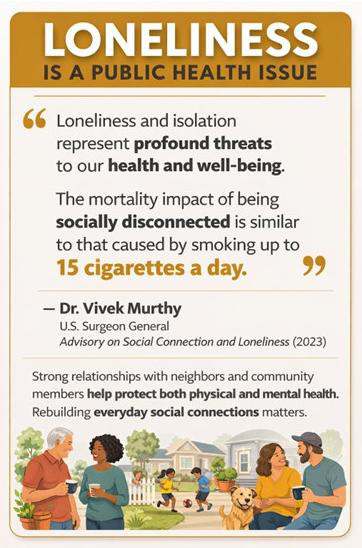
Now, these observations are backed by Missouri surveys from 2022 and 2024 that show many Missourians believe good neighbors should keep to themselves. This shift away from neighbors has caused, or at least contributed to, an increase in loneliness, depression, mistrust, and isolation, which was identified as a public health crisis by the U.S. Surgeon General in 2023. Additional changes have sped up our march toward isolation.
Americans began to move around more often for work or school and new technologies like television and the internet changed how we spent our time. Instead of talking to neighbors, people started staying inside their temperature-controlled homes more. Increasingly, Americans watched TV or played video games, and even when they were outside, they were not always talking others, often staying in the backyard.
Another big change was the way neighborhoods were built. the past, many homes were close together, and people had or backyards where they could easily see and talk to each other. Today, many houses are built far apart, with bigger yards or fences, which make it harder to connect with others. People often stay their homes and keep to themselves behind security systems automatic garage doors.
In many ways, we have become less open to social connections with the people who live near us. This isolation has shown up other ways as well.
A study referenced in Join or Die noted that only two in ten Americans report belonging to a hobby or activity group, neighborhood association, sports league, workout group, parent group or youth organization. In the workplace, less than 10 percent of Americans are members of a labor union. And religious membership, while still one of the most popular forms of association, is down to 33 percent.
Americans are connecting less, leading to increased isolation and diminished trust. In 1835, Alexis de Tocqueville observed that America's strength came from local connections — townships, associations, and neighborly bonds — that fostered grassroots democracy. But as he warned, unchecked individualism can fray society.
To rebuild, two practical approaches stand out. The Hopeful Neighborhood Field Guide encourages communities to "discover gifts, imagine possibilities, and pursue the common good,” focusing on strengths, not problems. Similarly, The Art of Neighboring outlines three simple steps: learn your neighbors' names, use them, and host social gatherings.
As author Seth Kaplan explains in Fragile Neighborhoods, we were once relationship rich and knowledge poor but now the reverse is true. If we want to repair our social fabric, the neighborhood is the best place to begin. This guide offers ideas to help anyone take meaningful steps toward reconnecting and strengthening their community.
Summary of survey findings (2022 & 2024)
These surveys asked people across Missouri about neighboring interactions, activities, expectations and behaviors. The results help paint a picture of how neighboring is changing — and what that means for our communities. A table summarizing the 2022 and 2024 results is located at the end of this guide. Unless otherwise noted, all figures in this section are drawn from the 2024 survey. Where relevant, changes from the 2022 survey are reported in percentage points.
What people value in a neighbor?
- Privacy is #1
Most people (71%) say a good neighbor is someone who respects their privacy. That was the top trait for both survey years. - Quiet and Clean Matter
Being quiet and taking care of your yard or home also rank high (65% and 63% respectively). From this we can assume that people want their neighborhood to be peaceful and look nice. - Helping is on the Rise
More people now say a good neighbor helps in emergencies, looks out for safety, and checks in on older neighbors, each up 5 points in the 2024 survey. This shows a growing sense of care. - Less Interest in Social Events
Fewer people want to host get-togethers (down 5 points) or help with things like babysitting (down 4 points). Personal, face-to-face connections are going down overall. - Small Acts Still Count
Many people still value things like loaning tools (up 5 points to 47%) or welcoming new neighbors (up 9 points). Practical kindness matters.
Notable trends and meaning
- More Casual Hellos
Waving or saying hello saw an increase (up 7.6 points) suggesting that neighbors are maintaining polite, surface-level interaction. That's good for being friendly, but it doesn't always lead to strong connections. - Growing Trust and Support
Most Missourians surveyed trust a neighbor (60%) or do favors (48%) for each other. Both of those increased by 5 points from 2022. That's a sign of goodwill that communities can build on. - Fewer Deep Friendships
The number of people inviting neighbors over (only 16% in 2022) or working on projects together has dropped (down 13 points in 2024). That's a warning sign: without real relationships, neighborhoods get weaker over time. - Neighboring Feels Less Important
Fewer people see neighboring as extremely or very important (down 5 points) or say they want more contact with neighbors (down 4 points). That shows a shift in priorities-or growing disconnection. As fewer people work together on neighborhood issues, it may become harder to solve problems like safety or local improvements. - Missed Chances to Connect
Even though people say they will attend a block party (up 2 points), few are inviting others over (just 27% in 2024). There are still chances to connect-if we are willing to take them. - Welcoming New Residents
An increase in welcoming new neighbors (up 2 points) indicates a growing appreciation for initial friendliness, though sustained social interaction remains less common. However, new residents to a community provide a great opportunity for building community capacity as they seek to build their social capital in a new place. - Consider Gender Differences
Men are more likely (+4%) than women to do a favor for a neighbor, which might explain why men are more likely (+7%) than women to say they have at least one trusted neighbor. Women are also more likely (+2%) to not know the names of any neighbors. - Loving Your Neighbor
In 2024, respondents were asked, "What does it mean to love your neighbor?" Most emphasized kindness, respect, empathy, and helping others-often grounded in moral or religious values. Many highlighted the importance of community connection and mutual care, while also noting the need to respect personal boundaries and privacy.
Some acknowledged challenges to forming relationships due to modern lifestyles and social mistrust.
Overall, responses reflect a desire for balanced neighborly relationships that blend compassion with respect. These insights reveal how the idea of loving one's neighbor plays out in daily life and offers guidance for building stronger, more connected communities.
Recommendations to strengthen neighboring
The survey findings reveal valuable insights into how Missourians interact with their neighbors. To improve neighborly connections and foster stronger communities, we offer the following recommendations in both individual and community categories.
Individual-level actions: What neighbors can do
- Foster Meaningful Connections
Encourage neighbors to move beyond casual greetings by taking simple, personal steps to build relationships. This can include hosting small group gatherings, doing "get-to-know-you" activities, or inviting neighbors to collaborate on informal efforts like yard sales or mini clean-up days. The key is creating frequent, low-pressure opportunities to connect face-to-face. Pick a project and date that you can repeat with regularity. - Remove Common Obstacles
Busy schedules, safety concerns, and cultural differences often prevent connection-but individuals can help lower those barriers.- Time Constraints: Host short, low-commitment driveway, porch, or garage gatherings that fit into everyday routines.
- Safety Concerns: Participate in or help organize neighborhood watch efforts to increase trust and shared responsibility.
- Cultural Differences: Practice curiosity and hospitality by celebrating diversity and encouraging mutual respect among neighbors.
- Build Everyday Support Systems
Encourage neighbors to exchange phone numbers, watch out for one another's homes, and offer practical help when needed. Informal efforts like meal sharing for new parents, checking on elderly residents, or helping during illness lay the groundwork for stronger support networks that can later expand into disaster and emergency preparedness. - Include Everyone
Neighbors play a key role in making sure connection opportunities are welcoming to all. Plan activities that appeal to different ages and interests-games for families, hobby groups for retirees, and casual gatherings for busy adults. Consider how people naturally relate: research suggests women often value face-to-face connection, while men may build relationships best "shoulder-to-shoulder" through shared tasks or projects.
Community-level actions: What neighborhoods & cities can do
- Design Neighborhoods That Connect
Promote physical layouts that naturally bring people together-front porches, shared paths, walkable streets, pocket parks, and community gardens. At the same time, be mindful of how large yards, privacy fencing, or disconnected street designs can unintentionally increase isolation. - Use Technology to Support Real Connection
Communities can promote digital tools for event announcements, safety alerts, and information sharing-but should emphasize that technology is meant to support, not replace, in-person relationships. Online connection works best when it leads back to real-world interaction. - Invest in Long-Term Resilience
At the community level, help neighbors prepare for emergencies together to foster collective responsibility. Celebrate stories of successful connection-building and establish annual or recurring activities to keep momentum strong. Over time, these consistent efforts build trust, readiness, and the resilience that allows neighborhoods to thrive.
Conclusion
Most Missourians believe a good neighbor is someone who respects their privacy and keeps to themselves. The first step in changing that narrative is helping people understand that ignoring neighbors isn't the same as being a good neighbor. Instead, engaged neighbors demonstrate neighborliness by staying involved locally while showing care and hospitality for those near them. Fostering deeper, sustained community connections may require more intentional efforts, like targeted neighborhood initiatives that build trust and connection.
Resources
A toolkit on neighboring is available from MU Extension and provides ideas for connection and other various approaches from an asset-based community development perspective. On the MU Extension website, you can find additional information on these educational programs and events related to neighboring:
- Neighboring 101 (ongoing monthly program on Zoom).
- Neighborhood Leadership Academy (10-week leadership program offered statewide in the fall).
- Missouri Good Neighbor Week (event Sept. 28-0ct. 4 at missourigoodneighborweek.com).
- Show-Me Neighborhood Art Week (a statewide public art event to increase belonging).
References
Cook, T., & Everts, D. (2020). The hopeful neighborhood field guide: Six sessions on pursuing the common good right where you live. lnterVarsity Press. de Tocqueville, A. (1835). Democracy in America (H. Reeve, Trans.). Saunders and Otley. (Original work published 1835)
Dunkelman, M. J. (2014). The vanishing neighbor: The transformation of American community. W.W. Norton & Company.
Davis, R., & Davis, P. (Directors). (2023). Join or die [Film]. Delevan Street Films.
Kaplan, S. (2023). Fragile neighborhoods: Repairing American society, one zip code at a time. Little, Brown Spark.
Klinenberg, E. (2018). Palaces for the people: How social infrastructure can help fight inequality, polarization, and the decline of civic life. Crown Publishing.
McKnight, J., & Block, P. (2012). The abundant community: Awakening the power of families and neighborhoods. Berrett-Koehler Publishers.
McKinney, C., & McKinney, E. (2020). Placed for a purpose: A simple and sustainable vision for loving your next-door neighbors. Columbia.
Murthy, V. H. (2020). Together: The healing power of human connection in a sometimes lonely world. Harper Wave.
Murthy, V. H. (2023). Our epidemic of loneliness and isolation: The U.S. Surgeon General's advisory on the healing effects of social connection and community. U.S. Department of Health and Human Services.
Olds, J., & Schwartz, R. S. (2010). The lonely American: Drifting apart in the twenty-first century. Random House.
Pathak, J., & Runyon, D. (2012). The art of neighboring: Building genuine relationships right outside your door. Baker Books.
Pressler, S., & Cox, D. A. (2024). Disconnected: The growing class divide in American civic life: Findings from the2024 American Social Capital Survey.
*For a comprehensive reading list of all books and research related to neighboring, see David Burton's post entitled, "David Burton's Neighboring Resources and Literature List" at his blog.