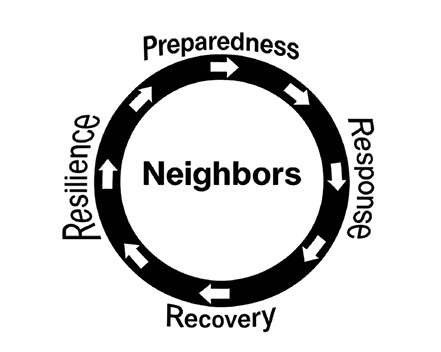
Emergencies, like natural disasters or other crises, can use up resources and make things difficult for communities. In these situations, neighbors helping each other—whether as individuals, families, or communities—becomes an important part of handling the emergency. Working together makes it easier to prepare and respond but also helps people recover and rebuild. This guide explores the multifaceted benefits of neighboring for emergency management through preparedness, response, recovery, and long-term community resilience.
Every year there are numerous examples highlighting how knowing neighbors has saved lives or aided first responders during emergencies across the United States. Throughout this guide are featured examples shared by MU Extension program participants. Neighbor relationships are not just a convenience—they are a necessity in disaster management. Whether responding to a fire in Highlandville, a tornado in Joplin, or an ice storm in Springfield, neighbors are often the first to act, long before emergency personnel arrive.
Now is the time to build those relationships. Strong, connected communities recover faster, save more lives, and emerge stronger after disasters. By investing in these connections today, we create safer, more resilient neighborhoods for the future.
Benefit #1: Enhanced preparedness
Neighboring promotes the sharing of knowledge, resources, and skills, which collectively improves a community’s readiness to respond when emergencies happen.
- Information sharing: Neighbors often possess localized knowledge about risks specific to their area, like flood-prone zones, wildfire pathways, or evacuation routes. By sharing this information, communities can develop more accurate risk assessments and tailored preparedness plans.
- Skill development: Neighboring facilitates the exchange of skills essential for emergencies, like first aid, fire suppression, or basic search-and-rescue techniques. Communities with diverse skill sets are better equipped to handle crises independently, especially during the initial stages when external assistance may not yet be available.
- Resource pooling: Preparedness often requires significant resources, like emergency kits, backup power supplies, or communication tools. Neighboring enables resource pooling, where individuals can collectively invest in shared assets like generators or satellite phones, reducing the financial burden on single households.
- Community drills and training: By fostering relationships, neighboring encourages participation in community-wide emergency drills and training sessions. These activities not only improve preparedness but also build trust and familiarity among participants, ensuring smoother collaboration during actual emergencies.
Case study: Snow Buddies are angels
In the winter of 2019, a heavy snowstorm in Republic, Missouri, gave one man a simple but meaningful opportunity—to shovel his elderly neighbors’ driveway. It took only a few minutes, but the impact lasted far longer. The grateful couple called him “the best neighbor we’ve ever had.” That small act of kindness revealed a powerful truth: even the simplest gestures can warm a community, especially in the coldest of seasons.
Across the country, cities have embraced this same spirit through programs like Snow Buddies and Snow Angels, where volunteers help older adults and residents with disabilities clear snow and stay safe. Inspired by examples from Colorado shared during MU Extension’s Neighboring 101 class, communities in Kansas City and Excelsior Springs, Missouri, launched their own Snow Buddy programs in 2024.
In places like Arvada, Colorado, volunteers are paired with residents for the entire winter, receiving training, recognition, and—most importantly—new friendships. These efforts go far beyond clearing driveways. They combat isolation, improve mental health, and remind people that they are seen and cared for. For many, winter can be a season of struggle. But for those with a Snow Buddy, it becomes a season of kindness and connection.
Benefit #2: Strengthened response capabilities
During emergencies, the speed and effectiveness of the response can significantly impact outcomes. Neighboring plays a crucial role in strengthening response capabilities through immediate assistance, communication, and coordination.
- Immediate assistance: In the critical moments following a disaster, neighbors are often the first responders. They provide immediate support by rescuing trapped individuals, offering first aid, or delivering essential supplies. Proximity allows neighbors to act quickly, often bridging the gap before professional emergency responders arrive.
- Effective communication: Strong neighborly ties improve communication during emergencies. Neighbors who know each other are more likely to check in, relay information, and alert one another to dangers. This localized communication network can complement official channels, ensuring that vital information reaches everyone promptly.
- Coordinated efforts: Neighboring encourages informal coordination, allowing communities to prioritize tasks and allocate resources effectively. For example, while some individuals may focus on clearing debris, others may assist vulnerable populations.
- Support for vulnerable populations: Community members with disabilities, senior residents, and families with young children often require additional support during emergencies. Neighboring ensures that these individuals are not overlooked, as neighbors are more likely to recognize and address their specific needs.
Case study: Paducah, Kentucky
When a tornado tore through Paducah, Kentucky, on Christmas Day 2021, Melanie Reason’s street was devastated. In the chaos, her neighbor was the first to check on her and her elderly parents—and to start digging through the rubble for survivors.
That quick response was not luck. Melanie, a neighborhood planner for Louisville Metro, had already invested in relationships with those around her after taking MU Extension’s Neighboring 101 series.
“In my case, knowing my neighbors saved lives,” Melanie said. “My neighbor across the street was the first to see if I was okay and to help dig through debris. Because of the relationships I’d built through neighboring, I knew who lived in each house, who had pets, and who might need special help. That knowledge made all the difference and helped me assist first responders.”
Her experience underscores a powerful truth: in a disaster, your first responders are often the people next door. While emergency services are essential, the strongest defense comes from neighbors who already know—and care for—each other. Melanie’s story shows how practicing neighboring before disaster strikes can save lives and strengthen entire communities.
Benefit #3: Facilitating recovery
The recovery phase of emergency management is often lengthy and resource intensive. Neighboring plays a vital role in fostering resilience and rebuilding efforts by providing emotional, social, and material support.
- Emotional support: Disasters can have a profound psychological impact on survivors, leading to stress, anxiety, or depression. Neighboring provides a sense of community and belonging, offering emotional support that helps individuals cope with a crisis.
- Shared resources and labor: Neighboring allows for the sharing of tools, materials, and labor, reducing the time and cost associated with recovery efforts. For example, neighbors may collectively clear debris, repair damaged structures, or assist with childcare while others focus on rebuilding.
- Re-establishing social networks: Disasters can disrupt social networks and community cohesion. Neighboring helps rebuild these connections, fostering a sense of normalcy and collective purpose. Strong social networks are critical for long-term recovery, as they facilitate the exchange of resources, information, and support.
- Advocacy and collective action: Communities that engage in neighboring are better positioned to advocate for recovery assistance from local governments, non-profits, or other organizations. Collective action amplifies their voices, increasing the likelihood of receiving timely and adequate support.
Case study: Springfield ice storm
For many years, James and Sheila Boutwell have made their home a place of refuge, opening their doors to those in need. Their generosity became especially vital during the ice storm that hit Springfield, Missouri in 2007 causing the entire city to lose power. With gas fireplaces and a gas stove, they welcomed neighbors seeking warmth.
As word spread about the warmth of their home, more neighbors arrived, bringing food that would have spoiled. Together they created a shared community, eventually sheltering 50 people. Neighbors shared tasks including clearing debris and cooking meals.
Evenings were filled with camaraderie, turning hardship into connection. When power was restored to the area several neighbors expressed disappointment, saying they would miss the connections fostered by the group.
Benefit #4: Long-term community resilience
Beyond immediate preparedness, response, and recovery, neighboring contributes to the development of long-term resilience by strengthening social cohesion, trust, and capacity.
- Social cohesion and trust: Neighboring fosters relationships built on trust and mutual respect, which are essential for collective resilience. Communities with strong social cohesion are better able to withstand and recover from shocks, as individuals are more likely to collaborate and support one another.
- Adaptive capacity: Disasters often reveal gaps in preparedness and response strategies. Neighboring encourages communities to learn from these experiences and adapt their plans accordingly. This iterative process of learning and adaptation enhances resilience to future emergencies.
- Community empowerment: Neighboring empowers communities to take ownership of their safety and well-being. By actively participating in emergency management efforts, individuals develop a sense of agency and confidence in their ability to navigate crises.
- Sustainability and self-reliance: Neighboring reduces reliance on external assistance by fostering self-reliance and sustainability. Communities that invest in local solutions and collaborative efforts are better equipped to handle emergencies independently.
Case study: Joplin and Branson tornadoes
On May 22, 2011, an EF5 tornado tore through Joplin, Missouri, leaving behind catastrophic destruction. In the hours that followed, residents didn’t wait for outside help—they mobilized. Neighbors searched for survivors, opened their homes to the displaced, and shared food, water, and shelter. The spirit of unity that rose from the rubble became one of Joplin’s most powerful stories.
Among the many grassroots responses, one stood out: the creation of the Joplin Tornado Info (JTI) Facebook page. Launched by Rebecca and Genevieve Williams less than two hours after the storm, JTI quickly became an essential hub for information, coordination, and hope. Run entirely by volunteers, the page connected survivors with vital resources, provided real-time updates, and helped dispel dangerous rumors at a time when reliable communication was scarce.
Within two days, JTI gained 17,000 followers and a 12-person volunteer team dedicated to fact-checking and moderating posts. For two weeks straight, they monitored the page around the clock—answering questions, sharing verified updates, and connecting people to aid.
At its peak, the page reached nearly 63,000 followers.
University of Missouri Extension specialist David Burton played a key role in JTI’s administration, ensuring the accuracy and credibility of every post. By insisting on verified, research-based information, the team helped calm confusion and reduce misinformation—one of the greatest challenges in any disaster.
Not a year later, when a tornado hit nearby Branson, Missouri, on February 28, 2012, communication lines were down and confusion ran high. Within hours, the Branson Tornado Info Facebook page became a lifeline—gaining more than 14,000 followers in just 12 hours following the model learned in Joplin.
Local agencies and relief partners quickly joined the effort, using the page to coordinate volunteers and direct residents to shelters, supply stations, and recovery meetings. National outlets, including the Associated Press, took notice, highlighting the page as a groundbreaking model for social media in disaster response.
More than a decade later, Branson Tornado Info continues to serve the community —sharing weather alerts, recovery updates, and notices about missing residents. What began as an experiment in digital connection became a trusted neighbor in its own right—proving that, in moments of crisis, information shared in real time can save lives and strengthen communities.
Strategies for promoting neighboring
While neighboring offers significant benefits, fostering strong community ties can be challenging. Strategies to promote neighboring include:

Community events
Organizing events like driveway parties, neighborhood cleanups, or group activities that tap into the strengths of the residents can help build relationships and encourage collaboration.
Local leadership
Empowering local leaders to advocate for neighboring and coordinate efforts can strengthen community engagement.
Inclusive practices
Ensuring that all community members, regardless of age, ethnicity, or socioeconomic status, are included in neighboring efforts fosters cohesion.
Technology and social media
Leveraging technology, such as neighborhood apps or social media groups, can facilitate communication and coordination among residents for face-to-face opportunities and events.
Case study: Rural Highlandville, Missouri
In 2022, several residents of rural Highlandville, Missouri, rushed to help when a neighbor’s home caught fire. Just two weeks earlier, most of them had been complete strangers.
The connection began when Echo Schneider, inspired by a Neighboring 101 class from MU Extension, decided to meet the people living around her. She created flyers, invited everyone within a two-mile radius, and hosted a simple neighborhood cookout. Thirty-two people showed up—many meeting each other in person for the first time. During the gathering, Schneider organized a neighborhood contact list so everyone could stay connected.
Only weeks later, that list proved invaluable. When a fire broke out at a nearby home, neighbors quickly called one another, helped the family to safety, rescued their dogs, and offered immediate support.
Schneider says the experience taught her that building relationships before a crisis can turn strangers into a lifeline. In rural areas especially, a single connection can make all the difference when disaster strikes.
Conclusion
Neighboring is a cornerstone of effective emergency management, offering numerous benefits across preparedness, response, recovery, and resilience. By fostering collaboration, trust, and resource sharing, neighboring empowers communities to navigate crises more effectively and emerge stronger in their aftermath. As the frequency and intensity of emergencies continue to rise, investing in neighboring is not just beneficial but essential for building resilient communities.
Glossary of key terms
Adaptive Capacity
The ability of individuals, neighborhoods, or communities to learn from past emergencies, adjust behaviors, and modify plans to better prepare for and respond to future disasters.
Asset-Based Community Development
ABCD - An approach to community building that focuses on identifying and mobilizing existing strengths rather than concentrating on needs or deficits.
Buddy System
A preparedness strategy where neighbors are paired or grouped to check on one another before, during, and after emergencies.
Community Emergency Response Team
CERT - A nationally recognized training program that equips residents with basic disaster response skills like fire safety, light search and rescue, and first aid, enabling neighbors to assist until responders arrive.
Community Resilience
The capacity of a community to withstand, adapt to, and recover from natural disasters, power outages, or health emergencies. Strengthened by trust, local leadership, shared resources, and social networks.
Emergency Preparedness
Actions taken before a disaster to reduce risk and improve readiness by relationship building, emergency planning, training, drills, and assembling emergency supplies.
First Responders (Informal)
Neighbors and community members who provide immediate assistance during the early moments of a disaster—often before police, fire, or medical professionals arrive.
Mutual Aid
Voluntary, reciprocal support among neighbors and community members, such as sharing food, shelter, labor, information, or care during times of crisis and recovery.
Neighboring
Intentional relationship-building among people living near one another. Neighboring functions as a critical layer of preparedness, response, and recovery.
Preparedness Drills
Practice activities that simulate emergency scenarios to test readiness, clarify roles, and improve coordination among neighbors.
Resource Pooling
The practice of sharing tools, equipment, or supplies among neighbors to reduce individual burden and improve readiness.
Social Capital
The networks of relationships, trust, and reciprocity that enable people to work together effectively. High social capital increases the speed and effectiveness of emergency response and recovery.
Social Cohesion
The degree to which community members feel connected, trust one another, and share a sense of belonging. Strong social cohesion enables cooperation, collective action, and emotional support during crises.
Vulnerable Populations
Individuals that may need additional assistance during emergencies, including older adults, people with disabilities, families with young children, individuals with medical needs, and those living alone.
Resources
Understanding How Communities Respond to Disaster
- Solnit, Rebecca. A Paradise Built in Hell: The Extraordinary Communities That Arise in Disasters. (2014).
- Klinenberg, Eric. Palaces for the People: How Social Infrastructure Can Help Fight Inequality, Polarization, and the Decline of Civic Life. (2019).
- Diers, Jim. Neighbor Power: Building Community the Seattle Way. (2004).
- Sampson, Robert J. Great American City: Chicago and the Enduring Neighborhood Effect. (2012).
Communication and Coordination in Emergencies
- Smith, Aaron. “Neighbors Online.” Pew Research Center, 2010.
- Oldenburg, Ray. The Great Good Place. (1989).
- Burton, David & Williams Genevieve & Williams, Rebecca. Using Social Media in Disaster. Recovery: The Joplin Tornado (2011) and Branson Tornado (2012) Model. (2013).
Practical Guides for Neighborhood Preparedness
- Walljasper, Jay. The Great Neighborhood Book: A Do-It-Yourself Guide to Placemaking. (2010).
- McKnight, John, & Block, Peter. The Abundant Community. (2012).
- Kretzmann, John P., & McKnight, John. Building Communities from the Inside Out. (2004).
- Duncan, Duston. Neighborhoods and Health. (2018).
Neighboring and Mutual Care After Disasters
- Murthy, Vivek H. Together: The Healing Power of Human Connection in a Sometimes Lonely World. (2020).
- Russell, Cormac & McKnight, John. The Connected Community: Discovering the Health, Wealth, and Power of Neighborhoods. (2022).
- Everts, Don. The Hopeful Neighborhood: What Happens When Christians Pursue the Common Good. (2020).
Social Capital, Trust, and Resilience
- Putnam, Robert D. Bowling Alone. (2000) and Better Together. (2004).
- Halpern, David. Social Capital. (2014).