It's beginning to smell a lot like Christmas.
-
Image
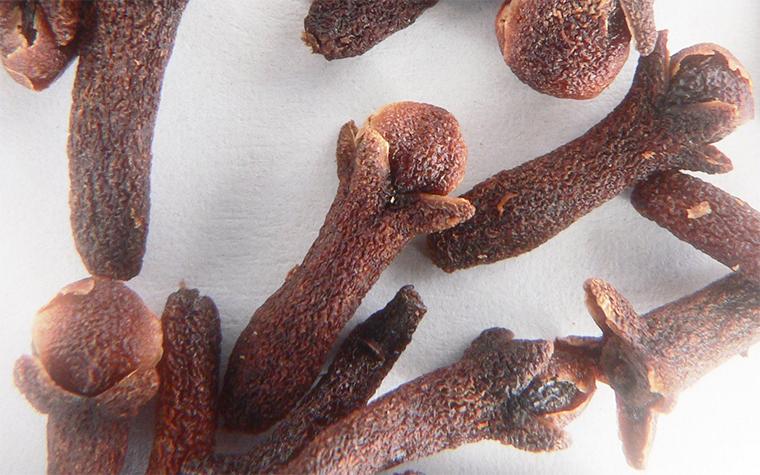 Dried cloves. Photo by David Monniaux via Wikimedia Commons. Shared under a Creative Commons license (CC-BY-3.0).
COLUMBIA, Mo. – The holiday season is filled with familiar sights and sounds. However, the aromas of the season often are responsible for evoking some of the most vivid memories.
Many of the aromas surrounding the holidays are from spices used in holiday cuisine, said University of Missouri Extension horticulturist David Trinklein.
“The holiday season simply would not be the same without the traditional foods and beverages associated with it. Many of these foods are special because of the use of certain spices or flavorings.”
Spices have had a profound influence on civilization, he said. Demand in Europe for spices led to a lucrative spice trade in which vast fortunes were made.
When the spice routes from the East Indies to Europe faltered because of political turmoil, the needs of the spice-starved European aristocrats had to be met in other ways. Explorers such as Columbus, da Gama and Magellan sailed west in search of a shorter route to the Indies. Thus, the New World was discovered.
Cinnamon, the ‘granddaddy’ of spices
Probably the oldest and most sought-after spice in history is cinnamon, Trinklein said. Now a key ingredient in many holiday treats, cinnamon goes back thousands of years. Ancient Egyptians used it to embalm the dead, and it remains a common ingredient in incense for sacred ceremonies.
True cinnamon comes from the bark of several species of tropical evergreens in the genus Cinnamomum. Most are small, bushy trees native to Sri Lanka and India. The outer bark of harvested branches is scraped off, then the inner bark is removed in sections that tend to curl into sticks as they dry. Bark that does not curl properly is made into ground cinnamon.
Cloves once used to treat bad breath
Another popular holiday spice is clove, the dried flower bud of a tree in the myrtle family native to Indonesia’s Molucca Archipelago, also known as the Spice Islands. It was once used to mask halitosis. Flowers of the clove tree bear a long calyx that ends with four spreading sepals and four rudimentary petals forming a ball in the center of the sepals. The buds are bright red but become reddish-brown when dried.
Cloves were among 16th- and 17th-century Europe’s most precious commodities, worth more than their weight in gold. Magellan’s ill-fated trip around the world, which began in 1519 with 250 men in five ships and ended in 1522 with a single ship and just 18 men, was still considered a financial success because of the 26 tons of cloves and cinnamon carried by the sole surviving ship.
Clove is a characteristic flavoring in Christmas holiday fare such as wassail and mulled cider. Cloves are strongly pungent because of eugenol, a substance extracted by distillation to yield an oil that is widely used to relieve pain.
The holidays a good excuse to use nutmeg
Nutmeg comes from the seed of a tropical evergreen tree native to the Moluccas. The dried lacy covering of the seed (the arillus) is the source of mace, another important spice. Most consider nutmeg the sweeter of the two, but mace has a more delicate flavor.
In ancient times, nutmeg was used as an amulet to protect against a wide variety of evils and dangers, Trinklein said. Today, its somewhat pungent fragrance and warm, slightly sweet taste lends itself to use in many holiday baked goods, main dishes and beverages such as eggnog.
Ginger no longer found in the wild
Ginger, another spice associated with the holidays, comes from the rhizome (underground stem) of Zingiber officinale, an herbaceous plant native to southeastern Asia. It is thought to be one of the first spices exported from Asia to Europe. Ginger is an example of a “cultigen.” This means there is no wild ginger to be found today, and it is only because of human intervention that it still exists. Gingerbread cookies, cakes and loaves are classic holiday treats that feature ground ginger for its warm, spicy flavor. Also, ginger ale is a common mixer for holiday punches.
“So, this holiday season, when traditional foods are enjoyed, consider the spices that make them so flavorful and the role they played in the discovery of the land we call home,” Trinklein said.
Photo
Cloves
Dried cloves. Photo by David Monniaux, CC BY-SA 3.0, via Wikimedia Commons.
