Easy-care houseplants gain popularity.
-
Image
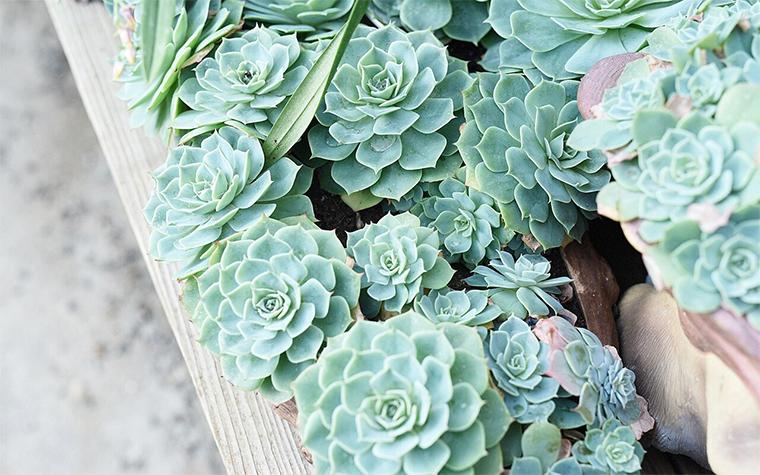 Succulent plants. Photo by Karl Thomas Moore via Wikimedia Commons. Shared under a Creative Commons license (CC BY-SA 4.0).
COLUMBIA, Mo. – From windowsills to office desks, succulents are everywhere. The hardy plants have become so popular in recent years that some enthusiasts call the trend “succulent mania,” said University of Missouri Extension horticulturist David Trinklein.
From a botanical standpoint, a succulent is defined as any plant that possesses adaptations that allows it to survive severe drought conditions, Trinklein said. There are about 55 plant families containing succulents of one form or another, with Cactaceae the most familiar. It is estimated there are more than 10,000 species of plants that can be classified as succulent.
“Succulents make good houseplants and are relatively easy to care for,” said Trinklein. Like all plants, they need certain basics such as light, a growing medium, water, plant nutrients and proper temperature to thrive. While all are important, light often is the most limiting factor for successful succulent growth.
When grown indoors, succulents should be placed in brightest location available. Ideally, they should receive 10 or more hours of bright, indirect light. When indoor light levels are inadequate, supplemental lighting is beneficial. High-output, full-spectrum light from fluorescent and LED fixtures works well in the home. Situate the fixtures 6-12 inches above the plants and keep them illuminated 14-16 hours daily.
Succulents need a porous growing medium that dries quickly and does not hold excessive moisture. In nature, this is provided by well-drained, sandy soils. Commercial all-purpose potting mixes retain too much water for long periods and can cause root rot and plant death. Alternatively, a self-formulated growing medium of one part potting mix and one part coarse sand, turkey grit or perlite works well.
Proper watering probably is the most important factor when caring for succulents. Succulents do not tolerate a wet growing medium for extended periods. A good approach to watering succulents growing indoors is to set up a wet-dry cycle. Begin the cycle by watering plants thoroughly, making sure the entire soil volume is fully wet. Following watering, let plants dry thoroughly, making sure the entire volume of soil is dry before watering again.
As a rule, succulents are not heavy feeders and require relatively little fertilizer. Only when plants are actively growing should they be fertilized. This normally is in the spring and summer. When the succulents are actively growing, applying a water-soluble fertilizer at one-quarter to one-half the rate listed on the label every three or four waterings normally is satisfactory.
Although most succulents are native to hot climates, they do not require above-average temperatures. Typical indoor temperatures are adequate for nearly all succulents. When growing indoors, succulents often prefer it cooler at night and warmer in the daytime. In general, keeping succulents between 55 F and 75 F is best. However, certain species will tolerate temperatures as low as 45 F and as high as 85 F.
Succulents are well-adapted to tolerate the low humidity typical of a home environment, especially during winter. If homes are equipped with humidifiers, good air circulation around succulents is needed. Air circulation lowers humidity, helps the potting medium to dry, and reduces the risk of insect pests such as mealybugs.
Photo
Succulent plants. Photo by Karl Thomas Moore via Wikimedia Commons. Shared under a Creative Commons license (CC BY-SA 4.0).
